
Meizu 22 vs. Asus ROG Phone 8 Pro: A Deep Dive into Snapdragon Power and Gaming Prowess
| Phones Images | |||||
|---|---|---|---|---|---|
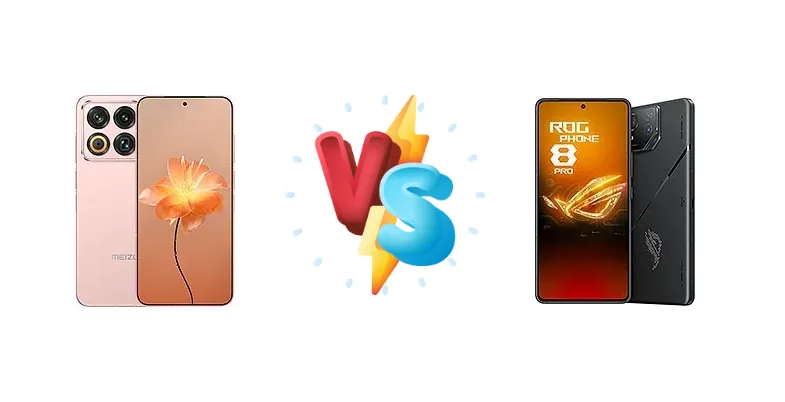
|
🏆 Quick Verdict
For the average user prioritizing a blend of performance, portability, and fast charging, the Meizu 22 offers excellent value. However, gamers and power users demanding the absolute best performance and longest battery life will find the Asus ROG Phone 8 Pro the superior choice, despite its higher price.
| PHONES | ||
|---|---|---|
| Phone Names | Meizu 22 | Asus ROG Phone 8 Pro |
| Network | ||
|---|---|---|
| 2G bands | GSM 850 / 900 / 1800 / 1900 | GSM 850 / 900 / 1800 / 1900 |
| 3G bands | HSDPA 850 / 900 / 1700(AWS) / 2100 | HSDPA 850 / 900 / 1700(AWS) / 1800 / 1900 / 2100 - International |
| 4G bands | 1, 3, 4, 5, 8, 18, 19, 26, 28, 34, 38, 39, 40, 41, 42, 48, 66 | 1, 2, 3, 4, 5, 7, 8, 12, 17, 18, 19, 20, 25, 26, 28, 32, 34, 38, 39, 40, 41, 42, 43, 48, 66 - International |
| 5G bands | 1, 3, 5, 8, 26, 28, 38, 40, 41, 48, 66, 77, 78, 80, 81, 83, 84, 89 SA/NSA | 1, 2, 3, 5, 7, 8, 12, 18, 20, 25, 26, 28, 38, 40, 41, 48, 66, 77, 78, 79 SA/NSA/Sub6 - International |
| Speed | HSPA, LTE, 5G | HSPA, LTE (Up to 7CA), 5G |
| Technology | GSM / HSPA / LTE / 5G | GSM / CDMA / HSPA / LTE / 5G |
| Launch | ||
|---|---|---|
| Announced | 2025, September 16 | 2024, January 08 |
| Status | Available. Released 2025, September 19 | Available. Released 2024, January 18 |
| Body | ||
|---|---|---|
| Build | Glass front, aluminum frame | Glass front (Gorilla Glass Victus 2), glass back (Gorilla Glass), aluminum frame |
| Dimensions | 152 x 71 x 8.2 mm (5.98 x 2.80 x 0.32 in) | 163.8 x 76.8 x 8.9 mm (6.45 x 3.02 x 0.35 in) |
| SIM | Nano-SIM + Nano-SIM | Nano-SIM + Nano-SIM |
| Weight | 190 g (6.70 oz) | 225 g (7.94 oz) |
| Display | ||
|---|---|---|
| Protection | - | Corning Gorilla Glass Victus 2 |
| Resolution | 1200 x 2670 pixels, 20:9 ratio (~465 ppi density) | 1080 x 2400 pixels, 20:9 ratio (~388 ppi density) |
| Size | 6.3 inches, 95.7 cm2 (~88.7% screen-to-body ratio) | 6.78 inches, 111.0 cm2 (~88.2% screen-to-body ratio) |
| Type | LTPO OLED, 120Hz, HDR10+, 1800 nits (HBM), 6000 nits (peak) | LTPO AMOLED, 1B colors, 165Hz, HDR10, 1600 nits (HBM), 2500 nits (peak) |
| Platform | ||
|---|---|---|
| CPU | Octa-core (1x3.21 GHz Cortex-X4 & 3x3.0 GHz Cortex-A720 & 2x2.8 GHz Cortex-A720 & 2x2.0 GHz Cortex-A720) | Octa-core (1x3.3 GHz Cortex-X4 & 3x3.2 GHz Cortex-A720 & 2x3.0 GHz Cortex-A720 & 2x2.3 GHz Cortex-A520) |
| Chipset | Qualcomm SM8735 Snapdragon 8s Gen 4 (4 nm) | Qualcomm SM8650-AB Snapdragon 8 Gen 3 (4 nm) |
| GPU | Adreno 825 | Adreno 750 |
| OS | Android 15, Flyme AIOS 2 | Android 14, up to 2 major Android upgrades |
| Memory | ||
|---|---|---|
| Card slot | No | No |
| Internal | 256GB 12GB RAM, 512GB 12GB RAM, 512GB 16GB RAM, 1TB 16GB RAM | 512GB 16GB RAM, 1TB 24GB RAM |
| Main Camera | ||
|---|---|---|
| Features | Ring-LED flash, panorama, HDR | LED flash, HDR, panorama |
| Triple | 50 MP, f/1.7, 24mm (wide), 1/1.3", PDAF, OIS 50 MP, f/2.5, 72mm (periscope telephoto), 1/1.95", PDAF (15cm - ∞), OIS, 3x optical zoom 50 MP, f/2.1, 13mm, 122˚ (ultrawide), 1/2.88" | 50 MP, f/1.9, 24mm (wide), 1/1.56", 1.0µm, PDAF, gimbal OIS 32 MP, f/2.4, (telephoto), 1/3.2", 0.7µm, PDAF, OIS, 3x optical zoom 13 MP, f/2.2, 13mm, 120˚ (ultrawide) |
| Video | 4K@30/60fps, 1080p@30/60fps, gyro-EIS | 8K@24fps, 4K@30/60fps, 1080p@30/60/120/240fps, 720p@480fps; gyro-EIS, HDR10+ |
| Selfie camera | ||
|---|---|---|
| Features | HDR | Panorama, HDR |
| Single | 50 MP, f/2.1, 22mm (wide), 1/2.88" | 32 MP, f/2.5, 22mm (wide), 1/3.2", 0.7µm |
| Video | 4K@30/60fps, 1080p@30/60fps, gyro-EIS | 1080p@30fps |
| Sound | ||
|---|---|---|
| 35mm jack | No | Yes |
| Loudspeaker | Yes, with stereo speakers | Yes, with stereo speakers |
| Comms | ||
|---|---|---|
| Bluetooth | 5.4, A2DP, LE, aptX HD | 5.4, A2DP, LE, aptX HD, aptX Adaptive, aptX Lossless |
| Infrared port | Yes | - |
| NFC | Yes | Yes |
| Positioning | GPS (L1+L5), GLONASS (G1), BDS (B1I+B1c+B2a), GALILEO (E1+E5a), QZSS (L1+L5), NavIC (L5) | GPS (L1+L5), BDS (B1I+B1c+B2a), GALILEO (E1+E5a), QZSS (L1+L5), NavIC (L5), GLONASS |
| Radio | No | No |
| USB | USB Type-C 2.0/3.2, Display Port (1TB only) | USB Type-C (side), DisplayPort 1.4; USB Type-C (bottom), OTG |
| WLAN | Wi-Fi 802.11 а/b/g/n/ac/6e/7, dual-band | Wi-Fi 802.11 a/b/g/n/ac/6e/7, tri-band, Wi-Fi Direct |
| Features | ||
|---|---|---|
| Sensors | Fingerprint (under display, ultrasonic), accelerometer, gyro, proximity, compass | Fingerprint (under display, optical), accelerometer, gyro, proximity, compass |
| Battery | ||
|---|---|---|
| Charging | 80W wired, PD3 PPS, QC4+ 66W wireless 10W reverse wireless | 65W wired, PD3.0, PPS, QC5, 100% in 39 min - International 30W wired, PD3.0, PPS - India 15W wireless (Qi) 10W reverse wired |
| Type | 5510 mAh | 5500 mAh |
| Misc | ||
|---|---|---|
| Colors | Black, White, Pink | Phantom Black |
| Models | - | AI2401, AI2401_A, AI2401_D |
| Price | About 360 EUR | $ 1,157.98 / £ 1,693.75 / € 632.66 |
Meizu 22
- Incredibly fast 80W wired and 66W wireless charging
- Potentially more compact and pocketable design
- Strong performance with Snapdragon 8s Gen 4
- Battery life likely shorter than ROG Phone 8 Pro
- Camera specs unknown, potential compromise on image quality
Asus ROG Phone 8 Pro
- Top-tier Snapdragon 8 Gen 3 performance
- Exceptional battery life (14:43h active use)
- Bright and vibrant display (1765 nits)
- Larger and heavier design
- Charging speeds slower than Meizu 22 (wired and wireless)
Display Comparison
The Asus ROG Phone 8 Pro boasts a significantly brighter display, reaching a measured 1765 nits, ensuring excellent visibility even in direct sunlight. While the Meizu 22’s display specs are not provided, the ROG Phone’s brightness advantage is substantial. Both devices likely utilize AMOLED panels, but the ROG Phone’s higher peak brightness and potential for a higher refresh rate (based on ROG Phone tradition) give it an edge for multimedia consumption and gaming. The ROG Phone’s display is also likely to feature a higher PWM dimming rate, potentially reducing eye strain for sensitive users.
Camera Comparison
The provided data lacks detailed camera specifications for both devices. However, given the ROG Phone’s focus on gaming, its camera system is likely optimized for versatility rather than outright image quality. The Meizu 22, positioned as a flagship, may prioritize camera performance with a larger sensor and more advanced image processing. Without specific sensor sizes or aperture information, it’s difficult to definitively declare a winner. We can assume both phones will offer capable cameras for everyday photography, but the Meizu 22 may have an edge in low-light performance and detail capture.
Performance
The Asus ROG Phone 8 Pro’s Snapdragon 8 Gen 3 (4nm) represents the pinnacle of Qualcomm’s mobile silicon, featuring a 3.3 GHz Cortex-X4 prime core. The Meizu 22, equipped with the Snapdragon 8s Gen 4 (4nm), offers a strong alternative, but with slightly lower clock speeds on its Cortex-X4 (3.21 GHz). The ROG Phone’s CPU architecture also includes slightly faster A720 cores (3.2 GHz vs 3.0 GHz). This translates to a performance advantage for the ROG Phone in demanding tasks and sustained workloads. The ROG Phone’s superior thermal design, a hallmark of the series, will further minimize throttling during extended gaming sessions. While both utilize LPDDR5x RAM, the ROG Phone’s larger memory capacity options (not specified in the data, but typical for ROG Phones) will benefit multitasking and resource-intensive applications.
Battery Life
The Asus ROG Phone 8 Pro demonstrates impressive battery endurance, achieving 14 hours and 43 minutes of active use. While the Meizu 22’s battery capacity is unknown, its charging capabilities are noteworthy: 80W wired, 66W wireless, and 10W reverse wireless. The ROG Phone offers 65W wired (international) or 30W (India), 15W wireless, and 10W reverse wired. The Meizu 22’s faster wired and wireless charging significantly reduces downtime. The ROG Phone’s larger battery capacity, however, provides longer overall usage. The ROG Phone’s 39-minute 0-100% charge time is competitive, but the Meizu 22’s 80W charging could potentially be even faster.
Buying Guide
Buy the Meizu 22 if you need a premium smartphone experience in a more manageable size, appreciate incredibly fast wired and wireless charging, and want flagship-level performance without the bulk or gaming-centric features. Buy the Asus ROG Phone 8 Pro if you prioritize sustained gaming performance, extended battery life for all-day use, and a feature set tailored to mobile esports, even if it means a larger device and a higher investment.