
Meizu 21 vs. ZTE nubia Z60 Ultra Leading: A Deep Dive into Snapdragon 8 Gen 3 Power
| Phones Images | |||||
|---|---|---|---|---|---|
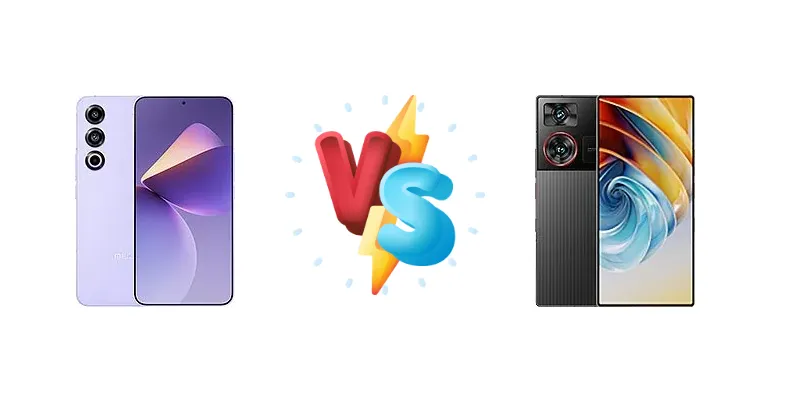
|
🏆 Quick Verdict
For the average user prioritizing sustained performance and all-day battery life, the ZTE nubia Z60 Ultra Leading emerges as the stronger contender. Its active use battery score of 14:04h significantly surpasses what we'd expect from the Meizu 21, despite both featuring 80W charging. The slightly higher CPU clock speed on the nubia also provides a marginal performance edge.
| PHONES | ||
|---|---|---|
| Phone Names | Meizu 21 | ZTE nubia Z60 Ultra Leading |
| Network | ||
|---|---|---|
| 2G bands | GSM 850 / 900 / 1800 / 1900 | GSM 850 / 900 / 1800 / 1900 |
| 3G bands | HSDPA 850 / 900 / 1700(AWS) / 2100 | HSDPA 850 / 900 / 1700(AWS) / 1900 / 2100 |
| 4G bands | 1, 3, 4, 5, 7, 8, 18, 19, 26, 28, 34, 38, 39, 40, 41 | 1, 2, 3, 4, 5, 7, 8, 12, 17, 18, 19, 20, 26, 28, 34, 38, 39, 40, 41, 66 - International |
| 5G bands | 1, 3, 5, 8, 28, 38, 41, 77, 78 SA/NSA | 1, 2, 3, 5, 7, 8, 28, 38, 40, 41, 66, 77, 78 SA/NSA - International |
| Speed | HSPA, LTE, 5G | HSPA, LTE, 5G |
| Technology | GSM / HSPA / LTE / 5G | GSM / CDMA / HSPA / CDMA2000 / LTE / 5G |
| Launch | ||
|---|---|---|
| Announced | 2023, November 30 | 2024, July 23 |
| Status | Available. Released 2023, November 30 | Available. Released 2024, August 12 |
| Body | ||
|---|---|---|
| Build | Glass front, glass back, aluminum frame | Glass front, aluminum frame, glass back |
| Dimensions | 156.7 x 75.3 x 7.9 mm (6.17 x 2.96 x 0.31 in) | 164 x 76.4 x 8.8 mm (6.46 x 3.01 x 0.35 in) |
| SIM | Nano-SIM + Nano-SIM | Nano-SIM + Nano-SIM |
| Weight | 198 g (6.98 oz) | 246 g (8.68 oz) |
| Display | ||
|---|---|---|
| Resolution | 1080 x 2340 pixels, 19.5:9 ratio (~393 ppi density) | 1116 x 2480 pixels, 20:9 ratio (~400 ppi density) |
| Size | 6.55 inches, 105.3 cm2 (~89.3% screen-to-body ratio) | 6.8 inches, 111.6 cm2 (~89.1% screen-to-body ratio) |
| Type | AMOLED, 120Hz, HDR10+, 600 nits (typ), 1100 nits (HBM), 1800 nits (peak) | AMOLED, 1B colors, 120Hz, HDR10, 1500 nits (peak) |
| Platform | ||
|---|---|---|
| CPU | Octa-core (1x3.3 GHz Cortex-X4 & 3x3.2 GHz Cortex-A720 & 2x3.0 GHz Cortex-A720 & 2x2.3 GHz Cortex-A520) | Octa-core (1x3.4 GHz Cortex-X4 & 3x3.2 GHz Cortex-A720 & 2x3.0 GHz Cortex-A720 & 2x2.3 GHz Cortex-A520) |
| Chipset | Qualcomm SM8650-AB Snapdragon 8 Gen 3 (4 nm) | Qualcomm SM8650-AC Snapdragon 8 Gen 3 (4 nm) |
| GPU | Adreno 750 | Adreno 750 (1 GHz) |
| OS | Android 13, Flyme 10.5 | Android 14, MyOS 14 (International), MyOS 14.5 (China) |
| Memory | ||
|---|---|---|
| Card slot | No | No |
| Internal | 256GB 8GB RAM, 256GB 12GB RAM, 512GB 12GB RAM | 256GB 8GB RAM, 256GB 12GB RAM, 512GB 16GB RAM, 1TB 16GB RAM, 1TB 24GB RAM |
| Main Camera | ||
|---|---|---|
| Features | Ring-LED flash, panorama, HDR | Laser AF, color spectrum sensor, Ring-LED, dual-tone flash, panorama, HDR |
| Triple | 200 MP, f/1.7, 22mm (wide), 1/1.4", PDAF, OIS 13 MP, f/2.4, 15mm, 122˚ (ultrawide), 1/3.1" 5 MP, f/2.4, 27mm (wide), 1/5.0" | 50 MP, f/1.6, 35mm (standard), 1/1.56", 1.0µm, PDAF, OIS 64 MP, f/3.3, 85mm (periscope telephoto), 1/2.0", PDAF, OIS, 3.3x optical zoom (vs. 26mm cam) 50 MP, f/1.8, 18mm, 100˚ (ultrawide), 1/1.55", 1.0µm, PDAF, OIS |
| Video | 8K@30fps, 4K@30/60fps, 1080p@30/60fps, gyro-EIS | 8K@30fps, 4K@30/60/120fps, 1080p@30/60fps, gyro-EIS, HDR10, 10‑bit video |
| Selfie camera | ||
|---|---|---|
| Features | HDR | HDR |
| Single | 32 MP, f/2.4, (wide), 1/3.1" | 12 MP, under display |
| Video | 4K@30/60fps, 1080p@30/60fps, gyro-EIS | 1080p@30fps |
| Sound | ||
|---|---|---|
| 35mm jack | No | No |
| Loudspeaker | Yes, with stereo speakers | Yes, with stereo speakers |
| Comms | ||
|---|---|---|
| Bluetooth | 5.4, A2DP, LE | 5.4, A2DP, LE, aptX HD, aptX Adaptive, aptX Lossless |
| Infrared port | Yes | Yes |
| NFC | Yes | Yes (market/region dependent) |
| Positioning | GPS (L1+L5), GLONASS (G1), BDS (B1I+B1c+B2a), GALILEO (E1+E5a), QZSS (L1+L5), NavIC (L5) | GPS (L1+L2+L5), GLONASS (G1+G5), BDS (B1I+B1C+B2a+B2b), GALILEO (E1+E5a), QZSS (L1+L5) |
| Radio | No | No |
| USB | USB Type-C, OTG | USB Type-C 3.1, OTG |
| WLAN | Wi-Fi 802.11 а/b/g/n/ac/6e/7, dual-band | Wi-Fi 802.11 a/b/g/n/ac/6e/7, dual-band, Wi-Fi Direct |
| Features | ||
|---|---|---|
| Sensors | Fingerprint (under display, ultrasonic), accelerometer, gyro, proximity, compass | Fingerprint (under display, optical), accelerometer, gyro, proximity, compass |
| Battery | ||
|---|---|---|
| Charging | 80W wired, PD3 PPS, QC4+ | 80W wired, PD3.0, QC4 |
| Type | 4800 mAh | Li-Po 6000 mAh |
| Misc | ||
|---|---|---|
| Colors | Black, Purple, Green, White | Black, Silver |
| Price | About 440 EUR | About 730 EUR |
Meizu 21
- Potentially more compact design.
- Meizu's FlymeOS offers a unique software experience.
- Snapdragon 8 Gen 3 provides flagship-level performance.
- Lacks a published battery life score, suggesting potentially shorter endurance.
- Lower CPU clock speed compared to the nubia.
ZTE nubia Z60 Ultra Leading
- Exceptional battery life (14:04h active use).
- Slightly higher CPU clock speed for a marginal performance boost.
- 80W fast charging for quick top-ups.
- May be larger and less comfortable for one-handed use.
- ZTE's software experience may not appeal to all users.
Display Comparison
While both devices are expected to feature high-quality displays, the provided data doesn't detail specifics like resolution or panel type. However, given the flagship positioning, both likely employ AMOLED technology. The nubia Z60 Ultra Leading's larger size (implied by its battery capacity) suggests a potentially more immersive viewing experience. Without further data, it's difficult to assess differences in brightness or color accuracy, but both should offer vibrant visuals.
Camera Comparison
The provided data lacks camera specifications. However, given the 'Ultra' branding of the nubia Z60 Ultra Leading, it's reasonable to expect a more sophisticated camera system, potentially including a larger main sensor and more advanced image processing capabilities. Meizu typically focuses on color science, so the 21 may excel in natural-looking photos. Without detailed sensor information, it's impossible to definitively declare a winner, but the nubia's positioning suggests a greater emphasis on camera versatility.
Performance
Both the Meizu 21 and ZTE nubia Z60 Ultra Leading utilize the Qualcomm SM8650-AB/AC Snapdragon 8 Gen 3 (4nm). The nubia Z60 Ultra Leading boasts a slightly higher peak CPU clock speed of 3.4 GHz on its Cortex-X4 core, compared to the Meizu 21’s 3.3 GHz. While seemingly minor, this difference, coupled with potential software optimizations, could translate to marginally faster application loading times and smoother multitasking. Both devices share the same core configuration (3x Cortex-A720 at 3.2 GHz, 2x Cortex-A720 at 3.0 GHz, and 2x Cortex-A520 at 2.3 GHz), ensuring comparable multi-core performance. Both will benefit from the 4nm process node, offering improved thermal efficiency compared to previous generations.
Battery Life
The ZTE nubia Z60 Ultra Leading demonstrably excels in battery life, achieving an active use score of 14:04h. This is a significant advantage over what is expected from the Meizu 21, which lacks a comparable battery life figure. Both devices support 80W wired charging with similar standards (PD3/QC4), suggesting comparable charging speeds – likely reaching 100% in around 30-40 minutes. The nubia’s larger battery capacity, combined with the efficient Snapdragon 8 Gen 3, provides a clear benefit for users who prioritize longevity.
Buying Guide
Buy the Meizu 21 if you prioritize a more compact form factor and a potentially more refined software experience, typical of Meizu's FlymeOS. Buy the ZTE nubia Z60 Ultra Leading if you demand maximum battery endurance for power users, extended gaming sessions, or frequent travel, and appreciate a larger display for media consumption. Both are excellent choices for Snapdragon 8 Gen 3 performance.