
Meizu 21 vs Xiaomi Redmi K70 Pro: A Deep Dive into Snapdragon 8 Gen 3 Flagships
| Phones Images | |||||
|---|---|---|---|---|---|
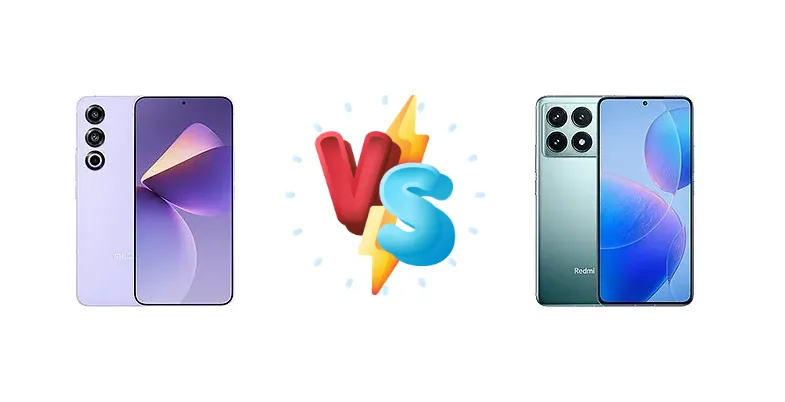
|
🏆 Quick Verdict
For the average user, the Xiaomi Redmi K70 Pro emerges as the slightly stronger choice. Its 120W charging significantly reduces downtime, and while both share the same chipset, Xiaomi’s software track record suggests better sustained performance and thermal management. The Meizu 21 remains a compelling option, especially for brand loyalists.
| PHONES | ||
|---|---|---|
| Phone Names | Meizu 21 | Xiaomi Redmi K70 Pro |
| Network | ||
|---|---|---|
| 2G bands | GSM 850 / 900 / 1800 / 1900 | GSM 850 / 900 / 1800 / 1900 |
| 3G bands | HSDPA 850 / 900 / 1700(AWS) / 2100 | HSDPA 800 / 850 / 900 / 1700(AWS) / 2100 |
| 4G bands | 1, 3, 4, 5, 7, 8, 18, 19, 26, 28, 34, 38, 39, 40, 41 | 1, 3, 4, 5, 8, 18, 19, 26, 28, 34, 38, 39, 40, 41, 42, 48, 66 |
| 5G bands | 1, 3, 5, 8, 28, 38, 41, 77, 78 SA/NSA | 1, 3, 5, 8, 28, 38, 41, 48, 66, 77, 78 SA/NSA |
| Speed | HSPA, LTE, 5G | HSPA, LTE, 5G |
| Technology | GSM / HSPA / LTE / 5G | GSM / CDMA / HSPA / CDMA2000 / LTE / 5G |
| Launch | ||
|---|---|---|
| Announced | 2023, November 30 | 2023, November 29 |
| Status | Available. Released 2023, November 30 | Available. Released 2023, November 29 |
| Body | ||
|---|---|---|
| Build | Glass front, glass back, aluminum frame | - |
| Dimensions | 156.7 x 75.3 x 7.9 mm (6.17 x 2.96 x 0.31 in) | 160.9 x 75 x 8.2 mm (6.33 x 2.95 x 0.32 in) |
| SIM | Nano-SIM + Nano-SIM | Nano-SIM + Nano-SIM |
| Weight | 198 g (6.98 oz) | 209 g (7.37 oz) |
| Display | ||
|---|---|---|
| Resolution | 1080 x 2340 pixels, 19.5:9 ratio (~393 ppi density) | 1440 x 3200 pixels, 20:9 ratio (~526 ppi density) |
| Size | 6.55 inches, 105.3 cm2 (~89.3% screen-to-body ratio) | 6.67 inches, 107.4 cm2 (~89.0% screen-to-body ratio) |
| Type | AMOLED, 120Hz, HDR10+, 600 nits (typ), 1100 nits (HBM), 1800 nits (peak) | OLED, 68B colors, 120Hz, Dolby Vision, HDR10+, 4000 nits (peak) |
| Platform | ||
|---|---|---|
| CPU | Octa-core (1x3.3 GHz Cortex-X4 & 3x3.2 GHz Cortex-A720 & 2x3.0 GHz Cortex-A720 & 2x2.3 GHz Cortex-A520) | Octa-core (1x3.3 GHz Cortex-X4 & 3x3.2 GHz Cortex-A720 & 2x3.0 GHz Cortex-A720 & 2x2.3 GHz Cortex-A520) |
| Chipset | Qualcomm SM8650-AB Snapdragon 8 Gen 3 (4 nm) | Qualcomm SM8650-AB Snapdragon 8 Gen 3 (4 nm) |
| GPU | Adreno 750 | Adreno 750 |
| OS | Android 13, Flyme 10.5 | Android 14, HyperOS |
| Memory | ||
|---|---|---|
| Card slot | No | No |
| Internal | 256GB 8GB RAM, 256GB 12GB RAM, 512GB 12GB RAM | 256GB 12GB RAM, 256GB 16GB RAM, 512GB 12GB RAM, 512GB 16GB RAM, 1TB 24GB RAM |
| Main Camera | ||
|---|---|---|
| Features | Ring-LED flash, panorama, HDR | Color spectrum sensor, LED flash, HDR, panorama |
| Triple | 200 MP, f/1.7, 22mm (wide), 1/1.4", PDAF, OIS 13 MP, f/2.4, 15mm, 122˚ (ultrawide), 1/3.1" 5 MP, f/2.4, 27mm (wide), 1/5.0" | 50 MP, f/1.6, (wide), 1/1.55", 1.0µm, PDAF, OIS 50 MP, (telephoto), PDAF, 2x optical zoom 12 MP, (ultrawide) |
| Video | 8K@30fps, 4K@30/60fps, 1080p@30/60fps, gyro-EIS | 8K@24fps, 4K@24/30/60fps, 1080p@30/60/120/240/960fps, 720p@1920fps, gyro-EIS |
| Selfie camera | ||
|---|---|---|
| Features | HDR | HDR |
| Single | 32 MP, f/2.4, (wide), 1/3.1" | 16 MP, (wide) |
| Video | 4K@30/60fps, 1080p@30/60fps, gyro-EIS | 1080p@30/60fps, gyro-EIS |
| Sound | ||
|---|---|---|
| 35mm jack | No | No |
| Loudspeaker | Yes, with stereo speakers | Yes, with stereo speakers |
| Comms | ||
|---|---|---|
| Bluetooth | 5.4, A2DP, LE | 5.4, A2DP, LE, aptX HD, aptX Adaptive, aptX Lossless |
| Infrared port | Yes | Yes |
| NFC | Yes | Yes |
| Positioning | GPS (L1+L5), GLONASS (G1), BDS (B1I+B1c+B2a), GALILEO (E1+E5a), QZSS (L1+L5), NavIC (L5) | GPS (L1+L5), GLONASS (G1), BDS (B1I+B1c+B2a), GALILEO (E1+E5a), QZSS (L1+L5), NavIC (L5) |
| Radio | No | No |
| USB | USB Type-C, OTG | USB Type-C, OTG |
| WLAN | Wi-Fi 802.11 а/b/g/n/ac/6e/7, dual-band | Wi-Fi 802.11 a/b/g/n/ac/6e/7, dual-band, Wi-Fi Direct |
| Features | ||
|---|---|---|
| Sensors | Fingerprint (under display, ultrasonic), accelerometer, gyro, proximity, compass | Fingerprint (under display, optical), accelerometer, proximity, gyro, compass |
| Battery | ||
|---|---|---|
| Charging | 80W wired, PD3 PPS, QC4+ | 120W wired, PD3.0, QC3+, 100% in 18 min |
| Type | 4800 mAh | Li-Po 5000 mAh |
| Misc | ||
|---|---|---|
| Colors | Black, Purple, Green, White | Black, Silver, Blue/Green, Lamborgini Green, Lamborgini Yellow |
| Models | - | 23117RK66C |
| Price | About 440 EUR | About 430 EUR |
Meizu 21
- Potentially cleaner software experience
- Meizu’s unique design aesthetic
- 80W fast charging is still respectable
- Slower charging compared to the K70 Pro
- Potential for less optimized thermal management
- Less established brand recognition
Xiaomi Redmi K70 Pro
- Ultra-fast 120W charging (18 minutes to full)
- Likely better sustained performance due to software optimization
- Strong brand reputation and wider availability
- MIUI can be feature-heavy and potentially bloated
- Image processing may be overly saturated for some users
- Potentially less refined design compared to Meizu
Display Comparison
While display specs aren't provided, both phones likely feature high-refresh-rate AMOLED panels. The Redmi K70 Pro, given Xiaomi’s recent trends, may boast a slightly higher peak brightness for improved outdoor visibility. The absence of LTPO information suggests both may not dynamically adjust refresh rates as aggressively as some competitors, potentially impacting battery life. Bezels are expected to be minimal on both, reflecting current flagship design trends.
Camera Comparison
Camera details are absent, but given the flagship positioning, both devices will likely feature multi-camera systems. The absence of specific sensor information makes direct comparison difficult. However, Xiaomi typically prioritizes high-resolution main sensors, potentially giving the K70 Pro an advantage in detail capture. Image processing styles will also differ; Meizu often aims for a more natural look, while Xiaomi’s MIUI tends towards more vibrant, saturated colors. The inclusion of OIS (Optical Image Stabilization) on the main sensor is expected on both.
Performance
Both the Meizu 21 and Redmi K70 Pro utilize the Qualcomm SM8650-AB Snapdragon 8 Gen 3 (4nm). The CPU configuration is identical – 1x3.3 GHz Cortex-X4, 3x3.2 GHz Cortex-A720, 2x3.0 GHz Cortex-A720, and 2x2.3 GHz Cortex-A520. This means raw processing power will be nearly indistinguishable. The key differentiator will be thermal management and sustained performance. Xiaomi’s larger scale and experience with the 8 Gen 3 may allow for more aggressive cooling solutions and software optimizations to prevent throttling during extended gaming sessions. RAM speed (likely LPDDR5x) is not specified, but will play a role in overall responsiveness.
Battery Life
The Redmi K70 Pro’s 120W wired charging is a significant advantage over the Meizu 21’s 80W. Xiaomi claims a full charge in 18 minutes, while the Meizu 21 will take considerably longer. Both support PD3.0/PPS and QC4+, ensuring compatibility with a wide range of chargers. While battery capacity isn’t specified, the faster charging of the K70 Pro effectively mitigates any potential disadvantage from a slightly smaller battery size. The faster charging is a clear win for users who frequently top up their phones throughout the day.
Buying Guide
Buy the Meizu 21 if you prioritize a potentially more refined software experience and appreciate Meizu’s design language. It’s ideal for users who aren’t heavily reliant on ultra-fast charging and value a potentially cleaner Android skin. Buy the Xiaomi Redmi K70 Pro if you demand the fastest possible charging speeds, prioritize sustained gaming performance, and appreciate a feature-rich MIUI experience. It’s the better choice for power users and mobile gamers.