
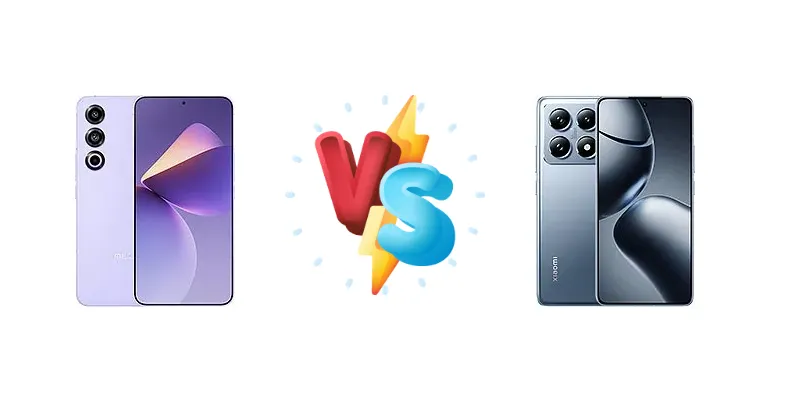
Meizu 21 vs Xiaomi 14T Pro: Which Flagship Reigns Supreme?
| Phones Images | |||||
|---|---|---|---|---|---|
|
🏆 Quick Verdict
For the average user prioritizing raw performance and rapid charging, the Xiaomi 14T Pro emerges as the winner. Its Dimensity 9300+ chipset delivers comparable, and in some cases superior, CPU performance, coupled with a significantly faster 120W charging solution. However, the Meizu 21 remains a strong contender for those deeply embedded in the Meizu ecosystem.
| PHONES | ||
|---|---|---|
| Phone Names | Meizu 21 | Xiaomi 14T Pro |
| Network | ||
|---|---|---|
| 2G bands | GSM 850 / 900 / 1800 / 1900 | GSM 850 / 900 / 1800 / 1900 |
| 3G bands | HSDPA 850 / 900 / 1700(AWS) / 2100 | HSDPA 800 / 850 / 900 / 1700(AWS) / 1900 / 2100 |
| 4G bands | 1, 3, 4, 5, 7, 8, 18, 19, 26, 28, 34, 38, 39, 40, 41 | 1, 2, 3, 4, 5, 7, 8, 12, 13, 17, 18, 19, 20, 25, 26, 28, 32, 38, 39, 40, 41, 42, 48, 66 |
| 5G bands | 1, 3, 5, 8, 28, 38, 41, 77, 78 SA/NSA | 1, 2, 3, 5, 7, 8, 12, 20, 25, 26, 28, 38, 40, 41, 48, 66, 75, 77, 78 SA/NSA |
| Speed | HSPA, LTE, 5G | HSPA, LTE, 5G |
| Technology | GSM / HSPA / LTE / 5G | GSM / HSPA / LTE / 5G |
| Launch | ||
|---|---|---|
| Announced | 2023, November 30 | 2024, September 26 |
| Status | Available. Released 2023, November 30 | Available. Released 2024, September 26 |
| Body | ||
|---|---|---|
| Build | Glass front, glass back, aluminum frame | Glass front (Gorilla Glass 5), aluminum frame, glass back (Panda X) |
| Dimensions | 156.7 x 75.3 x 7.9 mm (6.17 x 2.96 x 0.31 in) | 160.4 x 75.1 x 8.4 mm (6.31 x 2.96 x 0.33 in) |
| SIM | Nano-SIM + Nano-SIM | · Nano-SIM + eSIM· eSIM + eSIM· Nano-SIM + Nano-SIM |
| Weight | 198 g (6.98 oz) | 209 g (7.37 oz) |
| Display | ||
|---|---|---|
| Protection | - | Corning Gorilla Glass 5 |
| Resolution | 1080 x 2340 pixels, 19.5:9 ratio (~393 ppi density) | 1220 x 2712 pixels, 20:9 ratio (~446 ppi density) |
| Size | 6.55 inches, 105.3 cm2 (~89.3% screen-to-body ratio) | 6.67 inches, 107.4 cm2 (~89.1% screen-to-body ratio) |
| Type | AMOLED, 120Hz, HDR10+, 600 nits (typ), 1100 nits (HBM), 1800 nits (peak) | AMOLED, 68B colors, 144Hz, 3840Hz PWM, Dolby Vision, HDR10+, 1600 nits (HBM), 4000 nits (peak) |
| Platform | ||
|---|---|---|
| CPU | Octa-core (1x3.3 GHz Cortex-X4 & 3x3.2 GHz Cortex-A720 & 2x3.0 GHz Cortex-A720 & 2x2.3 GHz Cortex-A520) | Octa-core (1x3.4 GHz Cortex-X4 & 3x2.85 GHz Cortex-X4 & 4x2.0 GHz Cortex-A720) |
| Chipset | Qualcomm SM8650-AB Snapdragon 8 Gen 3 (4 nm) | Mediatek Dimensity 9300+ (4 nm) |
| GPU | Adreno 750 | Immortalis-G720 MC12 |
| OS | Android 13, Flyme 10.5 | Android 14, HyperOS |
| Memory | ||
|---|---|---|
| Card slot | No | No |
| Internal | 256GB 8GB RAM, 256GB 12GB RAM, 512GB 12GB RAM | 256GB 12GB RAM, 512GB 12GB RAM, 512GB 16GB RAM, 1TB 12GB RAM |
| Main Camera | ||
|---|---|---|
| Features | Ring-LED flash, panorama, HDR | Leica lens, Ultra HDR, LED flash, HDR, panorama |
| Triple | 200 MP, f/1.7, 22mm (wide), 1/1.4", PDAF, OIS 13 MP, f/2.4, 15mm, 122˚ (ultrawide), 1/3.1" 5 MP, f/2.4, 27mm (wide), 1/5.0" | 50 MP, f/1.6, 23mm (wide), 1/1.31", 1.2µm, PDAF, OIS 50 MP, f/2.0, 60mm (telephoto), 1/2.88", 0.61µm, PDAF, 2.6x optical zoom 12 MP, f/2.2, 15mm (ultrawide), 1/3.06", 1.12µm |
| Video | 8K@30fps, 4K@30/60fps, 1080p@30/60fps, gyro-EIS | 8K@24/30fps, 4K@24/30/60fps, 1080p@30/60/120/240/960fps, gyro-EIS, 10-bit Rec. 2020, HDR10+ |
| Selfie camera | ||
|---|---|---|
| Features | HDR | HDR |
| Single | 32 MP, f/2.4, (wide), 1/3.1" | 32 MP, f/2.0, 25mm (wide), 1/3.44", 0.64µm |
| Video | 4K@30/60fps, 1080p@30/60fps, gyro-EIS | 4K@30fps, 1080p@30/60fps, HDR10+ |
| Sound | ||
|---|---|---|
| 35mm jack | No | No |
| Loudspeaker | Yes, with stereo speakers | Yes, with stereo speakers |
| Comms | ||
|---|---|---|
| Bluetooth | 5.4, A2DP, LE | 5.4, A2DP, LE, LHDC |
| Infrared port | Yes | Yes |
| NFC | Yes | Yes (market/region dependent) |
| Positioning | GPS (L1+L5), GLONASS (G1), BDS (B1I+B1c+B2a), GALILEO (E1+E5a), QZSS (L1+L5), NavIC (L5) | GPS (L1+L5), BDS (B1I+B1C+B2a+B2b), GALILEO (E1+E5a+E5b), QZSS (L1+L5), NavIC (L5), GLONASS |
| Radio | No | No |
| USB | USB Type-C, OTG | USB Type-C 2.0, OTG |
| WLAN | Wi-Fi 802.11 а/b/g/n/ac/6e/7, dual-band | Wi-Fi 802.11 a/b/g/n/ac/6e/7, dual-band, Wi-Fi Direct |
| Features | ||
|---|---|---|
| Sensors | Fingerprint (under display, ultrasonic), accelerometer, gyro, proximity, compass | Fingerprint (under display, optical), accelerometer, gyro, proximity, compass |
| Battery | ||
|---|---|---|
| Charging | 80W wired, PD3 PPS, QC4+ | 120W wired, PD3.0, QC4, 100% in 19 min 50W wireless, 100% in 45 min |
| Type | 4800 mAh | Li-Po 5000 mAh |
| Misc | ||
|---|---|---|
| Colors | Black, Purple, Green, White | Titan Gray, Titan Blue, Titan Black |
| Models | - | 2407FPN8EG |
| Price | About 440 EUR | $ 550.00 / £ 498.00 / € 539.99 |
| SAR EU | - | 0.99 W/kg (head) 1.00 W/kg (body) |
Meizu 21
- Snapdragon 8 Gen 3 offers flagship-level performance.
- Potentially more refined software experience with FlymeOS.
- 80W charging is still relatively fast.
- Charging speed is significantly slower than the Xiaomi 14T Pro.
- Limited information available regarding display specifications.
Xiaomi 14T Pro
- Dimensity 9300+ provides excellent CPU performance.
- Industry-leading 120W wired and 50W wireless charging.
- High peak brightness (1228 nits) for excellent outdoor visibility.
- MediaTek chipsets sometimes face software optimization challenges.
- Xiaomi’s MIUI can be feature-rich but also bloated.
Display Comparison
While both devices likely feature high-quality AMOLED panels, the Xiaomi 14T Pro boasts a measured peak brightness of 1228 nits, suggesting a superior outdoor visibility experience compared to the Meizu 21 (brightness data unavailable). The absence of LTPO information for either device means we can't assess adaptive refresh rate efficiency. Bezels and color accuracy are unknown, but both brands typically deliver competitive displays in this price bracket.
Camera Comparison
Camera details are limited. Without sensor size or aperture information, a direct comparison is difficult. However, the focus should be on image processing algorithms. Meizu typically favors a more natural look, while Xiaomi often leans towards vibrant, saturated colors. The absence of details regarding OIS (Optical Image Stabilization) on either device makes it impossible to assess low-light performance capabilities. Any 2MP macro lenses present on either phone should be considered a marketing gimmick rather than a significant photographic asset.
Performance
The core battle lies in the chipsets. The Xiaomi 14T Pro’s MediaTek Dimensity 9300+ features a unique CPU configuration with 1x3.4 GHz Cortex-X4, 3x2.85 GHz Cortex-X4, and 4x2.0 GHz Cortex-A720 cores. This contrasts with the Meizu 21’s Qualcomm Snapdragon 8 Gen 3, which utilizes 1x3.3 GHz Cortex-X4, 3x3.2 GHz Cortex-A720, 2x3.0 GHz Cortex-A720, and 2x2.3 GHz Cortex-A520 cores. The Dimensity 9300+'s heavier reliance on the high-performance X4 cores suggests a potential edge in sustained CPU workloads. Both are built on a 4nm process, but the Dimensity 9300+'s architecture may offer better multi-core performance. RAM speed (LPDDR5x) is not specified for either, but thermal management will be crucial to prevent throttling under load.
Battery Life
The Xiaomi 14T Pro shines in battery and charging. Its 120W wired charging can fully charge the device in a claimed 19 minutes, a significant advantage over the Meizu 21’s 80W charging. The addition of 50W wireless charging on the Xiaomi 14T Pro further expands charging options. While the Meizu 21’s battery capacity is unknown, the Xiaomi 14T Pro achieves an active use score of 12:32h, indicating solid battery life despite the power-hungry chipset and high refresh rate. The faster charging speed of the Xiaomi 14T Pro effectively mitigates any potential concerns about battery capacity.
Buying Guide
Buy the Meizu 21 if you prioritize a streamlined software experience and are already invested in the Meizu FlymeOS ecosystem. Its Snapdragon 8 Gen 3 offers excellent performance, and 80W charging is still respectable. Buy the Xiaomi 14T Pro if you demand the fastest possible charging speeds (120W wired, 50W wireless) and a more aggressive CPU configuration, making it ideal for demanding multitasking and gaming.