
Meizu 21 vs. iQOO 12 Pro: A Deep Dive into Snapdragon 8 Gen 3 Flagships
| Phones Images | |||||
|---|---|---|---|---|---|
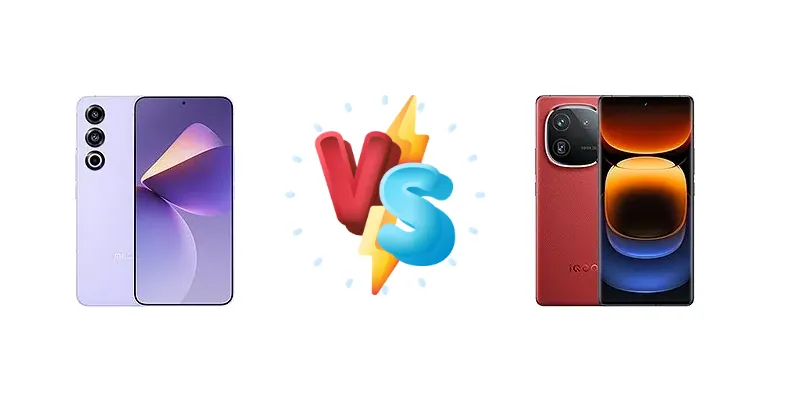
|
🏆 Quick Verdict
For users prioritizing the fastest possible charging and wireless convenience, the iQOO 12 Pro is the clear winner. Its 120W wired and 50W wireless charging significantly outperform the Meizu 21’s 80W wired-only solution. However, the Meizu 21 remains a compelling option for those seeking a refined experience and potentially better thermal management due to its lower peak charging demands.
| PHONES | ||
|---|---|---|
| Phone Names | Meizu 21 | vivo iQOO 12 Pro |
| Network | ||
|---|---|---|
| 2G bands | GSM 850 / 900 / 1800 / 1900 | GSM 850 / 900 / 1800 / 1900 |
| 3G bands | HSDPA 850 / 900 / 1700(AWS) / 2100 | HSDPA 800 / 850 / 900 / 1700(AWS) / 1900 / 2100 |
| 4G bands | 1, 3, 4, 5, 7, 8, 18, 19, 26, 28, 34, 38, 39, 40, 41 | 1, 2, 3, 4, 5, 7, 8, 12, 17, 18, 19, 20, 25, 26, 28, 34, 38, 39, 40, 41, 42, 66 |
| 5G bands | 1, 3, 5, 8, 28, 38, 41, 77, 78 SA/NSA | 1, 2, 3, 5, 7, 8, 12, 20, 25, 26, 28, 66, 38, 40, 41, 77, 78 SA/NSA |
| Speed | HSPA, LTE, 5G | HSPA, LTE, 5G |
| Technology | GSM / HSPA / LTE / 5G | GSM / CDMA / HSPA / CDMA2000 / LTE / 5G |
| Launch | ||
|---|---|---|
| Announced | 2023, November 30 | 2023, November 07 |
| Status | Available. Released 2023, November 30 | Available. Released 2023, November 14 |
| Body | ||
|---|---|---|
| Build | Glass front, glass back, aluminum frame | - |
| Dimensions | 156.7 x 75.3 x 7.9 mm (6.17 x 2.96 x 0.31 in) | 164.6 x 75.4 x 8.6 mm or 8.8 mm |
| SIM | Nano-SIM + Nano-SIM | Nano-SIM + Nano-SIM |
| Weight | 198 g (6.98 oz) | 205 g or 210 g (7.23 oz) |
| Display | ||
|---|---|---|
| Resolution | 1080 x 2340 pixels, 19.5:9 ratio (~393 ppi density) | 1440 x 3200 pixels, 20:9 ratio (~518 ppi density) |
| Size | 6.55 inches, 105.3 cm2 (~89.3% screen-to-body ratio) | 6.78 inches, 111.0 cm2 (~89.4% screen-to-body ratio) |
| Type | AMOLED, 120Hz, HDR10+, 600 nits (typ), 1100 nits (HBM), 1800 nits (peak) | LTPO AMOLED, 1B colors, 144Hz, HDR10+, 1600 nits (HBM), 3000 nits (peak) |
| Platform | ||
|---|---|---|
| CPU | Octa-core (1x3.3 GHz Cortex-X4 & 3x3.2 GHz Cortex-A720 & 2x3.0 GHz Cortex-A720 & 2x2.3 GHz Cortex-A520) | Octa-core (1x3.3 GHz Cortex-X4 & 3x3.2 GHz Cortex-A720 & 2x3.0 GHz Cortex-A720 & 2x2.3 GHz Cortex-A520) |
| Chipset | Qualcomm SM8650-AB Snapdragon 8 Gen 3 (4 nm) | Qualcomm SM8650-AB Snapdragon 8 Gen 3 (4 nm) |
| GPU | Adreno 750 | Adreno 750 |
| OS | Android 13, Flyme 10.5 | Android 14, up to 2 major Android upgrades, Funtouch 14 (International), OriginOS 4 (China) |
| Memory | ||
|---|---|---|
| Card slot | No | No |
| Internal | 256GB 8GB RAM, 256GB 12GB RAM, 512GB 12GB RAM | 256GB 16GB RAM, 512GB 16GB RAM, 1TB 16GB RAM |
| Main Camera | ||
|---|---|---|
| Features | Ring-LED flash, panorama, HDR | Color spectrum sensor, Dual-LED flash, HDR, panorama |
| Triple | 200 MP, f/1.7, 22mm (wide), 1/1.4", PDAF, OIS 13 MP, f/2.4, 15mm, 122˚ (ultrawide), 1/3.1" 5 MP, f/2.4, 27mm (wide), 1/5.0" | 50 MP, f/1.7, 23mm (wide), 1/1.3", 1.2µm, ulti-directional PDAF, OIS 64 MP, f/2.6, 70mm (periscope telephoto), 1/2.0", PDAF, OIS, 3x optical zoom 50 MP, f/2.0, 15mm, 119˚ (ultrawide), AF |
| Video | 8K@30fps, 4K@30/60fps, 1080p@30/60fps, gyro-EIS | 8K@30fps, 4K@24/30/60fps, 1080p@30/60/120/240fps, gyro-EIS |
| Selfie camera | ||
|---|---|---|
| Features | HDR | HDR |
| Single | 32 MP, f/2.4, (wide), 1/3.1" | 16 MP, f/2.5, (wide) |
| Video | 4K@30/60fps, 1080p@30/60fps, gyro-EIS | 1080p@30fps, gyro-EIS |
| Sound | ||
|---|---|---|
| 35mm jack | No | No |
| Loudspeaker | Yes, with stereo speakers | Yes, with stereo speakers |
| Comms | ||
|---|---|---|
| Bluetooth | 5.4, A2DP, LE | 5.4, A2DP, LE, aptX HD, aptX Adaptive, aptX Lossless |
| Infrared port | Yes | Yes |
| NFC | Yes | Yes |
| Positioning | GPS (L1+L5), GLONASS (G1), BDS (B1I+B1c+B2a), GALILEO (E1+E5a), QZSS (L1+L5), NavIC (L5) | GPS (L1+L5), GLONASS (G1), BDS (B1I+B1c+B2a), GALILEO (E1+E5a), QZSS (L1+L5) |
| Radio | No | No |
| USB | USB Type-C, OTG | USB Type-C 2.0, OTG |
| WLAN | Wi-Fi 802.11 а/b/g/n/ac/6e/7, dual-band | Wi-Fi 802.11 a/b/g/n/ac/6/7, tri-band, Wi-Fi Direct |
| Features | ||
|---|---|---|
| Sensors | Fingerprint (under display, ultrasonic), accelerometer, gyro, proximity, compass | Fingerprint (under display, ultrasonic), accelerometer, gyro, proximity, compass |
| Battery | ||
|---|---|---|
| Charging | 80W wired, PD3 PPS, QC4+ | 120W wired 50W wireless 10W reverse wireless |
| Type | 4800 mAh | 5100 mAh |
| Misc | ||
|---|---|---|
| Colors | Black, Purple, Green, White | Black, Red, White (BMW M branding) |
| Models | - | V2329A |
| Price | About 440 EUR | About 650 EUR |
Meizu 21
- Potentially better sustained performance due to lower peak charging heat.
- Refined software experience (based on Meizu’s brand reputation).
- Sleek and minimalist design (typical of Meizu).
- Slower charging speeds (80W wired only).
- Lacks wireless charging capability.
- Camera specs unknown, potential for lower performance.
vivo iQOO 12 Pro
- Ultra-fast 120W wired charging.
- Convenient 50W wireless charging.
- Likely superior thermal management for gaming.
- Potential for higher heat generation during charging.
- Software experience may be less refined than Meizu.
- Aggressive design may not appeal to all users.
Display Comparison
While both devices are expected to feature high-quality AMOLED displays, specific details like peak brightness and refresh rate are not provided. However, given the flagship positioning, both will likely offer vibrant colors and smooth scrolling. The absence of LTPO information suggests potential differences in power efficiency depending on how dynamically the refresh rate is adjusted. Bezels are likely to be minimal on both, reflecting current design trends. Color accuracy will be a key differentiator, and independent testing will be needed to determine which device offers more accurate color reproduction.
Camera Comparison
Context data lacks camera specifications. However, given the iQOO brand’s history, it’s reasonable to expect a multi-camera system with a high-resolution main sensor, potentially exceeding 50MP, and optical image stabilization (OIS). The Meizu 21, while potentially offering a similar setup, might prioritize image processing algorithms for a different aesthetic. Without sensor size and aperture information, a definitive comparison is impossible. The inclusion of a 2MP macro camera on either device would be largely inconsequential, offering limited practical benefit.
Performance
Both the Meizu 21 and iQOO 12 Pro utilize the Qualcomm SM8650-AB Snapdragon 8 Gen 3 (4nm), featuring an identical CPU configuration: 1x3.3 GHz Cortex-X4, 3x3.2 GHz Cortex-A720, 2x3.0 GHz Cortex-A720, and 2x2.3 GHz Cortex-A520. This means raw processing power will be nearly identical. The key difference will lie in thermal management. The iQOO 12 Pro, known for its gaming focus, likely employs a more aggressive cooling solution to sustain peak performance for longer durations. The Meizu 21, with its lower charging wattage, *may* experience less heat buildup during prolonged use, potentially leading to more consistent performance. RAM speed (likely LPDDR5x on both) will also play a role, but the chipset is the dominant factor.
Battery Life
The iQOO 12 Pro’s 120W wired charging is a significant advantage, allowing for a full charge in approximately 20-30 minutes. The Meizu 21’s 80W charging, while still fast, will take considerably longer. The addition of 50W wireless charging and 10W reverse wireless charging on the iQOO 12 Pro provides unparalleled convenience. While battery capacity isn’t specified, the faster charging speeds of the iQOO 12 Pro effectively mitigate the impact of a potentially smaller battery, offering more usable uptime throughout the day.
Buying Guide
Buy the Meizu 21 if you value a balanced flagship experience with a focus on software refinement and potentially sustained performance during extended gaming sessions. Buy the vivo iQOO 12 Pro if you absolutely need the fastest charging speeds available, including convenient 50W wireless charging, and prioritize maximizing battery uptime with minimal downtime.