
Meizu 21 vs Realme GT5 Pro: A Deep Dive into Snapdragon 8 Gen 3 Flagships
| Phones Images | |||||
|---|---|---|---|---|---|
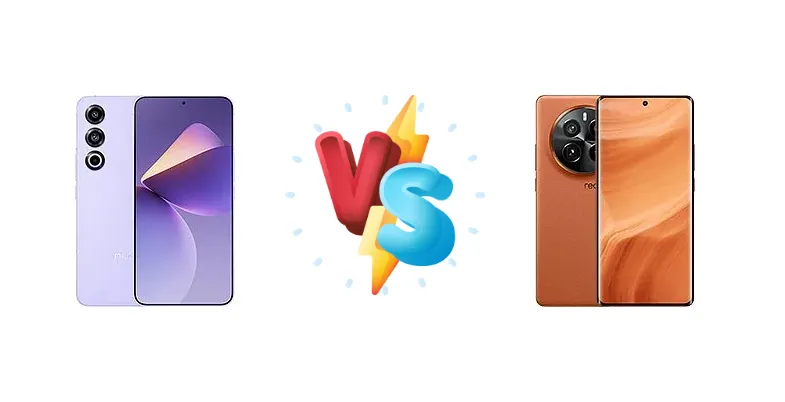
|
🏆 Quick Verdict
For the average user prioritizing rapid charging and extended battery life, the Realme GT5 Pro emerges as the winner. Its 100W wired and 50W wireless charging, coupled with a reported 14:16h active use battery score, provide a significant advantage over the Meizu 21’s 80W wired charging.
| PHONES | ||
|---|---|---|
| Phone Names | Meizu 21 | Realme GT5 Pro |
| Network | ||
|---|---|---|
| 2G bands | GSM 850 / 900 / 1800 / 1900 | GSM 850 / 900 / 1800 / 1900 |
| 3G bands | HSDPA 850 / 900 / 1700(AWS) / 2100 | HSDPA 850 / 900 / 2100 |
| 4G bands | 1, 3, 4, 5, 7, 8, 18, 19, 26, 28, 34, 38, 39, 40, 41 | 1, 3, 5, 7, 8, 28, 34, 38, 39, 40, 41 |
| 5G bands | 1, 3, 5, 8, 28, 38, 41, 77, 78 SA/NSA | 1, 3, 5, 8, 28, 41, 77, 78 SA/NSA |
| Speed | HSPA, LTE, 5G | HSPA, LTE, 5G |
| Technology | GSM / HSPA / LTE / 5G | GSM / CDMA / HSPA / CDMA2000 / LTE / 5G |
| Launch | ||
|---|---|---|
| Announced | 2023, November 30 | 2023, December 07 |
| Status | Available. Released 2023, November 30 | Available. Released 2023, December 14 |
| Body | ||
|---|---|---|
| Build | Glass front, glass back, aluminum frame | Glass front, glass back or silicone polymer back (eco leather), aluminum frame |
| Dimensions | 156.7 x 75.3 x 7.9 mm (6.17 x 2.96 x 0.31 in) | 161.7 x 75.1 x 9.2 mm (6.37 x 2.96 x 0.36 in) |
| SIM | Nano-SIM + Nano-SIM | Nano-SIM + Nano-SIM |
| Weight | 198 g (6.98 oz) | 218 g / 224 g (7.69 oz) |
| Display | ||
|---|---|---|
| Resolution | 1080 x 2340 pixels, 19.5:9 ratio (~393 ppi density) | 1264 x 2780 pixels (~450 ppi density) |
| Size | 6.55 inches, 105.3 cm2 (~89.3% screen-to-body ratio) | 6.78 inches, 111.7 cm2 (~92.0% screen-to-body ratio) |
| Type | AMOLED, 120Hz, HDR10+, 600 nits (typ), 1100 nits (HBM), 1800 nits (peak) | LTPO AMOLED, 1B colors, 144Hz, HDR10+, Dolby Vision, 4500 nits (peak) |
| Platform | ||
|---|---|---|
| CPU | Octa-core (1x3.3 GHz Cortex-X4 & 3x3.2 GHz Cortex-A720 & 2x3.0 GHz Cortex-A720 & 2x2.3 GHz Cortex-A520) | Octa-core (1x3.3 GHz Cortex-X4 & 3x3.2 GHz Cortex-A720 & 2x3.0 GHz Cortex-A720 & 2x2.3 GHz Cortex-A520) |
| Chipset | Qualcomm SM8650-AB Snapdragon 8 Gen 3 (4 nm) | Qualcomm SM8650-AB Snapdragon 8 Gen 3 (4 nm) |
| GPU | Adreno 750 | Adreno 750 |
| OS | Android 13, Flyme 10.5 | Android 14, upgradable to Android 15, Realme UI 6.0 |
| Memory | ||
|---|---|---|
| Card slot | No | No |
| Internal | 256GB 8GB RAM, 256GB 12GB RAM, 512GB 12GB RAM | 256GB 12GB RAM, 256GB 16GB RAM, 512GB 16GB RAM, 1TB 16GB RAM |
| Main Camera | ||
|---|---|---|
| Features | Ring-LED flash, panorama, HDR | Color spectrum sensor, Dual-LED dual-tone flash, HDR, panorama |
| Triple | 200 MP, f/1.7, 22mm (wide), 1/1.4", PDAF, OIS 13 MP, f/2.4, 15mm, 122˚ (ultrawide), 1/3.1" 5 MP, f/2.4, 27mm (wide), 1/5.0" | 50 MP, f/1.7, 23mm (wide), 1/1.43", 1.12µm, dual pixel PDAF, OIS 50 MP, f/2.6, 65mm (periscope telephoto), 1/1.56", 1.0µm, multi-directional PDAF, OIS, 2.7x optical zoom 8 MP, f/2.2, 16mm, 112˚ (ultrawide), 1/4.0", 1.12µm |
| Video | 8K@30fps, 4K@30/60fps, 1080p@30/60fps, gyro-EIS | 8K@24fps, 4K@30/60fps, 1080p@30/60fps, gyro-EIS, Dolby Vision |
| Selfie camera | ||
|---|---|---|
| Features | HDR | HDR, panorama |
| Single | 32 MP, f/2.4, (wide), 1/3.1" | 32 MP, f/2.5, 22mm (wide), 1/2.74" |
| Video | 4K@30/60fps, 1080p@30/60fps, gyro-EIS | 4K@30fps, 1080p@30fps, gyro-EIS |
| Sound | ||
|---|---|---|
| 35mm jack | No | No |
| Loudspeaker | Yes, with stereo speakers | Yes, with stereo speakers (Dolby Atmos certified) |
| Comms | ||
|---|---|---|
| Bluetooth | 5.4, A2DP, LE | 5.4, A2DP, LE, aptX HD |
| Infrared port | Yes | Yes |
| NFC | Yes | Yes, 360˚ |
| Positioning | GPS (L1+L5), GLONASS (G1), BDS (B1I+B1c+B2a), GALILEO (E1+E5a), QZSS (L1+L5), NavIC (L5) | GPS (L1+L5), GLONASS, BDS (B1I+B1c+B2a), GALILEO (E1+E5a), QZSS (L1+L5), NavIC |
| Radio | No | No |
| USB | USB Type-C, OTG | USB Type-C 3.2 |
| WLAN | Wi-Fi 802.11 а/b/g/n/ac/6e/7, dual-band | Wi-Fi 802.11 a/b/g/n/ac/6/7, tri-band, Wi-Fi Direct |
| Features | ||
|---|---|---|
| Sensors | Fingerprint (under display, ultrasonic), accelerometer, gyro, proximity, compass | Fingerprint (under display, optical), accelerometer, gyro, proximity, compass |
| Battery | ||
|---|---|---|
| Charging | 80W wired, PD3 PPS, QC4+ | 100W wired, 50% in 12 min 50W wireless |
| Type | 4800 mAh | Li-Ion 5400 mAh |
| Misc | ||
|---|---|---|
| Colors | Black, Purple, Green, White | Black, Silver, Orange |
| Models | - | RMX3888 |
| Price | About 440 EUR | About 430 EUR |
Meizu 21
- Potentially more refined software experience (Meizu’s Flyme OS)
- Likely more compact form factor (based on Meizu’s design history)
- Snapdragon 8 Gen 3 performance
- Slower 80W wired charging
- No wireless charging
- Limited battery life information
Realme GT5 Pro
- 100W wired charging with fast 0-50% times
- 50W wireless charging
- Excellent battery life (14:16h active use)
- Potentially less refined software experience (Realme UI)
- May be larger and heavier
- Software bloatware potential
Display Comparison
The Realme GT5 Pro boasts a measured peak brightness of 1660 nits, a substantial figure that ensures excellent visibility even under direct sunlight. While the Meizu 21’s display specifications are currently unavailable, Realme’s brightness advantage suggests a superior outdoor viewing experience. Both devices likely utilize AMOLED panels, but the GT5 Pro’s brightness indicates a potentially more advanced panel technology or calibration. Further analysis would require detailed display testing of the Meizu 21.
Camera Comparison
Camera details for the Meizu 21 are currently limited. The Realme GT5 Pro is expected to feature a robust camera system, though specific sensor details are needed for a comprehensive comparison. The presence of OIS (Optical Image Stabilization) is crucial for both devices to minimize blur in photos and videos. Without knowing the main sensor size and aperture of the Meizu 21, it’s difficult to assess its low-light performance relative to the GT5 Pro. We can assume both will offer a variety of shooting modes, but image processing algorithms will likely differentiate the final results.
Performance
Both the Meizu 21 and Realme GT5 Pro are equipped with the Qualcomm SM8650-AB Snapdragon 8 Gen 3 (4nm). The CPU configuration is identical – 1x3.3 GHz Cortex-X4, 3x3.2 GHz Cortex-A720, 2x3.0 GHz Cortex-A720, and 2x2.3 GHz Cortex-A520. This means raw processing power will be nearly indistinguishable between the two. However, thermal management will be crucial. The 4nm process node offers improved efficiency, but the Realme GT5 Pro’s larger battery may allow for more sustained peak performance due to better heat dissipation. RAM specifications are currently unknown for both devices, but LPDDR5x is expected, impacting multitasking and application loading speeds.
Battery Life
The Realme GT5 Pro’s 14:16h active use battery score is a significant advantage. While the Meizu 21’s battery capacity is unknown, the GT5 Pro’s endurance suggests a larger battery or more efficient power management. The charging speeds are a clear differentiator: 100W wired charging on the GT5 Pro, capable of 50% charge in 12 minutes, versus 80W on the Meizu 21. The GT5 Pro also adds 50W wireless charging, a feature absent on the Meizu 21. This makes the GT5 Pro the clear choice for users who frequently need to top up their battery quickly.
Buying Guide
Buy the Meizu 21 if you prioritize a potentially more refined software experience and a compact flagship form factor (based on Meizu’s historical design language). Buy the Realme GT5 Pro if you demand the fastest possible charging speeds, long-lasting battery life for power users, and a brighter display for outdoor visibility. The GT5 Pro caters to those who frequently game or consume media on the go.