
Meizu 21 vs OnePlus 12R: A Deep Dive into Snapdragon Power and Value
| Phones Images | |||||
|---|---|---|---|---|---|
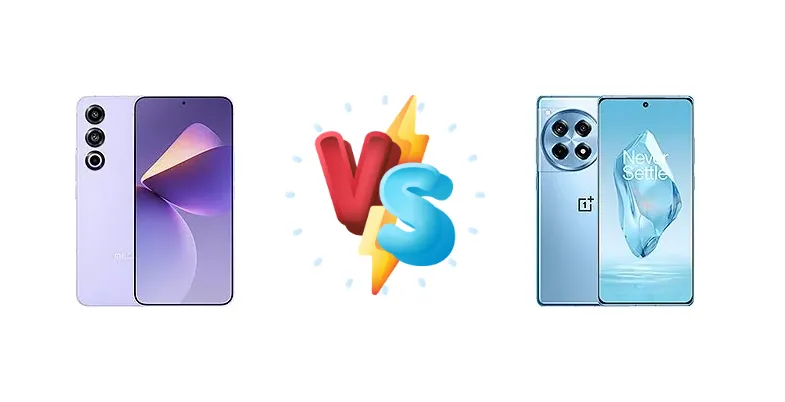
|
🏆 Quick Verdict
For users prioritizing raw performance and the latest technology, the Meizu 21 takes the lead thanks to its Snapdragon 8 Gen 3. However, the OnePlus 12R offers exceptional value with its robust 14:32h active use battery life and 100W charging, making it the better choice for those focused on longevity and quick top-ups.
| PHONES | ||
|---|---|---|
| Phone Names | Meizu 21 | OnePlus 12R |
| Network | ||
|---|---|---|
| 2G bands | GSM 850 / 900 / 1800 / 1900 | GSM 850 / 900 / 1800 / 1900 |
| 3G bands | HSDPA 850 / 900 / 1700(AWS) / 2100 | HSDPA 850 / 900 / 1700(AWS) / 1900 / 2100 |
| 4G bands | 1, 3, 4, 5, 7, 8, 18, 19, 26, 28, 34, 38, 39, 40, 41 | 1, 2, 3, 4, 5, 7, 8, 12, 17, 18, 19, 20, 26, 28, 32, 38, 39, 40, 41, 66 |
| 5G bands | 1, 3, 5, 8, 28, 38, 41, 77, 78 SA/NSA | 1, 2, 3, 5, 7, 8, 12, 20, 28, 38, 40, 41, 66, 77, 78 SA/NSA |
| Speed | HSPA, LTE, 5G | HSPA, LTE, 5G |
| Technology | GSM / HSPA / LTE / 5G | GSM / CDMA / HSPA / LTE / 5G |
| Launch | ||
|---|---|---|
| Announced | 2023, November 30 | 2024, January 23 |
| Status | Available. Released 2023, November 30 | Available. Released 2024, February 06 |
| Body | ||
|---|---|---|
| Build | Glass front, glass back, aluminum frame | Glass front (Gorilla Glass Victus 2), aluminum frame, glass back |
| Dimensions | 156.7 x 75.3 x 7.9 mm (6.17 x 2.96 x 0.31 in) | 163.3 x 75.3 x 8.8 mm (6.43 x 2.96 x 0.35 in) |
| SIM | Nano-SIM + Nano-SIM | · Nano-SIM + Nano-SIM + eSIM (max 2 at a time)· Nano-SIM + Nano-SIM |
| Weight | 198 g (6.98 oz) | 207 g (7.30 oz) |
| Display | ||
|---|---|---|
| Protection | - | Corning Gorilla Glass Victus 2 |
| Resolution | 1080 x 2340 pixels, 19.5:9 ratio (~393 ppi density) | 1264 x 2780 pixels (~450 ppi density) |
| Size | 6.55 inches, 105.3 cm2 (~89.3% screen-to-body ratio) | 6.78 inches, 111.7 cm2 (~90.9% screen-to-body ratio) |
| Type | AMOLED, 120Hz, HDR10+, 600 nits (typ), 1100 nits (HBM), 1800 nits (peak) | LTPO4 AMOLED, 1B colors, 120Hz, HDR10+, Dolby Vision, 1600 nits (HBM), 4500 nits (peak) |
| Platform | ||
|---|---|---|
| CPU | Octa-core (1x3.3 GHz Cortex-X4 & 3x3.2 GHz Cortex-A720 & 2x3.0 GHz Cortex-A720 & 2x2.3 GHz Cortex-A520) | Octa-core (1x3.2 GHz Cortex-X3 & 2x2.8 GHz Cortex-A715 & 2x2.8 GHz Cortex-A710 & 3x2.0 GHz Cortex-A510) |
| Chipset | Qualcomm SM8650-AB Snapdragon 8 Gen 3 (4 nm) | Qualcomm SM8550-AB Snapdragon 8 Gen 2 (4 nm) |
| GPU | Adreno 750 | Adreno 740 |
| OS | Android 13, Flyme 10.5 | Android 14, up to 3 major Android upgrades, OxygenOS 15 |
| Memory | ||
|---|---|---|
| Card slot | No | No |
| Internal | 256GB 8GB RAM, 256GB 12GB RAM, 512GB 12GB RAM | 128GB 8GB RAM, 256GB 8GB RAM, 256GB 12GB RAM, 256GB 16GB RAM |
| Main Camera | ||
|---|---|---|
| Features | Ring-LED flash, panorama, HDR | Laser AF, color spectrum sensor, LED flash, HDR, panorama |
| Triple | 200 MP, f/1.7, 22mm (wide), 1/1.4", PDAF, OIS 13 MP, f/2.4, 15mm, 122˚ (ultrawide), 1/3.1" 5 MP, f/2.4, 27mm (wide), 1/5.0" | 50 MP, f/1.8, 24mm (wide), 1/1.56", 1.0µm, multi-directional PDAF, OIS 8 MP, f/2.2, 16mm, 112˚ (ultrawide), 1/4.0", 1.12µm 2 MP (macro) |
| Video | 8K@30fps, 4K@30/60fps, 1080p@30/60fps, gyro-EIS | 4K@30/60fps, 1080p@30/60/120/240fps, gyro-EIS, OIS |
| Selfie camera | ||
|---|---|---|
| Features | HDR | HDR, panorama |
| Single | 32 MP, f/2.4, (wide), 1/3.1" | 16 MP, f/2.4, 26mm (wide), 1/3", 1.0µm |
| Video | 4K@30/60fps, 1080p@30/60fps, gyro-EIS | 1080p@30fps, gyro-EIS |
| Sound | ||
|---|---|---|
| 35mm jack | No | No |
| Loudspeaker | Yes, with stereo speakers | Yes, with stereo speakers |
| Comms | ||
|---|---|---|
| Bluetooth | 5.4, A2DP, LE | 5.3, A2DP, LE, aptX HD |
| Infrared port | Yes | Yes |
| NFC | Yes | Yes |
| Positioning | GPS (L1+L5), GLONASS (G1), BDS (B1I+B1c+B2a), GALILEO (E1+E5a), QZSS (L1+L5), NavIC (L5) | GPS, GALILEO, GLONASS, BDS, QZSS |
| Radio | No | No |
| USB | USB Type-C, OTG | USB Type-C 2.0 |
| WLAN | Wi-Fi 802.11 а/b/g/n/ac/6e/7, dual-band | Wi-Fi 802.11 a/b/g/n/ac/6/7, dual-band |
| Features | ||
|---|---|---|
| Sensors | Fingerprint (under display, ultrasonic), accelerometer, gyro, proximity, compass | Fingerprint (under display, optical), accelerometer, gyro, proximity, compass |
| Battery | ||
|---|---|---|
| Charging | 80W wired, PD3 PPS, QC4+ | 100W wired, 100% in 26 min |
| Type | 4800 mAh | Li-Ion 5500 mAh |
| Misc | ||
|---|---|---|
| Colors | Black, Purple, Green, White | Iron Gray, Cool Blue, Electric Violet, Sunset Dune |
| Models | - | CPH2609, CPH2585, CPH2611 |
| Price | About 440 EUR | € 410.84 / $ 399.95 / £ 649.00 |
| SAR | - | 1.19 W/kg (head) 0.82 W/kg (body) |
Meizu 21
- Latest Snapdragon 8 Gen 3 processor for top-tier performance
- Potentially more efficient CPU architecture
- Likely focus on color accuracy and display quality
- Battery life potentially lower due to more powerful processor
- 80W charging is slower than OnePlus 12R's 100W
- Software ecosystem less established than OnePlus
OnePlus 12R
- Excellent 14:32h active use battery life
- Ultra-fast 100W charging (0-100% in 26 minutes)
- Bright 1181 nit display for outdoor visibility
- Uses the previous-generation Snapdragon 8 Gen 2
- Performance is lower than the Meizu 21
- May not offer the same level of display refinement
Display Comparison
The OnePlus 12R boasts a bright display, peaking at 1181 nits, ensuring excellent visibility even in direct sunlight. While the Meizu 21’s display specifications are currently unavailable, Meizu typically focuses on color accuracy. The OnePlus 12R’s panel is likely a standard AMOLED, while the Meizu 21 may incorporate LTPO technology for variable refresh rates, potentially improving power efficiency. The OnePlus 12R’s brightness is a concrete advantage for outdoor use.
Camera Comparison
Without detailed camera specifications for the Meizu 21, a direct comparison is limited. However, the OnePlus 12R’s camera system is expected to be a solid performer, though likely not class-leading. The focus should be on the main sensor’s performance and image processing. The Meizu 21’s camera capabilities will be a key differentiator, and its success will depend on sensor size, aperture, and software optimization. We anticipate Meizu will emphasize image quality and color science.
Performance
The Meizu 21’s Snapdragon 8 Gen 3, built on a 4nm process, represents a significant leap over the OnePlus 12R’s Snapdragon 8 Gen 2 (also 4nm). The Gen 3 features a new CPU architecture with a Cortex-X4 prime core clocked at 3.3 GHz, compared to the Gen 2’s 3.2 GHz Cortex-X3. This translates to faster single-core performance and improved efficiency. The Meizu 21’s CPU configuration (1+3+2+2) also differs from the OnePlus 12R’s (1+2+2+3), potentially impacting multi-core workloads. While both utilize 4nm fabrication, the architectural improvements in the Gen 3 should yield noticeable gains in demanding tasks and gaming.
Battery Life
The OnePlus 12R shines with its impressive 14:32h active use battery score, indicating excellent real-world endurance. While the Meizu 21’s battery capacity is unknown, the more powerful Snapdragon 8 Gen 3 could potentially consume more power. The OnePlus 12R’s 100W charging, capable of a full charge in just 26 minutes, is significantly faster than the Meizu 21’s 80W charging. This faster charging speed provides a substantial convenience advantage for OnePlus 12R users.
Buying Guide
Buy the Meizu 21 if you demand the absolute fastest Android experience and are willing to pay a premium for the Snapdragon 8 Gen 3's processing power. Buy the OnePlus 12R if you prioritize all-day battery life, incredibly fast 100W charging, and a more established software ecosystem, all at a more accessible price point.