
Meizu 21 vs Honor Magic6 RSR Porsche Design: A Deep Dive into Snapdragon 8 Gen 3 Flagships
| Phones Images | |||||
|---|---|---|---|---|---|
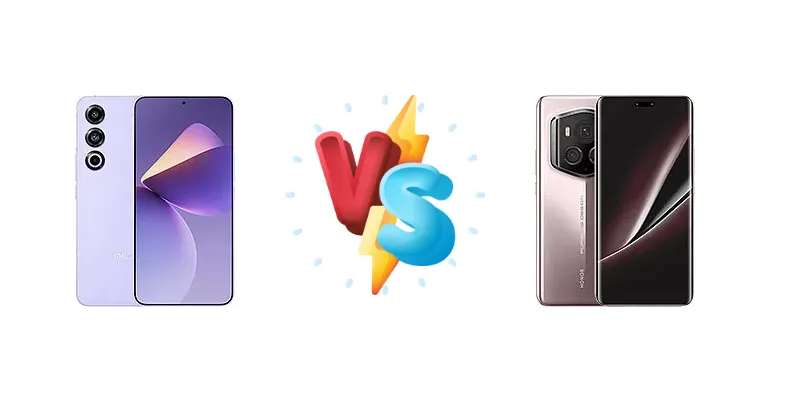
|
🏆 Quick Verdict
For the average user prioritizing battery life and convenience, the Honor Magic6 RSR Porsche Design is the superior choice. Its 14:14 active use battery score and inclusion of 66W wireless charging significantly outweigh the Meizu 21’s slightly more affordable price point. However, the Meizu 21 remains a compelling option for those seeking a clean software experience.
| PHONES | ||
|---|---|---|
| Phone Names | Meizu 21 | Honor Magic6 RSR Porsche Design |
| Network | ||
|---|---|---|
| 2G bands | GSM 850 / 900 / 1800 / 1900 | GSM 850 / 900 / 1800 / 1900 |
| 3G bands | HSDPA 850 / 900 / 1700(AWS) / 2100 | HSDPA 800 / 850 / 900 / 1700(AWS) / 1900 / 2100 |
| 4G bands | 1, 3, 4, 5, 7, 8, 18, 19, 26, 28, 34, 38, 39, 40, 41 | LTE |
| 5G bands | 1, 3, 5, 8, 28, 38, 41, 77, 78 SA/NSA | SA/NSA |
| Speed | HSPA, LTE, 5G | HSPA, LTE, 5G |
| Technology | GSM / HSPA / LTE / 5G | GSM / CDMA / HSPA / CDMA2000 / LTE / 5G |
| Launch | ||
|---|---|---|
| Announced | 2023, November 30 | 2024, March 18 |
| Status | Available. Released 2023, November 30 | Available. Released 2024, March 22 |
| Body | ||
|---|---|---|
| Build | Glass front, glass back, aluminum frame | Glass front (NanoCrystal Shield), glass back (NanoCrystal Shield), titanium frame |
| Dimensions | 156.7 x 75.3 x 7.9 mm (6.17 x 2.96 x 0.31 in) | 162.5 x 75.8 x 8.9 mm (6.40 x 2.98 x 0.35 in) |
| SIM | Nano-SIM + Nano-SIM | · Nano-SIM + eSIM· Nano-SIM + Nano-SIM |
| Weight | 198 g (6.98 oz) | 237 g (8.36 oz) |
| Display | ||
|---|---|---|
| Protection | - | NanoCrystal Shield |
| Resolution | 1080 x 2340 pixels, 19.5:9 ratio (~393 ppi density) | 1280 x 2800 pixels, 19.5:9 ratio (~453 ppi density) |
| Size | 6.55 inches, 105.3 cm2 (~89.3% screen-to-body ratio) | 6.8 inches, 112.8 cm2 (~91.6% screen-to-body ratio) |
| Type | AMOLED, 120Hz, HDR10+, 600 nits (typ), 1100 nits (HBM), 1800 nits (peak) | LTPO OLED, 1B colors, 120Hz, Dolby Vision, HDR, 1800 nits (HBM), 5000 nits (peak) |
| Platform | ||
|---|---|---|
| CPU | Octa-core (1x3.3 GHz Cortex-X4 & 3x3.2 GHz Cortex-A720 & 2x3.0 GHz Cortex-A720 & 2x2.3 GHz Cortex-A520) | Octa-core (1x3.3 GHz Cortex-X4 & 3x3.2 GHz Cortex-A720 & 2x3.0 GHz Cortex-A720 & 2x2.3 GHz Cortex-A520) |
| Chipset | Qualcomm SM8650-AB Snapdragon 8 Gen 3 (4 nm) | Qualcomm SM8650-AB Snapdragon 8 Gen 3 (4 nm) |
| GPU | Adreno 750 | Adreno 750 |
| OS | Android 13, Flyme 10.5 | Android 14, MagicOS 8 |
| Memory | ||
|---|---|---|
| Card slot | No | No |
| Internal | 256GB 8GB RAM, 256GB 12GB RAM, 512GB 12GB RAM | 1TB 24GB RAM |
| Main Camera | ||
|---|---|---|
| Features | Ring-LED flash, panorama, HDR | Color spectrum sensor, LED flash, HDR, panorama |
| Triple | 200 MP, f/1.7, 22mm (wide), 1/1.4", PDAF, OIS 13 MP, f/2.4, 15mm, 122˚ (ultrawide), 1/3.1" 5 MP, f/2.4, 27mm (wide), 1/5.0" | 50 MP, f/1.4-2.0, 23mm (wide), 1/1.3", LiDAR AF, PDAF, OIS 180 MP, f/2.6, (periscope telephoto), 1/1.49", 0.56µm, PDAF, OIS, 2.5x optical zoom 50 MP, f/2.0, 13mm, 122˚ (ultrawide), 1/2.88", AF |
| Video | 8K@30fps, 4K@30/60fps, 1080p@30/60fps, gyro-EIS | 4K@24/30/60fps, 1080p@30/60/120/240fps, gyro-EIS, OIS, HDR, 10-bit video |
| Selfie camera | ||
|---|---|---|
| Features | HDR | - |
| Single | 32 MP, f/2.4, (wide), 1/3.1" | 50 MP, f/2.0, 22mm (wide), 1/2.93", AF TOF 3D, (depth/biometrics sensor) |
| Video | 4K@30/60fps, 1080p@30/60fps, gyro-EIS | 4K@30fps, 1080p@30/60fps, gyro-EIS |
| Sound | ||
|---|---|---|
| 35mm jack | No | No |
| Loudspeaker | Yes, with stereo speakers | Yes, with stereo speakers |
| Comms | ||
|---|---|---|
| Bluetooth | 5.4, A2DP, LE | 5.3, A2DP, LE, aptX HD |
| Infrared port | Yes | Yes |
| NFC | Yes | Yes |
| Positioning | GPS (L1+L5), GLONASS (G1), BDS (B1I+B1c+B2a), GALILEO (E1+E5a), QZSS (L1+L5), NavIC (L5) | GPS (L1+L5), GLONASS, BDS (B1I+B1c+B2a), GALILEO (E1+E5a) |
| Radio | No | No |
| USB | USB Type-C, OTG | USB Type-C 3.2, DisplayPort 1.2, OTG |
| WLAN | Wi-Fi 802.11 а/b/g/n/ac/6e/7, dual-band | Wi-Fi 802.11 a/b/g/n/ac/6/7, dual-band, Wi-Fi Direct |
| Features | ||
|---|---|---|
| Sensors | Fingerprint (under display, ultrasonic), accelerometer, gyro, proximity, compass | Fingerprint (under display, optical), Face ID, accelerometer, gyro, proximity, compass |
| Battery | ||
|---|---|---|
| Charging | 80W wired, PD3 PPS, QC4+ | 80W wired 66W wireless Reverse wireless 5W reverse wired |
| Type | 4800 mAh | Si/C Li-Ion 5600 mAh |
| Misc | ||
|---|---|---|
| Colors | Black, Purple, Green, White | Agate Grey, Frozen Berry |
| Models | - | BVL-N59, BVL-AN20 |
| Price | About 440 EUR | About 3020 EUR |
Meizu 21
- Potentially more affordable price point
- Clean software experience (assumed based on Meizu’s history)
- Fast 80W wired charging
- Battery life likely inferior to the Honor
- No wireless charging
- Camera specifications unknown
Honor Magic6 RSR Porsche Design
- Exceptional 14:14 hour battery life
- 66W wireless charging and reverse charging
- Ultra-bright 1731 nit display
- Higher price due to Porsche Design branding
- Potential for software bloat (Honor’s history)
- Larger size and weight (likely)
Display Comparison
Both devices utilize the Qualcomm Snapdragon 8 Gen 3, but the Honor Magic6 RSR boasts a significantly brighter display, reaching a measured peak of 1731 nits. This is crucial for outdoor visibility, offering a far superior experience in direct sunlight compared to the Meizu 21 (brightness data unavailable). While both likely employ high refresh rate panels, the Honor’s brightness advantage is a clear differentiator. The Porsche Design model’s display is geared towards users who consume a lot of media outdoors or in brightly lit environments.
Camera Comparison
Camera specifications are not provided for the Meizu 21, making a direct comparison difficult. However, the Honor Magic6 RSR Porsche Design is expected to feature a high-end camera system befitting its price point. The focus should be on the main sensor size, aperture, and optical image stabilization (OIS) capabilities. Without detailed camera specs for the Meizu 21, it’s difficult to assess its image quality relative to the Honor. We can assume the Honor will offer more advanced computational photography features, leveraging the Snapdragon 8 Gen 3’s ISP.
Performance
Both the Meizu 21 and the Honor Magic6 RSR Porsche Design are equipped with the Qualcomm SM8650-AB Snapdragon 8 Gen 3 (4 nm) chipset, featuring the same Octa-core CPU configuration (1x3.3 GHz Cortex-X4, 3x3.2 GHz Cortex-A720, 2x3.0 GHz Cortex-A720, 2x2.3 GHz Cortex-A520). This means raw processing power will be nearly identical. However, sustained performance will depend on thermal management, a metric not provided. The Honor’s larger battery *could* contribute to better thermal headroom under prolonged load, but this requires independent testing. Both devices likely utilize LPDDR5x RAM, further minimizing performance bottlenecks.
Battery Life
The Honor Magic6 RSR Porsche Design clearly wins in battery endurance with a reported 14:14 hours of active use. While the Meizu 21’s battery capacity is unknown, the Honor’s longevity is a significant advantage. Both support 80W wired charging, offering rapid replenishment. However, the Honor adds 66W wireless charging and 5W reverse wired charging, providing unparalleled convenience. The inclusion of wireless charging caters to users who prefer a cable-free lifestyle, while reverse wireless charging can top up accessories like earbuds.
Buying Guide
Buy the Meizu 21 if you prioritize a clean, minimalist software experience and are comfortable with relying on wired charging. It’s ideal for users who frequently top up their phones throughout the day. Buy the Honor Magic6 RSR Porsche Design if you value all-day battery life, the convenience of wireless charging, and a premium design aesthetic, even if it comes at a higher cost. This phone suits power users and travelers who need reliable performance without constantly seeking an outlet.