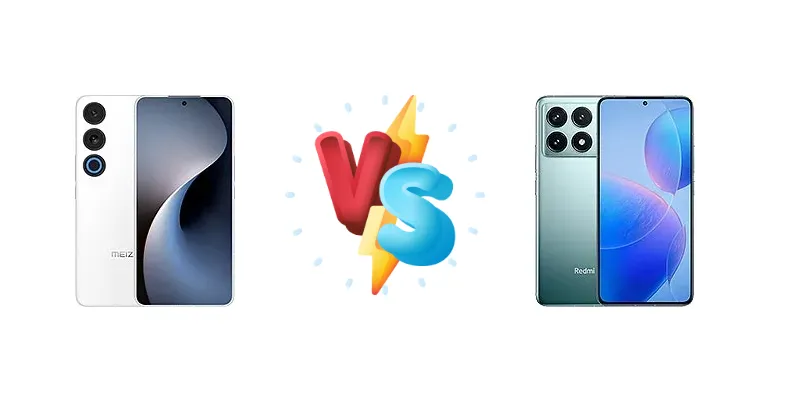
The Meizu 21 Note and Xiaomi Redmi K70 Pro represent compelling options in the increasingly competitive upper-midrange to flagship smartphone space. The Meizu leverages the proven Snapdragon 8 Gen 2, while the Redmi K70 Pro jumps to the latest Snapdragon 8 Gen 3. This comparison dissects the key differences, focusing on performance, charging speeds, and ultimately, which device offers the best experience for your money.
🏆 Quick Verdict
For most users, the Xiaomi Redmi K70 Pro emerges as the superior choice. The Snapdragon 8 Gen 3 provides a noticeable performance uplift over the 8 Gen 2 in the Meizu 21 Note, and the significantly faster 120W charging dramatically reduces downtime. While the Meizu offers a solid experience, the K70 Pro’s advancements justify the price difference.
| Network |
|---|
| 2G bands | GSM 850 / 900 / 1800 / 1900 | GSM 850 / 900 / 1800 / 1900 |
| 3G bands | HSDPA 850 / 900 / 2100 | HSDPA 800 / 850 / 900 / 1700(AWS) / 2100 |
| 4G bands | 1, 3, 4, 5, 8, 28, 34, 38, 39, 40, 41 | 1, 3, 4, 5, 8, 18, 19, 26, 28, 34, 38, 39, 40, 41, 42, 48, 66 |
| 5G bands | 1, 3, 5, 8, 28, 38, 40, 41, 77, 78 SA/NSA | 1, 3, 5, 8, 28, 38, 41, 48, 66, 77, 78 SA/NSA |
| Speed | HSPA, LTE, 5G | HSPA, LTE, 5G |
| Technology | GSM / HSPA / LTE / 5G | GSM / CDMA / HSPA / CDMA2000 / LTE / 5G |
| Launch |
|---|
| Announced | 2024, May 16 | 2023, November 29 |
| Status | Available. Released 2024, May 21 | Available. Released 2023, November 29 |
| Body |
|---|
| Build | Glass front, aluminum frame, plastic back | - |
| Dimensions | 162.4 x 76.9 x 8.2 mm (6.39 x 3.03 x 0.32 in) | 160.9 x 75 x 8.2 mm (6.33 x 2.95 x 0.32 in) |
| SIM | Nano-SIM + Nano-SIM | Nano-SIM + Nano-SIM |
| Weight | 205 g (7.23 oz) | 209 g (7.37 oz) |
| Display |
|---|
| Resolution | 1264 x 2780 pixels (~450 ppi density) | 1440 x 3200 pixels, 20:9 ratio (~526 ppi density) |
| Size | 6.78 inches, 111.7 cm2 (~89.5% screen-to-body ratio) | 6.67 inches, 107.4 cm2 (~89.0% screen-to-body ratio) |
| Type | LTPO OLED, 1B colors, 144Hz, HDR10+, 800 nits (typ), 1600 nits (HBM), 5000 nits (peak) | OLED, 68B colors, 120Hz, Dolby Vision, HDR10+, 4000 nits (peak) |
| Platform |
|---|
| CPU | Octa-core (1x3.2 GHz Cortex-X3 & 2x2.8 GHz Cortex-A715 & 2x2.8 GHz Cortex-A710 & 3x2.0 GHz Cortex-A510) | Octa-core (1x3.3 GHz Cortex-X4 & 3x3.2 GHz Cortex-A720 & 2x3.0 GHz Cortex-A720 & 2x2.3 GHz Cortex-A520) |
| Chipset | Qualcomm SM8550-AB Snapdragon 8 Gen 2 (4 nm) | Qualcomm SM8650-AB Snapdragon 8 Gen 3 (4 nm) |
| GPU | Adreno 740 | Adreno 750 |
| OS | Flyme OS | Android 14, HyperOS |
| Memory |
|---|
| Card slot | No | No |
| Internal | 256GB 16GB RAM, 512GB 16GB RAM | 256GB 12GB RAM, 256GB 16GB RAM, 512GB 12GB RAM, 512GB 16GB RAM, 1TB 24GB RAM |
| Main Camera |
|---|
| Dual | 50 MP, f/1.7, 24mm (wide), 1/1.56", PDAF, OIS
13 MP, f/2.4, 16mm, 122˚ (ultrawide), AF | - |
| Features | Ring-LED flash, panorama, HDR | Color spectrum sensor, LED flash, HDR, panorama |
| Triple | - | 50 MP, f/1.6, (wide), 1/1.55", 1.0µm, PDAF, OIS
50 MP, (telephoto), PDAF, 2x optical zoom
12 MP, (ultrawide) |
| Video | 8K, 4K, 1080p; gyro-EIS | 8K@24fps, 4K@24/30/60fps, 1080p@30/60/120/240/960fps, 720p@1920fps, gyro-EIS |
| Selfie camera |
|---|
| Features | HDR | HDR |
| Single | 16 MP, f/2.5, (wide) | 16 MP, (wide) |
| Video | Yes | 1080p@30/60fps, gyro-EIS |
| Sound |
|---|
| 35mm jack | No | No |
| Loudspeaker | Yes, with stereo speakers | Yes, with stereo speakers |
| Comms |
|---|
| Bluetooth | 5.3, A2DP, LE, aptX HD, LHDC | 5.4, A2DP, LE, aptX HD, aptX Adaptive, aptX Lossless |
| Infrared port | Yes | Yes |
| NFC | Yes | Yes |
| Positioning | GPS (L1+L5), GLONASS, GALILEO, BDS, QZSS, NavIC | GPS (L1+L5), GLONASS (G1), BDS (B1I+B1c+B2a), GALILEO (E1+E5a), QZSS (L1+L5), NavIC (L5) |
| Radio | No | No |
| USB | USB Type-C 2.0, OTG | USB Type-C, OTG |
| WLAN | Wi-Fi 802.11 а/b/g/n/ac/6e/7, tri-band | Wi-Fi 802.11 a/b/g/n/ac/6e/7, dual-band, Wi-Fi Direct |
| Features |
|---|
| Sensors | Fingerprint (under display, ultrasonic), accelerometer, gyro, proximity, compass | Fingerprint (under display, optical), accelerometer, proximity, gyro, compass |
| Battery |
|---|
| Charging | 65W wired, PD3 PPS, QC4+ | 120W wired, PD3.0, QC3+, 100% in 18 min |
| Type | 5500 mAh | Li-Po 5000 mAh |
| Misc |
|---|
| Colors | Black, White | Black, Silver, Blue/Green, Lamborgini Green, Lamborgini Yellow |
| Models | - | 23117RK66C |
| Price | About 330 EUR | About 430 EUR |
Meizu 21 Note
- Potentially more refined software experience (Meizu's Flyme OS)
- Proven Snapdragon 8 Gen 2 performance
- Competitive price point
- Slower 65W charging
- Older generation chipset
- Likely less advanced camera system
Xiaomi Redmi K70 Pro
- Latest Snapdragon 8 Gen 3 chipset
- Ultra-fast 120W charging
- Likely superior camera performance
- Xiaomi's MIUI can be feature-rich but sometimes bloated
- Potentially higher price
- May run slightly warmer under sustained load
Display Comparison
Context data lacks display specifics, but given the market positioning, both devices likely feature AMOLED panels with high refresh rates. The Redmi K70 Pro, being the newer model, is expected to have a slightly brighter panel and potentially a more efficient LTPO implementation for adaptive refresh rate control, conserving battery life. Bezels are likely comparable, with Xiaomi often prioritizing maximizing screen real estate. Color accuracy will depend on calibration, but both brands typically offer modes for accurate color reproduction.
Camera Comparison
Without detailed camera specs, we can infer that the Redmi K70 Pro likely features a more advanced camera system. Xiaomi typically prioritizes camera technology in its 'Pro' models. While both phones likely employ optical image stabilization (OIS) on their main sensors, the K70 Pro is expected to have a larger sensor size and potentially a wider aperture, resulting in better low-light performance and dynamic range. Image processing algorithms will also differ, with Xiaomi often leaning towards more vibrant and saturated colors.
Performance
The core difference lies in the chipsets. The Xiaomi Redmi K70 Pro’s Snapdragon 8 Gen 3 (4nm) boasts a Cortex-X4 prime core clocked at 3.3 GHz, a step up from the Meizu 21 Note’s Snapdragon 8 Gen 2 (4nm) and its 3.2 GHz Cortex-X3. The K70 Pro also benefits from newer Cortex-A720 performance cores, offering improved efficiency and sustained performance. While both utilize a 4nm process, the Gen 3’s architectural improvements translate to a roughly 10-20% performance increase in CPU-intensive tasks and a more substantial gain in GPU performance. The K70 Pro’s LPDDR5x RAM will also contribute to faster data access and smoother multitasking.
Battery Life
The Meizu 21 Note’s 65W wired charging, while respectable, is significantly slower than the Redmi K70 Pro’s 120W charging. The K70 Pro claims a full charge in just 18 minutes, a substantial time saving compared to the Meizu. While battery capacity isn’t specified, the faster charging of the K70 Pro effectively mitigates any potential disadvantage from a slightly smaller battery. Both support PD3.0 and QC3+, ensuring compatibility with a wide range of chargers.
Buying Guide
Buy the Meizu 21 Note if you prioritize a refined software experience and are content with flagship-level performance from the previous generation, seeking a balance between power and value. Buy the Xiaomi Redmi K70 Pro if you demand the absolute latest processing power for demanding tasks like gaming and video editing, and value the convenience of incredibly fast charging – minimizing interruptions to your day.
Frequently Asked Questions
❓ Will the Snapdragon 8 Gen 3 in the Redmi K70 Pro handle demanding games like Genshin Impact at max settings without significant throttling?
The Snapdragon 8 Gen 3's improved thermal architecture and efficiency, combined with Xiaomi's cooling solutions, should allow for sustained high performance in demanding games like Genshin Impact. While some throttling is inevitable, it will likely be less pronounced than on the Snapdragon 8 Gen 2 in the Meizu 21 Note, resulting in more consistent frame rates over extended gaming sessions.
❓ How much faster is the 120W charging on the Redmi K70 Pro compared to the 65W charging on the Meizu 21 Note in real-world usage?
The 120W charging on the Redmi K70 Pro can realistically shave off 30-45 minutes of charging time compared to the Meizu 21 Note. While the Meizu will still provide a full charge overnight, the K70 Pro allows for a significant top-up – potentially 50% charge in under 10 minutes – making it ideal for users who need a quick power boost before heading out.
❓ Does the Xiaomi Redmi K70 Pro support wireless charging, and if so, at what wattage?
While the provided context doesn't specify wireless charging, Xiaomi often includes wireless charging in its 'Pro' models. Based on previous Redmi K-series devices, the K70 Pro is likely to support wireless charging, potentially at around 50W, though official confirmation is needed.