
Meizu 21 Note vs. vivo iQOO 12 Pro: A Deep Dive into Snapdragon Power and Charging Speed
| Phones Images | |||||
|---|---|---|---|---|---|
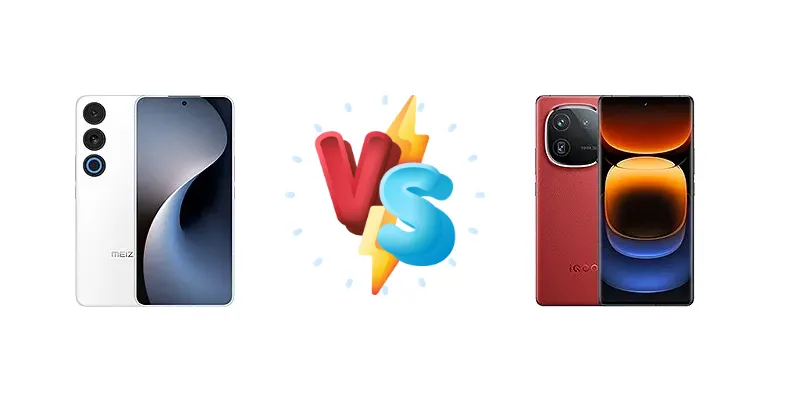
|
🏆 Quick Verdict
For most users, the vivo iQOO 12 Pro is the superior choice. The Snapdragon 8 Gen 3 offers a noticeable performance uplift, and the significantly faster 120W charging and 50W wireless charging capabilities provide a more convenient experience. However, the Meizu 21 Note remains a strong contender for budget-conscious users prioritizing value.
| PHONES | ||
|---|---|---|
| Phone Names | Meizu 21 Note | vivo iQOO 12 Pro |
| Network | ||
|---|---|---|
| 2G bands | GSM 850 / 900 / 1800 / 1900 | GSM 850 / 900 / 1800 / 1900 |
| 3G bands | HSDPA 850 / 900 / 2100 | HSDPA 800 / 850 / 900 / 1700(AWS) / 1900 / 2100 |
| 4G bands | 1, 3, 4, 5, 8, 28, 34, 38, 39, 40, 41 | 1, 2, 3, 4, 5, 7, 8, 12, 17, 18, 19, 20, 25, 26, 28, 34, 38, 39, 40, 41, 42, 66 |
| 5G bands | 1, 3, 5, 8, 28, 38, 40, 41, 77, 78 SA/NSA | 1, 2, 3, 5, 7, 8, 12, 20, 25, 26, 28, 66, 38, 40, 41, 77, 78 SA/NSA |
| Speed | HSPA, LTE, 5G | HSPA, LTE, 5G |
| Technology | GSM / HSPA / LTE / 5G | GSM / CDMA / HSPA / CDMA2000 / LTE / 5G |
| Launch | ||
|---|---|---|
| Announced | 2024, May 16 | 2023, November 07 |
| Status | Available. Released 2024, May 21 | Available. Released 2023, November 14 |
| Body | ||
|---|---|---|
| Build | Glass front, aluminum frame, plastic back | - |
| Dimensions | 162.4 x 76.9 x 8.2 mm (6.39 x 3.03 x 0.32 in) | 164.6 x 75.4 x 8.6 mm or 8.8 mm |
| SIM | Nano-SIM + Nano-SIM | Nano-SIM + Nano-SIM |
| Weight | 205 g (7.23 oz) | 205 g or 210 g (7.23 oz) |
| Display | ||
|---|---|---|
| Resolution | 1264 x 2780 pixels (~450 ppi density) | 1440 x 3200 pixels, 20:9 ratio (~518 ppi density) |
| Size | 6.78 inches, 111.7 cm2 (~89.5% screen-to-body ratio) | 6.78 inches, 111.0 cm2 (~89.4% screen-to-body ratio) |
| Type | LTPO OLED, 1B colors, 144Hz, HDR10+, 800 nits (typ), 1600 nits (HBM), 5000 nits (peak) | LTPO AMOLED, 1B colors, 144Hz, HDR10+, 1600 nits (HBM), 3000 nits (peak) |
| Platform | ||
|---|---|---|
| CPU | Octa-core (1x3.2 GHz Cortex-X3 & 2x2.8 GHz Cortex-A715 & 2x2.8 GHz Cortex-A710 & 3x2.0 GHz Cortex-A510) | Octa-core (1x3.3 GHz Cortex-X4 & 3x3.2 GHz Cortex-A720 & 2x3.0 GHz Cortex-A720 & 2x2.3 GHz Cortex-A520) |
| Chipset | Qualcomm SM8550-AB Snapdragon 8 Gen 2 (4 nm) | Qualcomm SM8650-AB Snapdragon 8 Gen 3 (4 nm) |
| GPU | Adreno 740 | Adreno 750 |
| OS | Flyme OS | Android 14, up to 2 major Android upgrades, Funtouch 14 (International), OriginOS 4 (China) |
| Memory | ||
|---|---|---|
| Card slot | No | No |
| Internal | 256GB 16GB RAM, 512GB 16GB RAM | 256GB 16GB RAM, 512GB 16GB RAM, 1TB 16GB RAM |
| Main Camera | ||
|---|---|---|
| Dual | 50 MP, f/1.7, 24mm (wide), 1/1.56", PDAF, OIS 13 MP, f/2.4, 16mm, 122˚ (ultrawide), AF | - |
| Features | Ring-LED flash, panorama, HDR | Color spectrum sensor, Dual-LED flash, HDR, panorama |
| Triple | - | 50 MP, f/1.7, 23mm (wide), 1/1.3", 1.2µm, ulti-directional PDAF, OIS 64 MP, f/2.6, 70mm (periscope telephoto), 1/2.0", PDAF, OIS, 3x optical zoom 50 MP, f/2.0, 15mm, 119˚ (ultrawide), AF |
| Video | 8K, 4K, 1080p; gyro-EIS | 8K@30fps, 4K@24/30/60fps, 1080p@30/60/120/240fps, gyro-EIS |
| Selfie camera | ||
|---|---|---|
| Features | HDR | HDR |
| Single | 16 MP, f/2.5, (wide) | 16 MP, f/2.5, (wide) |
| Video | Yes | 1080p@30fps, gyro-EIS |
| Sound | ||
|---|---|---|
| 35mm jack | No | No |
| Loudspeaker | Yes, with stereo speakers | Yes, with stereo speakers |
| Comms | ||
|---|---|---|
| Bluetooth | 5.3, A2DP, LE, aptX HD, LHDC | 5.4, A2DP, LE, aptX HD, aptX Adaptive, aptX Lossless |
| Infrared port | Yes | Yes |
| NFC | Yes | Yes |
| Positioning | GPS (L1+L5), GLONASS, GALILEO, BDS, QZSS, NavIC | GPS (L1+L5), GLONASS (G1), BDS (B1I+B1c+B2a), GALILEO (E1+E5a), QZSS (L1+L5) |
| Radio | No | No |
| USB | USB Type-C 2.0, OTG | USB Type-C 2.0, OTG |
| WLAN | Wi-Fi 802.11 а/b/g/n/ac/6e/7, tri-band | Wi-Fi 802.11 a/b/g/n/ac/6/7, tri-band, Wi-Fi Direct |
| Features | ||
|---|---|---|
| Sensors | Fingerprint (under display, ultrasonic), accelerometer, gyro, proximity, compass | Fingerprint (under display, ultrasonic), accelerometer, gyro, proximity, compass |
| Battery | ||
|---|---|---|
| Charging | 65W wired, PD3 PPS, QC4+ | 120W wired 50W wireless 10W reverse wireless |
| Type | 5500 mAh | 5100 mAh |
| Misc | ||
|---|---|---|
| Colors | Black, White | Black, Red, White (BMW M branding) |
| Models | - | V2329A |
| Price | About 330 EUR | About 650 EUR |
Meizu 21 Note
- Excellent value for money with flagship-level performance.
- Efficient Snapdragon 8 Gen 2 chipset.
- Respectable 65W wired charging.
- Slower charging compared to the iQOO 12 Pro.
- Potentially less advanced camera system.
vivo iQOO 12 Pro
- Cutting-edge Snapdragon 8 Gen 3 performance.
- Blazing-fast 120W wired and 50W wireless charging.
- Likely superior camera system with advanced features.
- Higher price point.
- Potentially more aggressive thermal throttling under sustained load.
Display Comparison
While specific display details are absent, both phones likely feature high refresh rate AMOLED panels. The iQOO 12 Pro, positioned as a premium device, likely boasts a higher peak brightness and potentially a more sophisticated LTPO implementation for adaptive refresh rates, improving battery efficiency. Meizu typically focuses on color accuracy, so expect a well-calibrated display, but the iQOO 12 Pro likely has the edge in overall visual fidelity and dynamic range.
Camera Comparison
Without detailed camera specs, it’s difficult to make a definitive judgment. However, given the iQOO 12 Pro’s positioning, it likely features a more advanced camera system with a larger main sensor and more sophisticated image processing algorithms. The iQOO 12 Pro is likely to offer better low-light performance and more versatile zoom capabilities. Meizu typically prioritizes natural-looking images, while iQOO often leans towards more vibrant, saturated colors. The absence of details on OIS is a key missing piece of information.
Performance
The core difference lies in the chipsets. The iQOO 12 Pro’s Snapdragon 8 Gen 3 (4nm) represents a significant architectural leap over the Meizu 21 Note’s Snapdragon 8 Gen 2 (4nm). The Gen 3 features the newer Cortex-X4 prime core clocked at 3.3 GHz, compared to the Gen 2’s 3.2 GHz Cortex-X3. Furthermore, the Gen 3 utilizes a revised CPU configuration with more Cortex-A720 cores, offering improved multi-core performance. This translates to faster app loading, smoother multitasking, and higher sustained frame rates in demanding games. Both utilize LPDDR5x RAM, but the Gen 3’s improved memory controller will likely yield better bandwidth. The iQOO 12 Pro will also benefit from a more advanced thermal solution to handle the increased power draw.
Battery Life
The iQOO 12 Pro’s charging capabilities are a standout feature. Its 120W wired charging dwarfs the Meizu 21 Note’s 65W, allowing for a significantly faster 0-100% charge time. The addition of 50W wireless charging and 10W reverse wireless charging further enhances the iQOO 12 Pro’s convenience. While the Meizu 21 Note’s 65W charging is still respectable, the iQOO 12 Pro offers a much quicker top-up. Battery capacity is not specified, but the iQOO 12 Pro’s faster charging mitigates the impact of a potentially smaller battery.
Buying Guide
Buy the Meizu 21 Note if you need a capable flagship experience without breaking the bank, and are comfortable with slightly slower charging speeds. It’s ideal for everyday users and casual gamers. Buy the vivo iQOO 12 Pro if you prioritize top-tier performance for demanding games and applications, and value the convenience of incredibly fast wired and wireless charging. This phone is geared towards power users and mobile gaming enthusiasts.