
Meizu 21 Note vs. Samsung Galaxy S24 FE: Which Android Flagship Delivers More?
| Phones Images | |||||
|---|---|---|---|---|---|
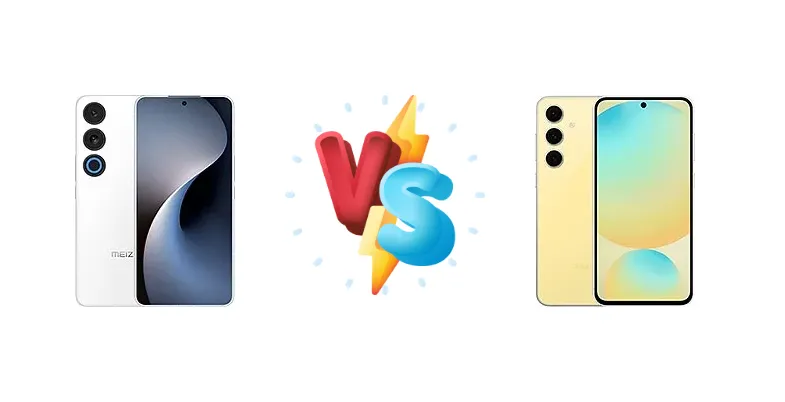
|
🏆 Quick Verdict
For the average user prioritizing long-term battery life and a well-rounded experience, the Samsung Galaxy S24 FE is the better choice. Its 42-hour endurance and robust feature set outweigh the Meizu 21 Note’s raw processing power. However, gamers and power users will appreciate the Meizu’s Snapdragon 8 Gen 2.
| PHONES | ||
|---|---|---|
| Phone Names | Meizu 21 Note | Samsung Galaxy S24 FE |
| Network | ||
|---|---|---|
| 2G bands | GSM 850 / 900 / 1800 / 1900 | GSM 850 / 900 / 1800 / 1900 |
| 3G bands | HSDPA 850 / 900 / 2100 | HSDPA 850 / 900 / 1700(AWS) / 1900 / 2100 |
| 4G bands | 1, 3, 4, 5, 8, 28, 34, 38, 39, 40, 41 | 1, 2, 3, 4, 5, 7, 8, 12, 17, 18, 19, 20, 25, 26, 28, 32, 38, 40, 41, 66 - International |
| 5G bands | 1, 3, 5, 8, 28, 38, 40, 41, 77, 78 SA/NSA | 1, 2, 3, 5, 7, 8, 12, 20, 25, 26, 28, 38, 40, 41, 66, 75, 77, 78 SA/NSA/Sub6 - International |
| Speed | HSPA, LTE, 5G | HSPA, LTE, 5G |
| Technology | GSM / HSPA / LTE / 5G | GSM / HSPA / LTE / 5G |
| Launch | ||
|---|---|---|
| Announced | 2024, May 16 | 2024, September 26 |
| Status | Available. Released 2024, May 21 | Available. Released 2024, October 03 |
| Body | ||
|---|---|---|
| Build | Glass front, aluminum frame, plastic back | Glass front (Gorilla Glass Victus+), glass back (Gorilla Glass Victus+), aluminum frame |
| Dimensions | 162.4 x 76.9 x 8.2 mm (6.39 x 3.03 x 0.32 in) | 162 x 77.3 x 8 mm (6.38 x 3.04 x 0.31 in) |
| SIM | Nano-SIM + Nano-SIM | · Nano-SIM· Nano-SIM + Nano-SIM· Nano-SIM + eSIM· eSIM + eSIM |
| Weight | 205 g (7.23 oz) | 213 g (7.51 oz) |
| Display | ||
|---|---|---|
| Protection | - | Corning Gorilla Glass Victus+, Mohs level 5 |
| Resolution | 1264 x 2780 pixels (~450 ppi density) | 1080 x 2340 pixels, 19.5:9 ratio (~385 ppi density) |
| Size | 6.78 inches, 111.7 cm2 (~89.5% screen-to-body ratio) | 6.7 inches, 110.2 cm2 (~88.0% screen-to-body ratio) |
| Type | LTPO OLED, 1B colors, 144Hz, HDR10+, 800 nits (typ), 1600 nits (HBM), 5000 nits (peak) | Dynamic AMOLED 2X, 120Hz, HDR10+, 1900 nits (peak) |
| Platform | ||
|---|---|---|
| CPU | Octa-core (1x3.2 GHz Cortex-X3 & 2x2.8 GHz Cortex-A715 & 2x2.8 GHz Cortex-A710 & 3x2.0 GHz Cortex-A510) | 10-core (1x3.1 GHz + 2x2.9 GHz + 3x2.6 GHz + 4x1.95 GHz) |
| Chipset | Qualcomm SM8550-AB Snapdragon 8 Gen 2 (4 nm) | Exynos 2400e (4 nm) |
| GPU | Adreno 740 | Xclipse 940 |
| OS | Flyme OS | Android 14, up to 7 major Android upgrades, One UI 8.0 |
| Memory | ||
|---|---|---|
| Card slot | No | No |
| Internal | 256GB 16GB RAM, 512GB 16GB RAM | 128GB 8GB RAM, 256GB 8GB RAM, 512GB 8GB RAM |
| Main Camera | ||
|---|---|---|
| Dual | 50 MP, f/1.7, 24mm (wide), 1/1.56", PDAF, OIS 13 MP, f/2.4, 16mm, 122˚ (ultrawide), AF | - |
| Features | Ring-LED flash, panorama, HDR | LED flash, HDR, panorama |
| Triple | - | 50 MP, f/1.8, 24mm (wide), 1/1.57", 1.0µm, dual pixel PDAF, OIS 8 MP, f/2.4, 75mm (telephoto), 1/4.4", 1.0µm, PDAF, OIS, 3x optical zoom 12 MP, f/2.2, 13mm, 123˚ (ultrawide), 1/3.0", 1.12µm |
| Video | 8K, 4K, 1080p; gyro-EIS | 8K@30fps, 4K@30/60/120fps, 1080p@30/60/120/240fps |
| Selfie camera | ||
|---|---|---|
| Features | HDR | - |
| Single | 16 MP, f/2.5, (wide) | 10 MP, f/2.4, 26mm (wide), 1/3.0", 1.22µm |
| Video | Yes | 4K@30/60fps, 1080p@30/60fps; gyro-EIS |
| Sound | ||
|---|---|---|
| 35mm jack | No | No |
| Loudspeaker | Yes, with stereo speakers | Yes, with stereo speakers |
| Comms | ||
|---|---|---|
| Bluetooth | 5.3, A2DP, LE, aptX HD, LHDC | 5.3, A2DP, LE |
| Infrared port | Yes | - |
| NFC | Yes | Yes |
| Positioning | GPS (L1+L5), GLONASS, GALILEO, BDS, QZSS, NavIC | GPS, GLONASS, GALILEO, BDS |
| Radio | No | Unspecified |
| USB | USB Type-C 2.0, OTG | USB Type-C 3.2, OTG |
| WLAN | Wi-Fi 802.11 а/b/g/n/ac/6e/7, tri-band | Wi-Fi 802.11 a/b/g/n/ac/6e, dual-band or tri-band (market/region dependent), Wi-Fi Direct |
| Features | ||
|---|---|---|
| Sensors | Fingerprint (under display, ultrasonic), accelerometer, gyro, proximity, compass | Fingerprint (under display, optical), accelerometer, gyro, compass |
| Battery | ||
|---|---|---|
| Charging | 65W wired, PD3 PPS, QC4+ | 25W wired, PD, QC2, 50% in 30 min 15W wireless Reverse wireless |
| Type | 5500 mAh | 4700 mAh |
| Misc | ||
|---|---|---|
| Colors | Black, White | Blue, Graphite, Gray, Mint, Yellow |
| Models | - | SM-S721B, SM-S721B/DS, SM-S721U1, SM-S721U, SM-S721W, SM-S7210, SM-S721N |
| Price | About 330 EUR | $ 249.74 / C$ 498.99 / £ 335.00 / € 387.00 / ₹ 34,180 |
| SAR | - | 0.94 W/kg (head) 0.71 W/kg (body) |
| SAR EU | - | 0.86 W/kg (head) 1.29 W/kg (body) |
| EU LABEL | ||
|---|---|---|
| Battery | - | 42:00h endurance, 2000 cycles |
| Energy | - | Class B |
| Free fall | - | Class A (270 falls) |
| Repairability | - | Class C |
Meizu 21 Note
- Faster Snapdragon 8 Gen 2 processor
- 65W wired charging for rapid top-ups
- Potentially more affordable price point
- Battery life is unknown and likely shorter than S24 FE
- Less established brand and software support
Samsung Galaxy S24 FE
- Exceptional 42-hour battery endurance
- Brighter display for outdoor visibility
- Samsung’s robust software and ecosystem
- Exynos 2400e performance lags behind Snapdragon 8 Gen 2
- Slower 25W wired charging
Display Comparison
The Samsung Galaxy S24 FE boasts a significantly brighter display, reaching a measured 1372 nits. This is crucial for outdoor use where the Meizu 21 Note’s brightness is not specified, likely falling short. While panel technology isn’t detailed for either, Samsung’s history suggests a high-quality AMOLED. The S24 FE’s brightness advantage will translate to better readability in direct sunlight. We expect both to have similar resolutions, but the S24 FE’s brightness is a clear win.
Camera Comparison
Without detailed camera specs for the Meizu 21 Note, a direct comparison is difficult. However, the S24 FE’s camera system is expected to prioritize image processing and versatility. While sensor sizes are unknown, Samsung typically focuses on computational photography. The S24 FE’s image processing will likely deliver consistently good results in various lighting conditions. The Meizu will likely rely more on the raw capabilities of its sensor, which may require more user expertise to achieve optimal results. We can assume both phones will have a standard wide, ultrawide, and potentially a telephoto lens, but the S24 FE’s software optimization is a key advantage.
Performance
The Meizu 21 Note’s Qualcomm Snapdragon 8 Gen 2 (4nm) is a powerhouse, featuring an octa-core configuration with a prime Cortex-X3 core clocked at 3.2 GHz. This contrasts with the Samsung Galaxy S24 FE’s Exynos 2400e (4nm) 10-core setup. While the Exynos has more cores, the Snapdragon 8 Gen 2’s architecture is generally considered more efficient and delivers superior sustained performance. The Snapdragon’s Adreno GPU will likely outperform the Xclipse GPU in the Exynos, especially in graphically intensive games. The 4nm process node on both chips is similar, but the Snapdragon’s architecture gives it an edge in thermal management, reducing the likelihood of throttling during extended use.
Battery Life
The Samsung Galaxy S24 FE shines in battery endurance, offering a remarkable 42-hour endurance rating and an active use score of 11 hours and 48 minutes. This is a significant advantage over the Meizu 21 Note, whose battery capacity and endurance are not specified. The S24 FE also supports 25W wired charging, reaching 50% in 30 minutes, alongside 15W wireless and reverse wireless charging. The Meizu 21 Note’s 65W wired charging is considerably faster, but the S24 FE’s overall endurance and wireless charging options provide greater convenience.
Buying Guide
Buy the Meizu 21 Note if you need uncompromising performance for demanding tasks like gaming and video editing, and prioritize speed over all else. You'll benefit from the Snapdragon 8 Gen 2's efficiency and quick charging. Buy the Samsung Galaxy S24 FE if you prefer a phone with exceptional battery life, a brighter display for outdoor visibility, and the broader ecosystem of Samsung features and software support.