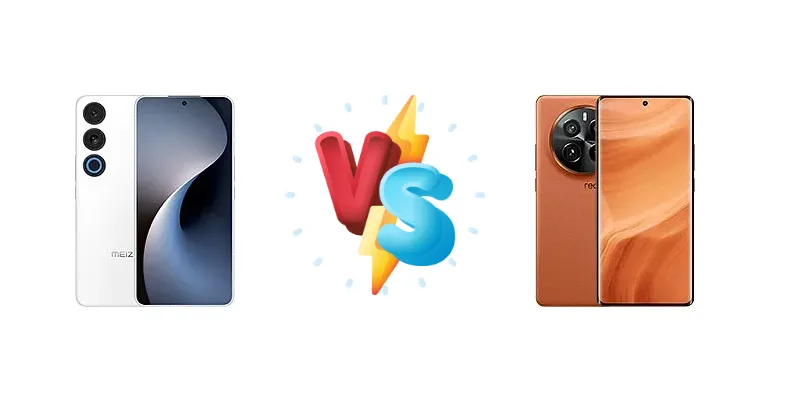
The Meizu 21 Note and Realme GT5 Pro represent distinct approaches to the flagship smartphone market. The Meizu offers a refined experience built around the Snapdragon 8 Gen 2, while the Realme GT5 Pro jumps to the latest Snapdragon 8 Gen 3, promising a significant performance leap. This comparison dissects their key differences to determine which device best suits your needs.
🏆 Quick Verdict
For most users, the Realme GT5 Pro emerges as the superior choice. Its Snapdragon 8 Gen 3 chipset delivers demonstrably faster performance, complemented by a brighter display and significantly faster charging. While the Meizu 21 Note remains a capable device, the GT5 Pro’s advancements justify the price difference.
| Network |
|---|
| 2G bands | GSM 850 / 900 / 1800 / 1900 | GSM 850 / 900 / 1800 / 1900 |
| 3G bands | HSDPA 850 / 900 / 2100 | HSDPA 850 / 900 / 2100 |
| 4G bands | 1, 3, 4, 5, 8, 28, 34, 38, 39, 40, 41 | 1, 3, 5, 7, 8, 28, 34, 38, 39, 40, 41 |
| 5G bands | 1, 3, 5, 8, 28, 38, 40, 41, 77, 78 SA/NSA | 1, 3, 5, 8, 28, 41, 77, 78 SA/NSA |
| Speed | HSPA, LTE, 5G | HSPA, LTE, 5G |
| Technology | GSM / HSPA / LTE / 5G | GSM / CDMA / HSPA / CDMA2000 / LTE / 5G |
| Launch |
|---|
| Announced | 2024, May 16 | 2023, December 07 |
| Status | Available. Released 2024, May 21 | Available. Released 2023, December 14 |
| Body |
|---|
| Build | Glass front, aluminum frame, plastic back | Glass front, glass back or silicone polymer back (eco leather), aluminum frame |
| Dimensions | 162.4 x 76.9 x 8.2 mm (6.39 x 3.03 x 0.32 in) | 161.7 x 75.1 x 9.2 mm (6.37 x 2.96 x 0.36 in) |
| SIM | Nano-SIM + Nano-SIM | Nano-SIM + Nano-SIM |
| Weight | 205 g (7.23 oz) | 218 g / 224 g (7.69 oz) |
| Display |
|---|
| Resolution | 1264 x 2780 pixels (~450 ppi density) | 1264 x 2780 pixels (~450 ppi density) |
| Size | 6.78 inches, 111.7 cm2 (~89.5% screen-to-body ratio) | 6.78 inches, 111.7 cm2 (~92.0% screen-to-body ratio) |
| Type | LTPO OLED, 1B colors, 144Hz, HDR10+, 800 nits (typ), 1600 nits (HBM), 5000 nits (peak) | LTPO AMOLED, 1B colors, 144Hz, HDR10+, Dolby Vision, 4500 nits (peak) |
| Platform |
|---|
| CPU | Octa-core (1x3.2 GHz Cortex-X3 & 2x2.8 GHz Cortex-A715 & 2x2.8 GHz Cortex-A710 & 3x2.0 GHz Cortex-A510) | Octa-core (1x3.3 GHz Cortex-X4 & 3x3.2 GHz Cortex-A720 & 2x3.0 GHz Cortex-A720 & 2x2.3 GHz Cortex-A520) |
| Chipset | Qualcomm SM8550-AB Snapdragon 8 Gen 2 (4 nm) | Qualcomm SM8650-AB Snapdragon 8 Gen 3 (4 nm) |
| GPU | Adreno 740 | Adreno 750 |
| OS | Flyme OS | Android 14, upgradable to Android 15, Realme UI 6.0 |
| Memory |
|---|
| Card slot | No | No |
| Internal | 256GB 16GB RAM, 512GB 16GB RAM | 256GB 12GB RAM, 256GB 16GB RAM, 512GB 16GB RAM, 1TB 16GB RAM |
| Main Camera |
|---|
| Dual | 50 MP, f/1.7, 24mm (wide), 1/1.56", PDAF, OIS
13 MP, f/2.4, 16mm, 122˚ (ultrawide), AF | - |
| Features | Ring-LED flash, panorama, HDR | Color spectrum sensor, Dual-LED dual-tone flash, HDR, panorama |
| Triple | - | 50 MP, f/1.7, 23mm (wide), 1/1.43", 1.12µm, dual pixel PDAF, OIS
50 MP, f/2.6, 65mm (periscope telephoto), 1/1.56", 1.0µm, multi-directional PDAF, OIS, 2.7x optical zoom
8 MP, f/2.2, 16mm, 112˚ (ultrawide), 1/4.0", 1.12µm |
| Video | 8K, 4K, 1080p; gyro-EIS | 8K@24fps, 4K@30/60fps, 1080p@30/60fps, gyro-EIS, Dolby Vision |
| Selfie camera |
|---|
| Features | HDR | HDR, panorama |
| Single | 16 MP, f/2.5, (wide) | 32 MP, f/2.5, 22mm (wide), 1/2.74" |
| Video | Yes | 4K@30fps, 1080p@30fps, gyro-EIS |
| Sound |
|---|
| 35mm jack | No | No |
| Loudspeaker | Yes, with stereo speakers | Yes, with stereo speakers (Dolby Atmos certified) |
| Comms |
|---|
| Bluetooth | 5.3, A2DP, LE, aptX HD, LHDC | 5.4, A2DP, LE, aptX HD |
| Infrared port | Yes | Yes |
| NFC | Yes | Yes, 360˚ |
| Positioning | GPS (L1+L5), GLONASS, GALILEO, BDS, QZSS, NavIC | GPS (L1+L5), GLONASS, BDS (B1I+B1c+B2a), GALILEO (E1+E5a), QZSS (L1+L5), NavIC |
| Radio | No | No |
| USB | USB Type-C 2.0, OTG | USB Type-C 3.2 |
| WLAN | Wi-Fi 802.11 а/b/g/n/ac/6e/7, tri-band | Wi-Fi 802.11 a/b/g/n/ac/6/7, tri-band, Wi-Fi Direct |
| Features |
|---|
| Sensors | Fingerprint (under display, ultrasonic), accelerometer, gyro, proximity, compass | Fingerprint (under display, optical), accelerometer, gyro, proximity, compass |
| Battery |
|---|
| Charging | 65W wired, PD3 PPS, QC4+ | 100W wired, 50% in 12 min
50W wireless |
| Type | 5500 mAh | Li-Ion 5400 mAh |
| Misc |
|---|
| Colors | Black, White | Black, Silver, Orange |
| Models | - | RMX3888 |
| Price | About 330 EUR | About 430 EUR |
Meizu 21 Note
- Potentially more refined software experience (Meizu's Flyme OS)
- Established brand reputation
- Competitive price point (likely)
- Older Snapdragon 8 Gen 2 chipset
- Slower 65W charging
- Display likely less bright than GT5 Pro
Realme GT5 Pro
- Latest Snapdragon 8 Gen 3 chipset for top-tier performance
- Ultra-fast 100W wired and 50W wireless charging
- Bright 1660 nit display for excellent visibility
- Realme's software (ColorOS) can be divisive
- Potentially higher price
- Larger size/weight (likely)
Display Comparison
The Realme GT5 Pro boasts a significantly brighter display, reaching a measured 1660 nits, compared to an unspecified peak brightness for the Meizu 21 Note. This higher brightness translates to improved visibility in direct sunlight. While both likely utilize AMOLED panels, the GT5 Pro’s brightness advantage is a clear win. We expect the GT5 Pro to also benefit from a more modern panel with potentially higher refresh rates and LTPO technology for adaptive refresh rate control, though this isn't explicitly stated. The Meizu 21 Note’s display quality remains unknown without further testing, but it will likely struggle to match the GT5 Pro’s peak luminance.
Camera Comparison
The context data is limited regarding camera specifics. However, Realme’s GT series typically emphasizes camera capabilities, and we anticipate the GT5 Pro to feature a more advanced camera system. The absence of sensor details prevents a direct comparison, but the GT5 Pro is likely to have a larger main sensor and more sophisticated image processing algorithms. The Meizu 21 Note’s camera performance is unknown, but it will likely be good, but not class-leading. We can assume both phones will offer a variety of shooting modes, but the GT5 Pro is expected to excel in low-light photography and video recording.
Performance
The core difference lies in the chipsets: the Meizu 21 Note features the Snapdragon 8 Gen 2 (4nm), while the Realme GT5 Pro utilizes the newer Snapdragon 8 Gen 3 (4nm). The 8 Gen 3’s CPU architecture – Cortex-X4 prime core clocked at 3.3 GHz versus the 8 Gen 2’s 3.2 GHz Cortex-X3 – provides a noticeable performance uplift. The GT5 Pro also benefits from newer Cortex-A720 performance cores, offering improved efficiency and speed. While both phones use LPDDR5x RAM, the GT5 Pro’s chipset will better leverage its bandwidth. The 4nm process node is consistent across both, but the architectural improvements in the 8 Gen 3 will result in superior sustained performance and reduced thermal throttling during demanding tasks like gaming.
Battery Life
The Realme GT5 Pro demonstrates a clear advantage in charging speed, offering 100W wired charging (50% in 12 minutes) and 50W wireless charging, compared to the Meizu 21 Note’s 65W wired charging. The GT5 Pro also boasts an impressive 14:16h active use battery score, suggesting excellent battery life. While the Meizu 21 Note’s battery capacity is unknown, the faster charging and longer runtime of the GT5 Pro make it the more convenient option for users who frequently need to top up their battery or rely on all-day usage.
Buying Guide
Buy the Meizu 21 Note if you prioritize a more established brand with a focus on software refinement and are comfortable with 65W charging. It’s ideal for users who want flagship performance without the absolute cutting-edge specs. Buy the Realme GT5 Pro if you demand the fastest possible performance, need rapid charging (100W wired, 50W wireless), and value a brighter, more vibrant display – making it the better choice for gamers and power users.
Frequently Asked Questions
❓ Will the Snapdragon 8 Gen 3 in the Realme GT5 Pro get noticeably hotter than the 8 Gen 2 in the Meizu 21 Note during extended gaming sessions?
While the Snapdragon 8 Gen 3 is more powerful, it also generates more heat. However, the improved efficiency of the 4nm process and potentially better thermal management solutions in the GT5 Pro should mitigate this. Expect some throttling under sustained load, but the GT5 Pro’s superior cooling should allow it to maintain higher frame rates for longer periods.
❓ Does the 100W charging on the Realme GT5 Pro degrade the battery health faster than the 65W charging on the Meizu 21 Note?
Modern smartphones employ sophisticated charging algorithms to minimize battery degradation. While faster charging *can* generate more heat, the Realme GT5 Pro’s charging system is designed to optimize battery health. The difference in degradation rates between 65W and 100W is likely to be minimal with typical usage.
❓ Is the Realme GT5 Pro’s ColorOS software significantly different from stock Android, and is it difficult to customize?
ColorOS is heavily customized, offering a distinct visual style and a range of additional features. While some users appreciate these additions, others prefer a cleaner Android experience. ColorOS does offer extensive customization options, allowing you to tailor the interface to your preferences, but it requires navigating a more complex settings menu.