
Meizu 21 Note vs OnePlus 12R: A Deep Dive into Snapdragon 8 Gen 2 Performance and Value
| Phones Images | |||||
|---|---|---|---|---|---|
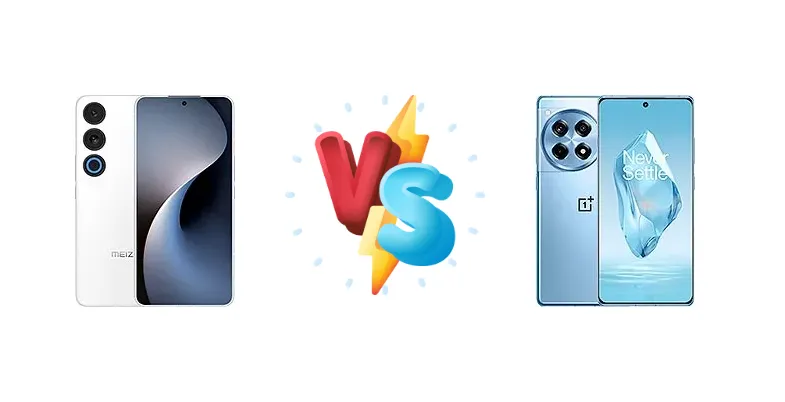
|
🏆 Quick Verdict
For most users, the OnePlus 12R emerges as the stronger choice. Its significantly faster 100W charging, achieving a full charge in just 26 minutes, coupled with a measured 14:32 hour active use battery score, provides a tangible advantage over the Meizu 21 Note’s 65W charging. While both share the same processor, the OnePlus 12R’s battery performance makes it the more practical daily driver.
| PHONES | ||
|---|---|---|
| Phone Names | Meizu 21 Note | OnePlus 12R |
| Network | ||
|---|---|---|
| 2G bands | GSM 850 / 900 / 1800 / 1900 | GSM 850 / 900 / 1800 / 1900 |
| 3G bands | HSDPA 850 / 900 / 2100 | HSDPA 850 / 900 / 1700(AWS) / 1900 / 2100 |
| 4G bands | 1, 3, 4, 5, 8, 28, 34, 38, 39, 40, 41 | 1, 2, 3, 4, 5, 7, 8, 12, 17, 18, 19, 20, 26, 28, 32, 38, 39, 40, 41, 66 |
| 5G bands | 1, 3, 5, 8, 28, 38, 40, 41, 77, 78 SA/NSA | 1, 2, 3, 5, 7, 8, 12, 20, 28, 38, 40, 41, 66, 77, 78 SA/NSA |
| Speed | HSPA, LTE, 5G | HSPA, LTE, 5G |
| Technology | GSM / HSPA / LTE / 5G | GSM / CDMA / HSPA / LTE / 5G |
| Launch | ||
|---|---|---|
| Announced | 2024, May 16 | 2024, January 23 |
| Status | Available. Released 2024, May 21 | Available. Released 2024, February 06 |
| Body | ||
|---|---|---|
| Build | Glass front, aluminum frame, plastic back | Glass front (Gorilla Glass Victus 2), aluminum frame, glass back |
| Dimensions | 162.4 x 76.9 x 8.2 mm (6.39 x 3.03 x 0.32 in) | 163.3 x 75.3 x 8.8 mm (6.43 x 2.96 x 0.35 in) |
| SIM | Nano-SIM + Nano-SIM | · Nano-SIM + Nano-SIM + eSIM (max 2 at a time)· Nano-SIM + Nano-SIM |
| Weight | 205 g (7.23 oz) | 207 g (7.30 oz) |
| Display | ||
|---|---|---|
| Protection | - | Corning Gorilla Glass Victus 2 |
| Resolution | 1264 x 2780 pixels (~450 ppi density) | 1264 x 2780 pixels (~450 ppi density) |
| Size | 6.78 inches, 111.7 cm2 (~89.5% screen-to-body ratio) | 6.78 inches, 111.7 cm2 (~90.9% screen-to-body ratio) |
| Type | LTPO OLED, 1B colors, 144Hz, HDR10+, 800 nits (typ), 1600 nits (HBM), 5000 nits (peak) | LTPO4 AMOLED, 1B colors, 120Hz, HDR10+, Dolby Vision, 1600 nits (HBM), 4500 nits (peak) |
| Platform | ||
|---|---|---|
| CPU | Octa-core (1x3.2 GHz Cortex-X3 & 2x2.8 GHz Cortex-A715 & 2x2.8 GHz Cortex-A710 & 3x2.0 GHz Cortex-A510) | Octa-core (1x3.2 GHz Cortex-X3 & 2x2.8 GHz Cortex-A715 & 2x2.8 GHz Cortex-A710 & 3x2.0 GHz Cortex-A510) |
| Chipset | Qualcomm SM8550-AB Snapdragon 8 Gen 2 (4 nm) | Qualcomm SM8550-AB Snapdragon 8 Gen 2 (4 nm) |
| GPU | Adreno 740 | Adreno 740 |
| OS | Flyme OS | Android 14, up to 3 major Android upgrades, OxygenOS 15 |
| Memory | ||
|---|---|---|
| Card slot | No | No |
| Internal | 256GB 16GB RAM, 512GB 16GB RAM | 128GB 8GB RAM, 256GB 8GB RAM, 256GB 12GB RAM, 256GB 16GB RAM |
| Main Camera | ||
|---|---|---|
| Dual | 50 MP, f/1.7, 24mm (wide), 1/1.56", PDAF, OIS 13 MP, f/2.4, 16mm, 122˚ (ultrawide), AF | - |
| Features | Ring-LED flash, panorama, HDR | Laser AF, color spectrum sensor, LED flash, HDR, panorama |
| Triple | - | 50 MP, f/1.8, 24mm (wide), 1/1.56", 1.0µm, multi-directional PDAF, OIS 8 MP, f/2.2, 16mm, 112˚ (ultrawide), 1/4.0", 1.12µm 2 MP (macro) |
| Video | 8K, 4K, 1080p; gyro-EIS | 4K@30/60fps, 1080p@30/60/120/240fps, gyro-EIS, OIS |
| Selfie camera | ||
|---|---|---|
| Features | HDR | HDR, panorama |
| Single | 16 MP, f/2.5, (wide) | 16 MP, f/2.4, 26mm (wide), 1/3", 1.0µm |
| Video | Yes | 1080p@30fps, gyro-EIS |
| Sound | ||
|---|---|---|
| 35mm jack | No | No |
| Loudspeaker | Yes, with stereo speakers | Yes, with stereo speakers |
| Comms | ||
|---|---|---|
| Bluetooth | 5.3, A2DP, LE, aptX HD, LHDC | 5.3, A2DP, LE, aptX HD |
| Infrared port | Yes | Yes |
| NFC | Yes | Yes |
| Positioning | GPS (L1+L5), GLONASS, GALILEO, BDS, QZSS, NavIC | GPS, GALILEO, GLONASS, BDS, QZSS |
| Radio | No | No |
| USB | USB Type-C 2.0, OTG | USB Type-C 2.0 |
| WLAN | Wi-Fi 802.11 а/b/g/n/ac/6e/7, tri-band | Wi-Fi 802.11 a/b/g/n/ac/6/7, dual-band |
| Features | ||
|---|---|---|
| Sensors | Fingerprint (under display, ultrasonic), accelerometer, gyro, proximity, compass | Fingerprint (under display, optical), accelerometer, gyro, proximity, compass |
| Battery | ||
|---|---|---|
| Charging | 65W wired, PD3 PPS, QC4+ | 100W wired, 100% in 26 min |
| Type | 5500 mAh | Li-Ion 5500 mAh |
| Misc | ||
|---|---|---|
| Colors | Black, White | Iron Gray, Cool Blue, Electric Violet, Sunset Dune |
| Models | - | CPH2609, CPH2585, CPH2611 |
| Price | About 330 EUR | € 410.84 / $ 399.95 / £ 649.00 |
| SAR | - | 1.19 W/kg (head) 0.82 W/kg (body) |
Meizu 21 Note
- Potentially refined Flyme OS software experience (subjective)
- Snapdragon 8 Gen 2 provides flagship-level performance
- 65W charging is still relatively fast
- Slower charging speed compared to OnePlus 12R
- Battery life data unavailable, potentially inferior to OnePlus 12R
- Limited information on display specifications
OnePlus 12R
- 100W SuperVOOC charging for incredibly fast top-ups
- Excellent 14:32 hour active use battery life
- High peak display brightness (1181 nits)
- OxygenOS can be polarizing for some users
- Software updates may be less frequent than some competitors
- Camera specifications are currently unknown
Display Comparison
The OnePlus 12R boasts a brighter display, reaching a measured peak brightness of 1181 nits, which translates to better visibility under direct sunlight compared to the Meizu 21 Note (brightness data unavailable). While both likely utilize AMOLED panels for vibrant colors, the OnePlus 12R’s higher peak brightness is a clear advantage for outdoor use. Details regarding refresh rate and panel technology (LTPO) are missing for the Meizu 21 Note, potentially indicating a less power-efficient display solution.
Camera Comparison
Camera specifications for the Meizu 21 Note are currently unavailable, making a direct comparison challenging. The OnePlus 12R’s camera setup is also not detailed in the provided data. Without information on sensor sizes, lens apertures, or optical image stabilization (OIS), it’s difficult to assess image quality. It’s reasonable to assume both phones will offer competent camera systems, but the absence of specifics prevents a meaningful analysis. We can expect both to leverage the Snapdragon 8 Gen 2’s ISP for image processing.
Performance
Both the Meizu 21 Note and OnePlus 12R are powered by the Qualcomm SM8550-AB Snapdragon 8 Gen 2 (4 nm) chipset, featuring the same Octa-core CPU configuration (1x3.2 GHz Cortex-X3, 2x2.8 GHz Cortex-A715, 2x2.8 GHz Cortex-A710, and 3x2.0 GHz Cortex-A510). This means raw processing power will be nearly identical. However, the OnePlus 12R’s larger battery capacity and potentially more sophisticated thermal management system (details unavailable for Meizu 21 Note) could allow it to sustain peak performance for longer periods during demanding tasks like gaming. RAM configurations are not specified, but LPDDR5x is expected on both devices, contributing to fast data transfer speeds.
Battery Life
The OnePlus 12R distinguishes itself with its 100W wired charging capability, achieving a full charge in a remarkable 26 minutes. This is a significant advantage over the Meizu 21 Note’s 65W charging. Furthermore, the OnePlus 12R demonstrates impressive battery life, achieving 14:32 hours of active use. While the Meizu 21 Note’s battery capacity is unknown, the slower charging speed and lack of active use data suggest it may fall short in endurance compared to the OnePlus 12R. The OnePlus 12R’s support for PD3 PPS and QC4+ ensures compatibility with a wider range of chargers.
Buying Guide
Buy the Meizu 21 Note if you prioritize a potentially more refined software experience (based on Meizu’s Flyme OS, though this is subjective and requires further user testing) and are comfortable with slower charging speeds. Buy the OnePlus 12R if you value rapid charging, extended battery life, and a proven track record of software stability and updates, making it ideal for power users and those constantly on the go.