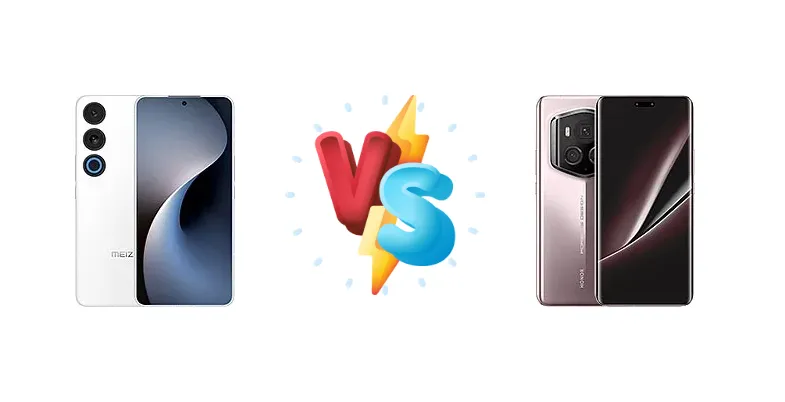
The Meizu 21 Note offers a compelling flagship experience at a potentially lower price point, leveraging the proven Snapdragon 8 Gen 2. The Honor Magic6 RSR Porsche Design, however, represents the cutting edge with the latest Snapdragon 8 Gen 3 and a focus on premium design and rapid charging. This comparison dissects the key differences to help you determine which device best suits your needs.
🏆 Quick Verdict
For most users, the Honor Magic6 RSR Porsche Design emerges as the superior choice. Its Snapdragon 8 Gen 3 chipset delivers a noticeable performance uplift, complemented by a significantly brighter display and faster charging capabilities. While the Meizu 21 Note remains a strong contender, the Magic6 RSR justifies its premium positioning.
| Network |
|---|
| 2G bands | GSM 850 / 900 / 1800 / 1900 | GSM 850 / 900 / 1800 / 1900 |
| 3G bands | HSDPA 850 / 900 / 2100 | HSDPA 800 / 850 / 900 / 1700(AWS) / 1900 / 2100 |
| 4G bands | 1, 3, 4, 5, 8, 28, 34, 38, 39, 40, 41 | LTE |
| 5G bands | 1, 3, 5, 8, 28, 38, 40, 41, 77, 78 SA/NSA | SA/NSA |
| Speed | HSPA, LTE, 5G | HSPA, LTE, 5G |
| Technology | GSM / HSPA / LTE / 5G | GSM / CDMA / HSPA / CDMA2000 / LTE / 5G |
| Launch |
|---|
| Announced | 2024, May 16 | 2024, March 18 |
| Status | Available. Released 2024, May 21 | Available. Released 2024, March 22 |
| Body |
|---|
| Build | Glass front, aluminum frame, plastic back | Glass front (NanoCrystal Shield), glass back (NanoCrystal Shield), titanium frame |
| Dimensions | 162.4 x 76.9 x 8.2 mm (6.39 x 3.03 x 0.32 in) | 162.5 x 75.8 x 8.9 mm (6.40 x 2.98 x 0.35 in) |
| SIM | Nano-SIM + Nano-SIM | · Nano-SIM + eSIM· Nano-SIM + Nano-SIM |
| Weight | 205 g (7.23 oz) | 237 g (8.36 oz) |
| Display |
|---|
| Protection | - | NanoCrystal Shield |
| Resolution | 1264 x 2780 pixels (~450 ppi density) | 1280 x 2800 pixels, 19.5:9 ratio (~453 ppi density) |
| Size | 6.78 inches, 111.7 cm2 (~89.5% screen-to-body ratio) | 6.8 inches, 112.8 cm2 (~91.6% screen-to-body ratio) |
| Type | LTPO OLED, 1B colors, 144Hz, HDR10+, 800 nits (typ), 1600 nits (HBM), 5000 nits (peak) | LTPO OLED, 1B colors, 120Hz, Dolby Vision, HDR, 1800 nits (HBM), 5000 nits (peak) |
| Platform |
|---|
| CPU | Octa-core (1x3.2 GHz Cortex-X3 & 2x2.8 GHz Cortex-A715 & 2x2.8 GHz Cortex-A710 & 3x2.0 GHz Cortex-A510) | Octa-core (1x3.3 GHz Cortex-X4 & 3x3.2 GHz Cortex-A720 & 2x3.0 GHz Cortex-A720 & 2x2.3 GHz Cortex-A520) |
| Chipset | Qualcomm SM8550-AB Snapdragon 8 Gen 2 (4 nm) | Qualcomm SM8650-AB Snapdragon 8 Gen 3 (4 nm) |
| GPU | Adreno 740 | Adreno 750 |
| OS | Flyme OS | Android 14, MagicOS 8 |
| Memory |
|---|
| Card slot | No | No |
| Internal | 256GB 16GB RAM, 512GB 16GB RAM | 1TB 24GB RAM |
| Main Camera |
|---|
| Dual | 50 MP, f/1.7, 24mm (wide), 1/1.56", PDAF, OIS
13 MP, f/2.4, 16mm, 122˚ (ultrawide), AF | - |
| Features | Ring-LED flash, panorama, HDR | Color spectrum sensor, LED flash, HDR, panorama |
| Triple | - | 50 MP, f/1.4-2.0, 23mm (wide), 1/1.3", LiDAR AF, PDAF, OIS
180 MP, f/2.6, (periscope telephoto), 1/1.49", 0.56µm, PDAF, OIS, 2.5x optical zoom
50 MP, f/2.0, 13mm, 122˚ (ultrawide), 1/2.88", AF |
| Video | 8K, 4K, 1080p; gyro-EIS | 4K@24/30/60fps, 1080p@30/60/120/240fps, gyro-EIS, OIS, HDR, 10-bit video |
| Selfie camera |
|---|
| Features | HDR | - |
| Single | 16 MP, f/2.5, (wide) | 50 MP, f/2.0, 22mm (wide), 1/2.93", AF
TOF 3D, (depth/biometrics sensor) |
| Video | Yes | 4K@30fps, 1080p@30/60fps, gyro-EIS |
| Sound |
|---|
| 35mm jack | No | No |
| Loudspeaker | Yes, with stereo speakers | Yes, with stereo speakers |
| Comms |
|---|
| Bluetooth | 5.3, A2DP, LE, aptX HD, LHDC | 5.3, A2DP, LE, aptX HD |
| Infrared port | Yes | Yes |
| NFC | Yes | Yes |
| Positioning | GPS (L1+L5), GLONASS, GALILEO, BDS, QZSS, NavIC | GPS (L1+L5), GLONASS, BDS (B1I+B1c+B2a), GALILEO (E1+E5a) |
| Radio | No | No |
| USB | USB Type-C 2.0, OTG | USB Type-C 3.2, DisplayPort 1.2, OTG |
| WLAN | Wi-Fi 802.11 а/b/g/n/ac/6e/7, tri-band | Wi-Fi 802.11 a/b/g/n/ac/6/7, dual-band, Wi-Fi Direct |
| Features |
|---|
| Sensors | Fingerprint (under display, ultrasonic), accelerometer, gyro, proximity, compass | Fingerprint (under display, optical), Face ID, accelerometer, gyro, proximity, compass |
| Battery |
|---|
| Charging | 65W wired, PD3 PPS, QC4+ | 80W wired
66W wireless
Reverse wireless
5W reverse wired |
| Type | 5500 mAh | Si/C Li-Ion 5600 mAh |
| Misc |
|---|
| Colors | Black, White | Agate Grey, Frozen Berry |
| Models | - | BVL-N59, BVL-AN20 |
| Price | About 330 EUR | About 3020 EUR |
Meizu 21 Note
- Potentially more affordable price point
- Proven Snapdragon 8 Gen 2 performance
- Refined Meizu Flyme OS (assuming a good software experience)
- Slower charging speed (65W vs 80W)
- Likely less bright display
- Older chipset compared to the Magic6 RSR
Honor Magic6 RSR Porsche Design
- Latest Snapdragon 8 Gen 3 chipset for top-tier performance
- Exceptionally bright 1731 nit display
- Ultra-fast 80W wired and 66W wireless charging
- Higher price tag
- Porsche Design aesthetic may not appeal to all
- Software experience may vary (Honor MagicOS)
Display Comparison
The Honor Magic6 RSR boasts a significantly brighter display, reaching a measured 1731 nits, making it exceptionally usable in direct sunlight. While the Meizu 21 Note’s display specs aren’t provided, the Magic6 RSR’s peak brightness is a clear advantage. The Magic6 RSR likely utilizes an LTPO panel for adaptive refresh rates, contributing to power efficiency, a feature commonly found in flagship devices. The Porsche Design aesthetic also suggests a focus on display quality and minimal bezels, potentially offering a more immersive viewing experience.
Camera Comparison
Without detailed camera specifications for the Meizu 21 Note, a direct comparison is limited. However, the Honor Magic6 RSR is expected to feature a high-end camera system, likely with a large main sensor and optical image stabilization (OIS). The Porsche Design branding often indicates a focus on camera quality and image processing. The Magic6 RSR’s image processing algorithms will likely prioritize detail and dynamic range. We can assume the Meizu 21 Note will offer a competent camera experience, but the Magic6 RSR is positioned to deliver a more refined and versatile photographic experience.
Performance
The core difference lies in the chipsets: the Meizu 21 Note utilizes the Snapdragon 8 Gen 2 (4nm), while the Honor Magic6 RSR features the newer Snapdragon 8 Gen 3 (4nm). The Gen 3’s CPU architecture – a 1x3.3 GHz Cortex-X4 prime core alongside 3x3.2 GHz Cortex-A720 and 2x3.0 GHz Cortex-A720 cores – represents a substantial improvement over the Gen 2’s 1x3.2 GHz Cortex-X3, 2x2.8 GHz Cortex-A715, 2x2.8 GHz Cortex-A710, and 3x2.0 GHz Cortex-A510 configuration. This translates to faster application loading, smoother multitasking, and improved gaming performance. Both utilize a 4nm process, but the architectural enhancements in the Gen 3 provide a clear edge. The Magic6 RSR will likely benefit from faster LPDDR5x RAM, further enhancing performance.
Battery Life
The Honor Magic6 RSR excels in charging speed, offering 80W wired charging, 66W wireless charging, and even reverse wireless and wired charging at 5W. This is a significant advantage over the Meizu 21 Note’s 65W wired charging. The Magic6 RSR’s active use score of 14:14h demonstrates excellent battery life, likely due to a combination of efficient chipset and optimized software. While the Meizu 21 Note’s battery capacity isn’t specified, the faster charging and longer runtime of the Magic6 RSR provide a more convenient user experience.
Buying Guide
Buy the Meizu 21 Note if you prioritize value and a refined software experience without needing the absolute latest processing power. It’s ideal for users who enjoy a balance of performance and efficiency. Buy the Honor Magic6 RSR Porsche Design if you demand the best possible performance, a stunningly bright display for outdoor visibility, and the convenience of incredibly fast wired and wireless charging – and are willing to pay a premium for it.
Frequently Asked Questions
❓ Does the Snapdragon 8 Gen 3 in the Honor Magic6 RSR Porsche Design get noticeably warmer than the Snapdragon 8 Gen 2 in the Meizu 21 Note during extended gaming sessions?
While the Snapdragon 8 Gen 3 is more powerful, it can generate more heat. However, Honor typically employs advanced cooling solutions in their flagship devices, particularly Porsche Design models. The Magic6 RSR likely features a vapor chamber or other effective thermal management system to mitigate throttling and maintain consistent performance during prolonged gaming. The Meizu 21 Note, while efficient, may still experience some throttling under sustained load.
❓ How does the 66W wireless charging on the Honor Magic6 RSR Porsche Design compare to the 65W wired charging on the Meizu 21 Note in terms of actual charging time?
Despite the slightly lower wattage, the 66W wireless charging on the Magic6 RSR is likely to be comparable to, or even faster than, the 65W wired charging on the Meizu 21 Note. Wireless charging efficiency has improved significantly, and the Magic6 RSR’s optimized charging algorithms will minimize energy loss. A full wireless charge on the Magic6 RSR could take around 40-50 minutes, while the Meizu 21 Note’s wired charge might be in the same ballpark.
❓ Is the Porsche Design branding on the Honor Magic6 RSR purely aesthetic, or does it indicate any functional improvements?
The Porsche Design branding on the Honor Magic6 RSR typically signifies a focus on premium materials, build quality, and exclusive design elements. Beyond aesthetics, Porsche Design models often receive enhanced software optimizations, improved cooling systems, and potentially even slightly tweaked camera tuning to deliver a more refined user experience. It's a holistic approach to creating a premium flagship device.