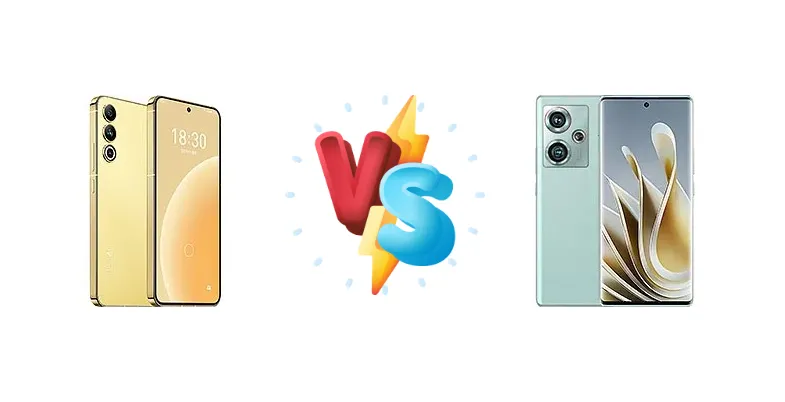
The Snapdragon 8 Gen 2 is a powerhouse, and both the Meizu 20 and ZTE nubia Z50 leverage it. But beyond the shared chipset, these phones offer distinct experiences. This comprehensive comparison will help you decide which device best suits your needs and budget.
🏆 Quick Verdict
The nubia Z50 edges out the Meizu 20 thanks to its faster 80W charging and potentially more aggressive pricing. However, Meizu's FlymeOS and potential design advantages might sway some users. Both offer flagship performance, but charging speed and software are key differentiators.
| Network |
|---|
| 2G bands | GSM 850 / 900 / 1800 / 1900 | GSM 850 / 900 / 1800 / 1900 |
| 3G bands | HSDPA 850 / 900 / 1900 / 2100 | HSDPA 850 / 900 / 1700(AWS) / 1900 / 2100 |
| 4G bands | 1, 2, 3, 4, 5, 7, 8, 12, 28, 34, 38, 39, 40, 41 | LTE |
| 5G bands | 1, 3, 5, 8, 28, 38, 41, 77, 78 SA/NSA | SA/NSA |
| Speed | HSPA, LTE, 5G | HSPA, LTE, 5G |
| Technology | GSM / HSPA / LTE / 5G | GSM / CDMA / HSPA / LTE / 5G |
| | - | CDMA 800 |
| Launch |
|---|
| Announced | 2023, March 30 | 2022, December 19 |
| Status | Available. Released 2023, May 22 | Available. Released 2022, December 26 |
| Body |
|---|
| Build | - | Glass front, aluminum frame, glass back or eco leather back |
| Dimensions | 157.9 x 73.5 x 8 mm (6.22 x 2.89 x 0.31 in) | 162.9 x 72.9 x 8.5 mm or 8.7 mm |
| SIM | Nano-SIM + Nano-SIM | Nano-SIM + Nano-SIM |
| Weight | 190 g (6.70 oz) | 197 g or 199 g (6.95 oz) |
| | IP54 | - |
| Display |
|---|
| Resolution | 1080 x 2400 pixels, 20:9 ratio (~402 ppi density) | 1080 x 2400 pixels, 20:9 ratio (~395 ppi density) |
| Size | 6.55 inches, 103.6 cm2 (~89.2% screen-to-body ratio) | 6.67 inches, 107.4 cm2 (~90.4% screen-to-body ratio) |
| Type | OLED, 1B colors, 144Hz, 500 nits (typ), 800 nits (HBM) | AMOLED, 1B colors, 144Hz, HDR10+, 1000 nits |
| Platform |
|---|
| CPU | Octa-core (1x3.2 GHz Cortex-X3 & 2x2.8 GHz Cortex-A715 & 2x2.8 GHz Cortex-A710 & 3x2.0 GHz Cortex-A510) | Octa-core (1x3.2 GHz Cortex-X3 & 2x2.8 GHz Cortex-A715 & 2x2.8 GHz Cortex-A710 & 3x2.0 GHz Cortex-A510) |
| Chipset | Qualcomm SM8550-AB Snapdragon 8 Gen 2 (4 nm) | Qualcomm SM8550-AB Snapdragon 8 Gen 2 (4 nm) |
| GPU | Adreno 740 | Adreno 740 |
| OS | Android 13, Flyme 10 | Android 13, MyOS 13 |
| Memory |
|---|
| Card slot | No | No |
| Internal | 128GB 12GB RAM, 256GB 12GB RAM, 512GB 12GB RAM | 128GB 8GB RAM, 256GB 8GB RAM, 256GB 12GB RAM, 512GB 12GB RAM, 1TB 16GB RAM |
| | UFS 4.0
UFS 3.1 - 128GB only | UFS 4.0
UFS 3.1 (128GB only) |
| Main Camera |
|---|
| Dual | - | 64 MP, f/1.6, 35mm (standard), 1/1.7", PDAF, OIS
50 MP, f/2.2, 14mm, 116˚ (ultrawide), AF |
| Features | Ring-LED flash, panorama, HDR | Ring-LED flash (4 LEDs), panorama, HDR |
| Single | - | 16 MP, (wide) |
| Triple | 50 MP, f/1.9, 24mm (wide), 1/1.56", PDAF, OIS
16 MP, f/2.4, 16mm, 122˚ (ultrawide)
5 MP, f/2.4 | - |
| Video | 8K, 4K, 1080p; gyro-EIS | 8K, 4K |
| Selfie camera |
|---|
| Features | HDR | HDR |
| Single | 32 MP, f/2.5, (wide) | 16 MP, (wide) |
| Video | Yes | 1080p@30fps |
| Sound |
|---|
| 3.5mm jack | No | No |
| 35mm jack | No | No |
| Loudspeaker | Yes, with stereo speakers | Yes, with stereo speakers |
| | - | 24-bit/192kHz audio |
| Comms |
|---|
| Bluetooth | 5.3, A2DP, LE | 5.3, A2DP, LE |
| NFC | Yes | Yes |
| Positioning | GPS (L1+L5), GLONASS, BDS (B1I+B1c+B2a), GALILEO, QZSS | GPS (L1+L5), GLONASS, BDS, GALILEO, QZSS |
| Radio | No | No |
| USB | USB Type-C, OTG | USB Type-C 3.1, OTG |
| WLAN | Wi-Fi 802.11 а/b/g/n/ac/6e/7, dual-band | Wi-Fi 802.11 a/b/g/n/ac/6e, dual-band, Wi-Fi Direct |
| Features |
|---|
| Sensors | Fingerprint (under display, ultrasonic), accelerometer, gyro, proximity, compass | Fingerprint (under display, optical), accelerometer, gyro, proximity, compass |
| Battery |
|---|
| Charging | 67W wired, PD3 PPS, QC4+ | 80W wired |
| Type | Li-Po 4700 mAh | Li-Po 5000 mAh |
| Misc |
|---|
| Colors | Gray, Yellow, Mint, Rose Gold | Black, Silver, Mint, Rabit red |
| Models | - | NX711J |
| Price | About 400 EUR | About 400 EUR |
Meizu 20
- Potentially refined design
- FlymeOS (unique software experience)
- Good build quality
- Snapdragon 8 Gen 2 performance
- Slower charging (67W)
- Potentially higher price
- FlymeOS may not appeal to everyone
ZTE nubia Z50
- Faster charging (80W)
- Potentially larger display
- Competitive pricing (likely)
- Snapdragon 8 Gen 2 performance
- nubia UI may not be as polished as some competitors
- Design might be less premium than Meizu
- Camera performance needs verification
Display Comparison
Both phones likely feature high-quality AMOLED displays with 120Hz refresh rates, but the nubia Z50 is rumored to have a larger screen size (around 6.8 inches) compared to the Meizu 20 (likely around 6.5-6.6 inches). Color accuracy and brightness will be key factors to consider in a hands-on comparison.
Camera Comparison
While both phones likely feature high-resolution main sensors, the nubia Z50 is rumored to have a more advanced camera system with potentially better image processing. Meizu often focuses on a more natural color profile, while ZTE might lean towards more vibrant images. Detailed camera tests are needed to determine the true winner.
Performance
Identical Snapdragon 8 Gen 2 chipsets mean near-identical performance in benchmarks and real-world usage. Expect smooth multitasking, demanding gaming, and snappy app launches on both devices. Thermal management will be a crucial factor in sustained performance.
Battery Life
The nubia Z50's 80W wired charging significantly outperforms the Meizu 20's 67W charging. Battery capacity is likely similar (around 4800-5000mAh), meaning the nubia Z50 will charge much faster.
Buying Guide
The Meizu 20 is ideal for users who appreciate a refined design, a potentially more polished software experience (FlymeOS), and are willing to pay a premium. The ZTE nubia Z50 is a better choice for those prioritizing fast charging, a large display, and potentially a more competitive price point.
Frequently Asked Questions
❓ What is the difference between FlymeOS and nubia UI?
FlymeOS is Meizu's custom Android skin, known for its unique design and features. nubia UI is ZTE's skin, often criticized for being less polished but improving over time. User preference will dictate which is better.
❓ Which phone is better for gaming?
Both phones offer excellent gaming performance thanks to the Snapdragon 8 Gen 2. Thermal management will be the deciding factor in sustained performance during long gaming sessions.