
Meizu 20 vs Xiaomi 13: A Detailed Flagship Showdown
| Phones Images | |||||
|---|---|---|---|---|---|
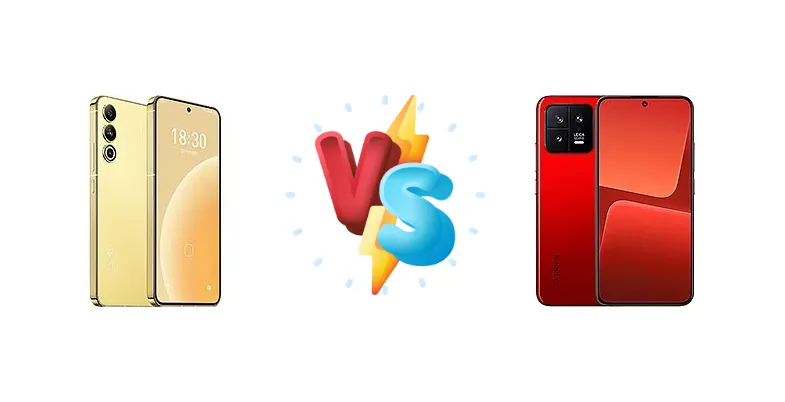
|
🏆 Quick Verdict
The Xiaomi 13 emerges as the overall winner thanks to its superior charging speeds (wired and wireless), potentially better camera system (based on Xiaomi's reputation), and longer-lasting battery. While the Meizu 20 offers a clean software experience, Xiaomi's feature set and charging capabilities give it the edge.
| PHONES | ||
|---|---|---|
| Phone Names | Meizu 20 | Xiaomi 13 |
| Network | ||
|---|---|---|
| 2G bands | GSM 850 / 900 / 1800 / 1900 | GSM 850 / 900 / 1800 / 1900 |
| 3G bands | HSDPA 850 / 900 / 1900 / 2100 | HSDPA 800 / 850 / 900 / 1700(AWS) / 1900 / 2100 |
| 4G bands | 1, 2, 3, 4, 5, 7, 8, 12, 28, 34, 38, 39, 40, 41 | 1, 2, 3, 4, 5, 7, 8, 12, 13, 17, 18, 19, 20, 25, 26, 28, 32, 38, 39, 40, 41, 42, 48, 66 - International |
| 5G bands | 1, 3, 5, 8, 28, 38, 41, 77, 78 SA/NSA | 1, 3, 5, 7, 8, 20, 28, 38, 40, 41, 66, 71, 75, 77, 78 SA/NSA - International |
| Speed | HSPA, LTE, 5G | HSPA, LTE, 5G |
| Technology | GSM / HSPA / LTE / 5G | GSM / CDMA / HSPA / CDMA2000 / LTE / 5G |
| - | 1, 3, 5, 8, 28, 38, 40, 41, 77, 78 SA/NSA - China | |
| Launch | ||
|---|---|---|
| Announced | 2023, March 30 | 2022, December 11 |
| Status | Available. Released 2023, May 22 | Available. Released 2022, December 14 |
| Body | ||
|---|---|---|
| Build | - | Glass front (Gorilla Glass 5), glass back or silicone polymer back, aluminum frame |
| Dimensions | 157.9 x 73.5 x 8 mm (6.22 x 2.89 x 0.31 in) | 152.8 x 71.5 x 8.0 mm or 8.1 mm |
| SIM | Nano-SIM + Nano-SIM | · Nano-SIM + eSIM· Nano-SIM + Nano-SIM |
| Weight | 190 g (6.70 oz) | 185 g or 189 g (6.53 oz) |
| IP54 | IP68 dust/water resistant (up to 1.5m for 30 min) | |
| Display | ||
|---|---|---|
| Protection | - | Corning Gorilla Glass 5 |
| Resolution | 1080 x 2400 pixels, 20:9 ratio (~402 ppi density) | 1080 x 2400 pixels, 20:9 ratio (~414 ppi density) |
| Size | 6.55 inches, 103.6 cm2 (~89.2% screen-to-body ratio) | 6.36 inches, 97.7 cm2 (~89.4% screen-to-body ratio) |
| Type | OLED, 1B colors, 144Hz, 500 nits (typ), 800 nits (HBM) | AMOLED, 120Hz, Dolby Vision, HDR10+, 1200 nits (HBM), 1900 nits (peak) |
| Platform | ||
|---|---|---|
| CPU | Octa-core (1x3.2 GHz Cortex-X3 & 2x2.8 GHz Cortex-A715 & 2x2.8 GHz Cortex-A710 & 3x2.0 GHz Cortex-A510) | Octa-core (1x3.2 GHz Cortex-X3 & 2x2.8 GHz Cortex-A715 & 2x2.8 GHz Cortex-A710 & 3x2.0 GHz Cortex-A510) |
| Chipset | Qualcomm SM8550-AB Snapdragon 8 Gen 2 (4 nm) | Qualcomm SM8550-AB Snapdragon 8 Gen 2 (4 nm) |
| GPU | Adreno 740 | Adreno 740 |
| OS | Android 13, Flyme 10 | Android 13, upgradable to Android 14, MIUI 14 |
| Memory | ||
|---|---|---|
| Card slot | No | No |
| Internal | 128GB 12GB RAM, 256GB 12GB RAM, 512GB 12GB RAM | 128GB 8GB RAM, 256GB 8GB RAM, 256GB 12GB RAM, 512GB 12GB RAM |
| UFS 4.0 UFS 3.1 - 128GB only | UFS 3.1 - 128GB UFS 4.0 - 256/512GB | |
| Main Camera | ||
|---|---|---|
| Features | Ring-LED flash, panorama, HDR | Leica lens, color spectrum sensor, Dual-LED dual-tone flash, HDR, panorama |
| Triple | 50 MP, f/1.9, 24mm (wide), 1/1.56", PDAF, OIS 16 MP, f/2.4, 16mm, 122˚ (ultrawide) 5 MP, f/2.4 | 50 MP, f/1.8, 23mm (wide), 1/1.49", 1.0µm, PDAF, OIS 10 MP, f/2.0, 75mm (telephoto), 1/3.75", 1.0µm, PDAF, OIS, 3.2x optical zoom 12 MP, f/2.2, 15mm, 120˚ (ultrawide), 1/3.06", 1.12µm |
| Video | 8K, 4K, 1080p; gyro-EIS | 8K@24fps (HDR), 4K@24/30/60fps (HDR10+, 10-bit Dolby Vision HDR, 10-bit LOG), 1080p@30/120/240/960fps, 1080p@1920fps, gyro-EIS |
| Selfie camera | ||
|---|---|---|
| Features | HDR | HDR, panorama |
| Single | 32 MP, f/2.5, (wide) | 32 MP, f/2.0, 22mm (wide), 1/3.14", 0.7µm |
| Video | Yes | 1080p@30fps |
| Sound | ||
|---|---|---|
| 3.5mm jack | No | No |
| 35mm jack | No | No |
| Loudspeaker | Yes, with stereo speakers | Yes, with stereo speakers |
| - | 24-bit/192kHz audio | |
| Comms | ||
|---|---|---|
| Bluetooth | 5.3, A2DP, LE | 5.3, A2DP, LE, aptX HD, aptX Adaptive |
| Infrared port | - | Yes |
| NFC | Yes | Yes |
| Positioning | GPS (L1+L5), GLONASS, BDS (B1I+B1c+B2a), GALILEO, QZSS | GPS (L1+L5), GLONASS (G1), BDS (B1I+B1c+B2a), GALILEO (E1+E5a), QZSS (L1+L5), NavIC (L5) |
| Radio | No | No |
| USB | USB Type-C, OTG | USB Type-C 2.0, OTG |
| WLAN | Wi-Fi 802.11 а/b/g/n/ac/6e/7, dual-band | Wi-Fi 802.11 a/b/g/n/ac/6e, dual-band, Wi-Fi Direct |
| Features | ||
|---|---|---|
| Sensors | Fingerprint (under display, ultrasonic), accelerometer, gyro, proximity, compass | Fingerprint (under display, optical), accelerometer, proximity, gyro, compass |
| Battery | ||
|---|---|---|
| Charging | 67W wired, PD3 PPS, QC4+ | 67W wired, PD3.0, QC4, 100% in 38 min 50W wireless, 100% in 48 min 10W reverse wireless |
| Type | Li-Po 4700 mAh | Li-Po 4500 mAh |
| Misc | ||
|---|---|---|
| Colors | Gray, Yellow, Mint, Rose Gold | White, Black, Flora Green, Mountain Blue, Red, Blue, Yellow, Green, Gray |
| Models | - | 2211133C, 2211133G |
| Price | About 400 EUR | € 314.00 |
| Tests | ||
|---|---|---|
| Battery life | - | Endurance rating 108h |
| Camera | - | Photo / Video |
| Display | - | Contrast ratio: Infinite (nominal) |
| Loudspeaker | - | -25.8 LUFS (Very good) |
| Performance | - | AnTuTu: 1248260 (v9) GeekBench: 5129 (v5.1) GFXBench: 109fps (ES 3.1 onscreen) |
Meizu 20
- Clean Android experience
- Unique design
- Powerful Snapdragon 8 Gen 2
- Unknown battery capacity
- Less established camera reputation
- Potentially lower brightness display
Xiaomi 13
- Fast charging (wired & wireless)
- Excellent battery life (108h endurance)
- Strong camera system (expected)
- High brightness display (1254 nits)
- MIUI software (can be polarizing)
- Potentially more bloatware
Display Comparison
Both phones feature excellent displays powered by the Snapdragon 8 Gen 2. The Xiaomi 13 boasts a measured peak brightness of 1254 nits, significantly higher than the Meizu 20, offering better outdoor visibility. Xiaomi's 'Infinite' contrast ratio suggests deep blacks and vibrant colors, though this is a nominal value. The Meizu 20's display is likely very good, but lacks specific brightness figures.
Camera Comparison
Xiaomi has a strong reputation for camera quality, and the Xiaomi 13 is expected to deliver excellent photo and video capabilities. While the Meizu 20's camera is likely capable, it's difficult to assess without detailed reviews. Xiaomi's software processing and features likely give it an advantage.
Performance
Performance is virtually identical. Both devices utilize the Snapdragon 8 Gen 2 chipset with the same CPU configuration. Expect blazing-fast speeds and smooth multitasking on both phones. Real-world performance differences will likely be minimal and depend more on software optimization.
Battery Life
The Xiaomi 13 claims an impressive endurance rating of 108 hours, suggesting exceptional battery life. The Meizu 20's battery capacity is unknown, but the Xiaomi 13's charging speeds (67W wired, 50W wireless, 10W reverse wireless) provide a significant advantage in quickly replenishing power.
Buying Guide
The Meizu 20 is ideal for users who prioritize a clean, minimalist Android experience and appreciate a unique design. The Xiaomi 13 is a better choice for those who want a versatile camera system, fast charging, and a wider range of features.