
Meizu 20 vs. vivo X90 Pro+: A Deep Dive into Snapdragon 8 Gen 2 Flagships
| Phones Images | |||||
|---|---|---|---|---|---|
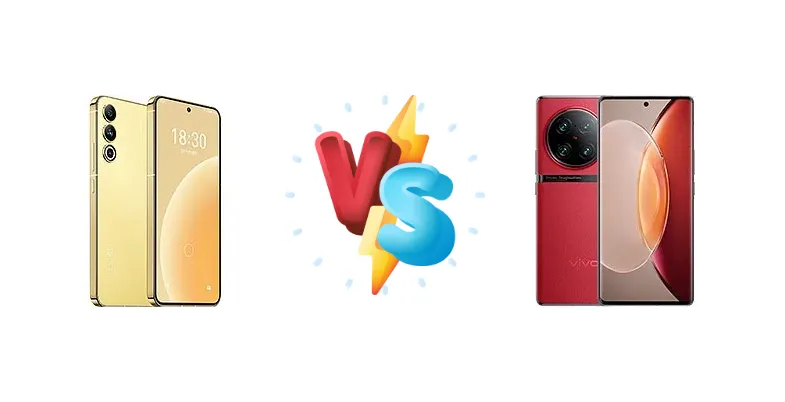
|
🏆 Quick Verdict
For the average user prioritizing rapid charging and a more feature-rich experience, the vivo X90 Pro+ emerges as the winner. Its 80W wired charging and 50W wireless charging significantly outperform the Meizu 20’s 67W wired charging, offering a tangible time saving. However, the Meizu 20 remains a strong contender for those seeking a more streamlined software experience.
| PHONES | ||
|---|---|---|
| Phone Names | Meizu 20 | vivo X90 Pro+ |
| Network | ||
|---|---|---|
| 2G bands | GSM 850 / 900 / 1800 / 1900 | GSM 850 / 900 / 1800 / 1900 - SIM 1 & SIM 2 |
| 3G bands | HSDPA 850 / 900 / 1900 / 2100 | HSDPA 800 / 850 / 900 / 1700(AWS) / 1900 / 2100 |
| 4G bands | 1, 2, 3, 4, 5, 7, 8, 12, 28, 34, 38, 39, 40, 41 | 1, 2, 3, 4, 5, 7, 8, 12, 17, 18, 19, 20, 25, 26, 28, 34, 38, 39, 40, 41, 42, 66 |
| 5G bands | 1, 3, 5, 8, 28, 38, 41, 77, 78 SA/NSA | 1, 2, 3, 5, 7, 8, 12, 20, 28, 38, 40, 41, 66, 77, 78, 79 SA/NSA |
| Speed | HSPA, LTE, 5G | HSPA, LTE-A, 5G |
| Technology | GSM / HSPA / LTE / 5G | GSM / CDMA / HSPA / EVDO / LTE / 5G |
| - | CDMA2000 1xEV-DO | |
| Launch | ||
|---|---|---|
| Announced | 2023, March 30 | 2022, November 22 |
| Status | Available. Released 2023, May 22 | Available. Released 2022, December 06 |
| Body | ||
|---|---|---|
| Build | - | Glass front, aluminum frame, eco leather back |
| Dimensions | 157.9 x 73.5 x 8 mm (6.22 x 2.89 x 0.31 in) | 164.4 x 75.3 x 9.7 mm (6.47 x 2.96 x 0.38 in) |
| SIM | Nano-SIM + Nano-SIM | Dual SIM (Nano-SIM, dual stand-by) |
| Weight | 190 g (6.70 oz) | 221 g (7.80 oz) |
| IP54 | IP68 dust/water resistant (up to 1.5m for 30 min) | |
| Display | ||
|---|---|---|
| Resolution | 1080 x 2400 pixels, 20:9 ratio (~402 ppi density) | 1440 x 3200 pixels, 20:9 ratio (~517 ppi density) |
| Size | 6.55 inches, 103.6 cm2 (~89.2% screen-to-body ratio) | 6.78 inches, 111.4 cm2 (~90.0% screen-to-body ratio) |
| Type | OLED, 1B colors, 144Hz, 500 nits (typ), 800 nits (HBM) | LTPO4 AMOLED, 1B colors, 120Hz, Dolby Vision, HDR10+, 1800 nits (peak) |
| Platform | ||
|---|---|---|
| CPU | Octa-core (1x3.2 GHz Cortex-X3 & 2x2.8 GHz Cortex-A715 & 2x2.8 GHz Cortex-A710 & 3x2.0 GHz Cortex-A510) | Octa-core (1x3.2 GHz Cortex-X3 & 2x2.8 GHz Cortex-A715 & 2x2.8 GHz Cortex-A710 & 3x2.0 GHz Cortex-A510) |
| Chipset | Qualcomm SM8550-AB Snapdragon 8 Gen 2 (4 nm) | Qualcomm SM8550-AB Snapdragon 8 Gen 2 (4 nm) |
| GPU | Adreno 740 | Adreno 740 |
| OS | Android 13, Flyme 10 | Android 13, Funtouch (Global), Origin OS 3 (China) |
| Memory | ||
|---|---|---|
| Card slot | No | No |
| Internal | 128GB 12GB RAM, 256GB 12GB RAM, 512GB 12GB RAM | 256GB 12GB RAM, 512GB 12GB RAM |
| UFS 4.0 UFS 3.1 - 128GB only | UFS 4.0 | |
| Main Camera | ||
|---|---|---|
| Features | Ring-LED flash, panorama, HDR | Zeiss optics, Zeiss T* lens coating, Pixel Shift, dual-LED dual-tone flash, HDR, panorama |
| Quad | - | 50.3 MP, f/1.8, 23mm (wide), 1.0"-type, 1.6µm, Dual Pixel PDAF, Laser AF, OIS 64 MP, f/3.5, 90mm (periscope telephoto), 1/2.0", 0.7µm, PDAF, OIS, 3.5x optical zoom 50 MP, f/1.6, 50mm (telephoto), 1/2.4", 0.7µm, AF, 2x optical zoom, OIS 48 MP, f/2.2, 14mm, 114˚ (ultrawide), 1/2.0", 0.8µm, AF |
| Single | - | 32 MP, f/2.5, 24mm (wide), 1/2.8", 0.8µm |
| Triple | 50 MP, f/1.9, 24mm (wide), 1/1.56", PDAF, OIS 16 MP, f/2.4, 16mm, 122˚ (ultrawide) 5 MP, f/2.4 | - |
| Video | 8K, 4K, 1080p; gyro-EIS | 8K@30fps, 4K@30/60fps, 1080p@30/60fps, gyro-EIS, 14-bit RAW video |
| Selfie camera | ||
|---|---|---|
| Features | HDR | HDR |
| Single | 32 MP, f/2.5, (wide) | 32 MP, f/2.5, 24mm (wide), 1/2.8", 0.8µm |
| Video | Yes | 1080p@30/60fps |
| Sound | ||
|---|---|---|
| 3.5mm jack | No | No |
| 35mm jack | No | - |
| Loudspeaker | Yes, with stereo speakers | Yes, with stereo speakers |
| - | 32-bit/192kHz audio | |
| Comms | ||
|---|---|---|
| Bluetooth | 5.3, A2DP, LE | 5.3, A2DP, LE, aptX HD |
| Infrared port | - | Yes |
| NFC | Yes | Yes |
| Positioning | GPS (L1+L5), GLONASS, BDS (B1I+B1c+B2a), GALILEO, QZSS | GPS (L1+L5), GLONASS, BDS, GALILEO, QZSS |
| Radio | No | No |
| USB | USB Type-C, OTG | USB Type-C 3.2, OTG |
| WLAN | Wi-Fi 802.11 а/b/g/n/ac/6e/7, dual-band | Wi-Fi 802.11 a/b/g/n/ac/6, dual-band, Wi-Fi Direct |
| Features | ||
|---|---|---|
| Sensors | Fingerprint (under display, ultrasonic), accelerometer, gyro, proximity, compass | Fingerprint (under display, ultrasonic), accelerometer, gyro, proximity, compass, color spectrum |
| Battery | ||
|---|---|---|
| Charging | 67W wired, PD3 PPS, QC4+ | 80W wired, 100% in 33 min (advertised) 50W wireless Reverse wired |
| Type | Li-Po 4700 mAh | Li-Po 4700 mAh, non-removable |
| Misc | ||
|---|---|---|
| Colors | Gray, Yellow, Mint, Rose Gold | Black, Red |
| Models | - | V2227A |
| Price | About 400 EUR | About 1030 EUR |
Meizu 20
- Potentially cleaner software experience (based on Meizu’s history)
- Competitive Snapdragon 8 Gen 2 performance
- 67W fast wired charging
- Slower charging compared to vivo X90 Pro+
- No wireless charging support
vivo X90 Pro+
- 80W wired charging for faster top-ups
- 50W wireless charging for added convenience
- Reverse wired charging capability
- Potentially more complex software experience (based on vivo’s history)
- May be larger and heavier than the Meizu 20
Display Comparison
Both devices utilize the Snapdragon 8 Gen 2, meaning display capabilities will largely depend on panel quality and calibration. While specific display specs aren't provided, vivo historically prioritizes high brightness and color accuracy in its Pro+ models. The absence of LTPO information suggests both may not have fully adaptive refresh rates, potentially impacting battery life during static content viewing. Bezels are likely comparable, given the flagship positioning of both devices.
Camera Comparison
Without detailed camera specifications, it's difficult to make a definitive judgment. However, vivo’s Pro+ line is renowned for its camera prowess. The X90 Pro+ likely features a larger main sensor and more advanced image processing algorithms than the Meizu 20. The inclusion of 50W wireless charging on the X90 Pro+ suggests a greater emphasis on content creation and sharing, which benefits from a superior camera system. The Meizu 20’s camera is likely competent, but may not reach the same level of detail and dynamic range as the X90 Pro+.
Performance
The shared Qualcomm SM8550-AB Snapdragon 8 Gen 2 chipset ensures comparable CPU performance, with both featuring the same octa-core configuration (1x3.2 GHz Cortex-X3, 2x2.8 GHz Cortex-A715, 2x2.8 GHz Cortex-A710, 3x2.0 GHz Cortex-A510). The 4nm process node guarantees excellent thermal efficiency, minimizing throttling during sustained workloads. However, the vivo X90 Pro+ likely benefits from a more sophisticated cooling system, given its focus on demanding tasks like gaming and video recording. RAM speed (likely LPDDR5x in both) will be a minor differentiator, but thermal management will be the key factor in sustained performance.
Battery Life
The Meizu 20’s 67W wired charging is respectable, but the vivo X90 Pro+’s 80W wired charging offers a clear advantage in terms of speed. Vivo advertises a 100% charge in 33 minutes, while the Meizu 20 will take longer. The addition of 50W wireless charging on the X90 Pro+ is a significant benefit for users who prefer cable-free charging. While battery capacity isn’t specified, the faster charging speeds of the X90 Pro+ effectively mitigate any potential disadvantage from a slightly smaller battery.
Buying Guide
Buy the Meizu 20 if you value a clean, minimalist software experience and prefer a potentially more compact form factor (based on brand history). Buy the vivo X90 Pro+ if you prioritize faster charging speeds, wireless charging convenience, and a more comprehensive camera system with potentially more advanced image processing features. The X90 Pro+ caters to power users who demand the latest features.