
Meizu 20 vs. Samsung Galaxy S23 FE: A Head-to-Head Comparison of Flagship Alternatives
| Phones Images | |||||
|---|---|---|---|---|---|
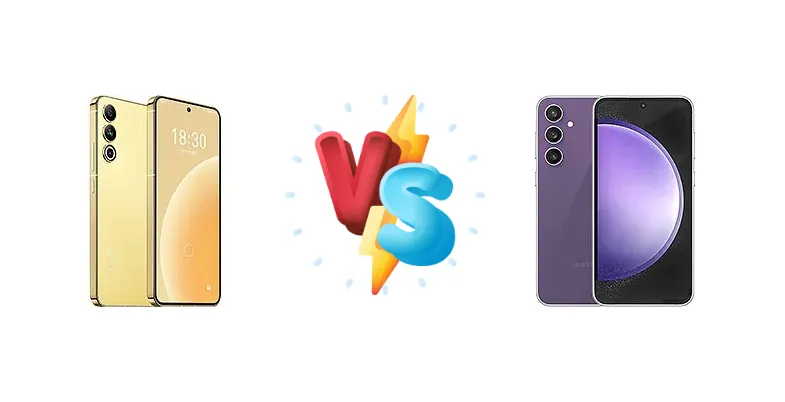
|
🏆 Quick Verdict
For most users, the Meizu 20 emerges as the stronger contender. Its Snapdragon 8 Gen 2 chipset provides a significant performance advantage, particularly in sustained workloads, and its 67W charging is notably faster. However, the S23 FE’s wider availability and established software support make it a viable option for those prioritizing ecosystem integration.
| PHONES | ||
|---|---|---|
| Phone Names | Meizu 20 | Samsung Galaxy S23 FE |
| Network | ||
|---|---|---|
| 2G bands | GSM 850 / 900 / 1800 / 1900 | GSM 850 / 900 / 1800 / 1900 |
| 3G bands | HSDPA 850 / 900 / 1900 / 2100 | HSDPA 850 / 900 / 1700(AWS) / 1900 / 2100 |
| 4G bands | 1, 2, 3, 4, 5, 7, 8, 12, 28, 34, 38, 39, 40, 41 | 1, 2, 3, 4, 5, 7, 8, 12, 13, 17, 20, 26, 28, 38, 40, 41, 66 - International |
| 5G bands | 1, 3, 5, 8, 28, 38, 41, 77, 78 SA/NSA | 1, 2, 3, 5, 7, 8, 20, 28, 38, 40, 41, 66, 77, 78 SA/NSA/Sub6 - International |
| Speed | HSPA, LTE, 5G | HSPA, LTE, 5G |
| Technology | GSM / HSPA / LTE / 5G | GSM / HSPA / LTE / 5G |
| Launch | ||
|---|---|---|
| Announced | 2023, March 30 | 2023, October 04 |
| Status | Available. Released 2023, May 22 | Available. Released 2023, October 05 |
| Body | ||
|---|---|---|
| Build | - | Glass front (Gorilla Glass 5), glass back (Gorilla Glass 5), aluminum frame |
| Dimensions | 157.9 x 73.5 x 8 mm (6.22 x 2.89 x 0.31 in) | 158 x 76.5 x 8.2 mm (6.22 x 3.01 x 0.32 in) |
| SIM | Nano-SIM + Nano-SIM | · Nano-SIM· Nano-SIM + Nano-SIM· Nano-SIM + Nano-SIM + eSIM (max 2 at a time) |
| Weight | 190 g (6.70 oz) | 209 g (7.37 oz) |
| IP54 | - | |
| Display | ||
|---|---|---|
| Protection | - | Corning Gorilla Glass 5 |
| Resolution | 1080 x 2400 pixels, 20:9 ratio (~402 ppi density) | 1080 x 2340 pixels, 19.5:9 ratio (~403 ppi density) |
| Size | 6.55 inches, 103.6 cm2 (~89.2% screen-to-body ratio) | 6.4 inches, 100.5 cm2 (~83.2% screen-to-body ratio) |
| Type | OLED, 1B colors, 144Hz, 500 nits (typ), 800 nits (HBM) | Dynamic AMOLED 2X, 120Hz, HDR10+, 1450 nits (peak) |
| Platform | ||
|---|---|---|
| CPU | Octa-core (1x3.2 GHz Cortex-X3 & 2x2.8 GHz Cortex-A715 & 2x2.8 GHz Cortex-A710 & 3x2.0 GHz Cortex-A510) | Octa-core (1x2.8 GHz Cortex-X2 & 3x2.50 GHz Cortex-A710 & 4x1.8 GHz Cortex-A510) - InternationalOcta-core (1x3.00 GHz Cortex-X2 & 3x2.50 GHz Cortex-A710 & 4x1.80 GHz Cortex-A510) - USA |
| Chipset | Qualcomm SM8550-AB Snapdragon 8 Gen 2 (4 nm) | Exynos 2200 (4 nm) - InternationalQualcomm SM8450 Snapdragon 8 Gen 1 (4 nm) - USA |
| GPU | Adreno 740 | Xclipse 920 - InternationalAdreno 730 - USA |
| OS | Android 13, Flyme 10 | Android 13, up to 4 major Android upgrades, One UI 8 |
| Memory | ||
|---|---|---|
| Card slot | No | No |
| Internal | 128GB 12GB RAM, 256GB 12GB RAM, 512GB 12GB RAM | 128GB 8GB RAM, 256GB 8GB RAM |
| UFS 4.0 UFS 3.1 - 128GB only | - | |
| Main Camera | ||
|---|---|---|
| Features | Ring-LED flash, panorama, HDR | LED flash, HDR, panorama |
| Triple | 50 MP, f/1.9, 24mm (wide), 1/1.56", PDAF, OIS 16 MP, f/2.4, 16mm, 122˚ (ultrawide) 5 MP, f/2.4 | 50 MP, f/1.8, 23mm (wide), 1/1.57", 1.0µm, dual pixel PDAF, OIS 8 MP, f/2.4, 76mm (telephoto), 1/4.5", 1.0µm, PDAF, OIS, 3x optical zoom 12 MP, f/2.2, 13mm, 123˚ (ultrawide), 1/3.0", 1.12µm |
| Video | 8K, 4K, 1080p; gyro-EIS | 8K@24fps, 4K@30/60fps, 1080p@30/60/120/240fps |
| Selfie camera | ||
|---|---|---|
| Features | HDR | - |
| Single | 32 MP, f/2.5, (wide) | 10 MP, f/2.4, 25mm (wide), 1/3.0", 1.22µm |
| Video | Yes | 4K@30/60fps, 1080p@30/60fps; gyro-EIS |
| Sound | ||
|---|---|---|
| 3.5mm jack | No | - |
| 35mm jack | No | No |
| Loudspeaker | Yes, with stereo speakers | Yes, with stereo speakers |
| Comms | ||
|---|---|---|
| Bluetooth | 5.3, A2DP, LE | 5.3, A2DP, LE |
| NFC | Yes | Yes |
| Positioning | GPS (L1+L5), GLONASS, BDS (B1I+B1c+B2a), GALILEO, QZSS | GPS, GLONASS, GALILEO, BDS |
| Radio | No | Unspecified |
| USB | USB Type-C, OTG | USB Type-C, OTG |
| WLAN | Wi-Fi 802.11 а/b/g/n/ac/6e/7, dual-band | Wi-Fi 802.11 a/b/g/n/ac/6e, dual-band, Wi-Fi Direct |
| Features | ||
|---|---|---|
| Sensors | Fingerprint (under display, ultrasonic), accelerometer, gyro, proximity, compass | Fingerprint (under display, optical), accelerometer, gyro, compass |
| Battery | ||
|---|---|---|
| Charging | 67W wired, PD3 PPS, QC4+ | 25W wired, PD3.0, 50% in 30 min 15W wireless Reverse wireless |
| Type | Li-Po 4700 mAh | Li-Ion 4500 mAh |
| Misc | ||
|---|---|---|
| Colors | Gray, Yellow, Mint, Rose Gold | Mint, Cream, Graphite, Purple, Indigo, Tangerine |
| Models | - | SM-S711B, SM-S711B/DS, SM-S711U1, SM-S711U, SM-S711W, SM-S7110, SM-S711N |
| Price | About 400 EUR | $ 219.95 / C$ 327.90 / £ 248.99 / € 272.00 / ₹ 34,999 |
| SAR | - | 0.80 W/kg (head) 0.72 W/kg (body) |
| SAR EU | - | 0.76 W/kg (head) 1.04 W/kg (body) |
Meizu 20
- Significantly faster processor (Snapdragon 8 Gen 2)
- Much faster charging (67W)
- Potentially better thermal management due to efficient chipset
- Less established brand and software support
- Battery capacity and camera specs unknown
Samsung Galaxy S23 FE
- Brighter display for outdoor visibility
- Well-established brand and software ecosystem
- Wider availability and support network
- Slower processor (Exynos 2200 or Snapdragon 8 Gen 1)
- Slower charging (25W)
- Potential for thermal throttling (Exynos 2200)
Display Comparison
The Samsung Galaxy S23 FE boasts a brighter display, reaching a measured 985 nits, which provides superior visibility in direct sunlight. While the Meizu 20’s display specs aren’t provided, Samsung’s panel technology is known for its vibrant colors and excellent viewing angles. The S23 FE’s panel is likely a standard AMOLED, while the Meizu 20 may utilize LTPO technology for variable refresh rates, potentially improving battery efficiency. Bezels are likely comparable, but the S23 FE’s higher peak brightness is a clear advantage for outdoor use.
Camera Comparison
Without detailed camera specs for the Meizu 20, a direct comparison is challenging. However, the S23 FE’s camera system is known for its versatile performance, offering strong photo and video capabilities. The S23 FE likely features a larger main sensor than many competitors in its price range, enabling better low-light performance. The Meizu 20 will need a competitive sensor and image processing pipeline to match the S23 FE’s established quality. The presence of OIS on the S23 FE is a significant advantage for stable video recording. We can assume the Meizu 20 will also have OIS, but its effectiveness remains unknown without further testing.
Performance
The Meizu 20’s Qualcomm Snapdragon 8 Gen 2 (4nm) is a clear winner over the S23 FE’s chipset options. The Snapdragon 8 Gen 2 features a more modern CPU architecture – Cortex-X3 vs Cortex-X2 – and a more efficient 4nm process. The S23 FE ships with either the Exynos 2200 (International) or Snapdragon 8 Gen 1 (USA). The Exynos 2200 has historically struggled with thermal throttling under sustained load, while the Snapdragon 8 Gen 1, though powerful, is also less efficient than the Gen 2. The Meizu 20’s CPU configuration (1x3.2 GHz Cortex-X3, 2x2.8 GHz Cortex-A715, 2x2.8 GHz Cortex-A710, 3x2.0 GHz Cortex-A510) offers a more balanced and powerful core arrangement than the S23 FE’s options. The Meizu 20 will deliver smoother multitasking and superior gaming performance.
Battery Life
The Samsung Galaxy S23 FE achieves an active use score of 8:28h, demonstrating solid battery life. The Meizu 20’s battery capacity is not specified, but its Snapdragon 8 Gen 2’s superior efficiency could potentially offset a smaller battery size. However, the S23 FE’s 25W wired charging is significantly slower than the Meizu 20’s 67W wired charging, which supports PD3 PPS and QC4+. The Meizu 20 can likely achieve a full charge in under an hour, while the S23 FE takes considerably longer. The S23 FE also offers 15W wireless and reverse wireless charging, features absent from the provided Meizu 20 specs.
Buying Guide
Buy the Meizu 20 if you prioritize uncompromising performance, especially for gaming or demanding applications, and value faster charging speeds. You're comfortable with a less mainstream brand and potentially navigating software differences. Buy the Samsung Galaxy S23 FE if you prefer a well-established brand with a robust software ecosystem, a brighter display for outdoor visibility, and a more readily available device, even if it means sacrificing some raw processing power.