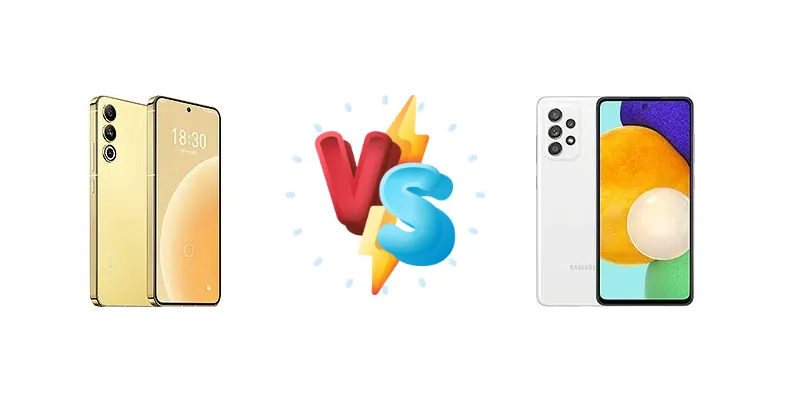
The smartphone market is brimming with options, making it tough to choose. Today, we pit the Meizu 20, a flagship contender, against the Samsung Galaxy A52 5G, a popular mid-range choice. Let's dive into a comprehensive comparison to see which device emerges victorious.
🏆 Quick Verdict
The Meizu 20 offers significantly superior performance thanks to its Snapdragon 8 Gen 2 chipset and faster charging. However, the Galaxy A52 5G boasts excellent battery life and Samsung's reliable software support. The Meizu 20 is for power users, while the A52 5G is a solid all-rounder.
| Network |
|---|
| 2G bands | GSM 850 / 900 / 1800 / 1900 | GSM 850 / 900 / 1800 / 1900 |
| 3G bands | HSDPA 850 / 900 / 1900 / 2100 | HSDPA 850 / 900 / 1700(AWS) / 1900 / 2100 |
| 4G bands | 1, 2, 3, 4, 5, 7, 8, 12, 28, 34, 38, 39, 40, 41 | 1, 2, 3, 4, 5, 7, 8, 12, 17, 20, 26, 28, 32, 38, 40, 41, 66 |
| 5G bands | 1, 3, 5, 8, 28, 38, 41, 77, 78 SA/NSA | 1, 3, 5, 7, 8, 20, 28, 38, 40, 41, 66, 78 SA/NSA/Sub6 |
| Speed | HSPA, LTE, 5G | HSPA, LTE, 5G |
| Technology | GSM / HSPA / LTE / 5G | GSM / HSPA / LTE / 5G |
| Launch |
|---|
| Announced | 2023, March 30 | 2021, March 17 |
| Status | Available. Released 2023, May 22 | Available. Released 2021, March 19 |
| Body |
|---|
| Build | - | Glass front (Gorilla Glass 5), plastic back |
| Dimensions | 157.9 x 73.5 x 8 mm (6.22 x 2.89 x 0.31 in) | 159.9 x 75.1 x 8.4 mm (6.30 x 2.96 x 0.33 in) |
| SIM | Nano-SIM + Nano-SIM | · Nano-SIM· Nano-SIM + Nano-SIM |
| Weight | 190 g (6.70 oz) | 189 g (6.67 oz) |
| | IP54 | IP67 dust/water resistant (up to 1m for 30 min) |
| Display |
|---|
| Protection | - | Corning Gorilla Glass 5 |
| Resolution | 1080 x 2400 pixels, 20:9 ratio (~402 ppi density) | 1080 x 2400 pixels, 20:9 ratio (~407 ppi density) |
| Size | 6.55 inches, 103.6 cm2 (~89.2% screen-to-body ratio) | 6.5 inches, 101.0 cm2 (~84.1% screen-to-body ratio) |
| Type | OLED, 1B colors, 144Hz, 500 nits (typ), 800 nits (HBM) | Super AMOLED, 120Hz, HDR10+, 800 nits (HBM) |
| | - | Always-on display |
| Platform |
|---|
| CPU | Octa-core (1x3.2 GHz Cortex-X3 & 2x2.8 GHz Cortex-A715 & 2x2.8 GHz Cortex-A710 & 3x2.0 GHz Cortex-A510) | Octa-core (2x2.2 GHz Kryo 570 & 6x1.8 GHz Kryo 570) |
| Chipset | Qualcomm SM8550-AB Snapdragon 8 Gen 2 (4 nm) | Qualcomm SM7225 Snapdragon 750G 5G (8 nm) |
| GPU | Adreno 740 | Adreno 619 |
| OS | Android 13, Flyme 10 | Android 11, upgradable to Android 14, One UI 6.1 |
| Memory |
|---|
| Card slot | No | microSDXC (uses shared SIM slot) |
| Internal | 128GB 12GB RAM, 256GB 12GB RAM, 512GB 12GB RAM | 128GB 4GB RAM, 128GB 6GB RAM, 128GB 8GB RAM, 256GB 4GB RAM, 256GB 8GB RAM |
| | UFS 4.0
UFS 3.1 - 128GB only | - |
| Main Camera |
|---|
| Features | Ring-LED flash, panorama, HDR | LED flash, panorama, HDR |
| Quad | - | 64 MP, f/1.8, 26mm (wide), 1/1.7X", 0.8µm, PDAF, OIS
12 MP, f/2.2, 123˚ (ultrawide), 1.12µm
5 MP (macro)
Auxiliary lens |
| Triple | 50 MP, f/1.9, 24mm (wide), 1/1.56", PDAF, OIS
16 MP, f/2.4, 16mm, 122˚ (ultrawide)
5 MP, f/2.4 | - |
| Video | 8K, 4K, 1080p; gyro-EIS | 4K@30fps, 1080p@30/60fps; gyro-EIS |
| Selfie camera |
|---|
| Features | HDR | HDR |
| Single | 32 MP, f/2.5, (wide) | 32 MP, f/2.2, 26mm (wide), 1/2.8", 0.8µm |
| Video | Yes | 4K@30fps, 1080p@30fps |
| Sound |
|---|
| 3.5mm jack | No | Yes |
| 35mm jack | No | Yes |
| Loudspeaker | Yes, with stereo speakers | Yes, with stereo speakers |
| Comms |
|---|
| Bluetooth | 5.3, A2DP, LE | 5.0, A2DP, LE |
| NFC | Yes | Yes (market/region dependent) |
| Positioning | GPS (L1+L5), GLONASS, BDS (B1I+B1c+B2a), GALILEO, QZSS | GPS, GLONASS, GALILEO, BDS |
| Radio | No | FM radio (market/region dependent) |
| USB | USB Type-C, OTG | USB Type-C 2.0, OTG |
| WLAN | Wi-Fi 802.11 а/b/g/n/ac/6e/7, dual-band | Wi-Fi 802.11 a/b/g/n/ac, dual-band, Wi-Fi Direct |
| Features |
|---|
| Sensors | Fingerprint (under display, ultrasonic), accelerometer, gyro, proximity, compass | Fingerprint (under display, optical), accelerometer, gyro, compass |
| | - | Virtual proximity sensing |
| Battery |
|---|
| Charging | 67W wired, PD3 PPS, QC4+ | 25W wired, 50% in 30 min |
| Type | Li-Po 4700 mAh | Li-Po 4500 mAh |
| Misc |
|---|
| Colors | Gray, Yellow, Mint, Rose Gold | Awesome Black, Awesome White, Awesome Violet, Awesome Blue |
| Models | - | SM-A526B, SM-A526B/DS, SM-A5260, SM-A526W, SM-A526U, SM-A526U1 |
| Price | About 400 EUR | $ 137.39 / £ 280.00 / € 115.49 |
| SAR | - | 0.74 W/kg (head) 0.53 W/kg (body) |
| SAR EU | - | 1.05 W/kg (head) 1.42 W/kg (body) |
| Tests |
|---|
| Battery life | - |
Endurance rating 111h
|
| Camera | - |
Photo / Video |
| Display | - |
Contrast ratio: Infinite (nominal) |
| Loudspeaker | - |
-27.5 LUFS (Good)
|
| Performance | - |
AnTuTu: 334981 (v8), 386474 (v9)
GeekBench: 1820 (v5.1)
GFXBench: 16fps (ES 3.1 onscreen) |
Meizu 20
- Flagship Performance (Snapdragon 8 Gen 2)
- Fast Charging (67W)
- Premium Design & Build
- Likely Superior Display
- Potentially Better Camera
- Higher Price
- Meizu's Software Support (potentially less robust than Samsung)
- Battery life may be shorter than A52 5G
Samsung Galaxy A52 5G
- Excellent Battery Life
- Samsung's Software Support & Ecosystem
- Reliable Camera Performance
- More Affordable
- Water and Dust Resistance (likely IP67)
- Mid-Range Performance (Snapdragon 750G)
- Slower Charging (25W)
- Less Premium Design
- Lower Display Quality compared to Meizu 20
Display Comparison
The Meizu 20 likely features a higher resolution AMOLED display with a 120Hz refresh rate, offering vibrant colors and smooth scrolling. The Galaxy A52 5G has a respectable 787 nits brightness and an infinite contrast ratio, but likely lacks the same level of visual fidelity as the Meizu 20. Expect better color accuracy and HDR support on the Meizu.
Camera Comparison
While both phones offer Photo/Video capabilities, the Meizu 20's higher-end chipset likely translates to better image processing and potentially a more advanced camera system. The Galaxy A52 5G is known for its consistent and reliable camera performance, particularly in good lighting conditions. Expect better low-light performance and video stabilization on the Meizu.
Performance
Here's where the Meizu 20 truly shines. The Snapdragon 8 Gen 2 is a powerhouse, easily handling demanding games and multitasking. The Galaxy A52 5G's Snapdragon 750G is capable, but noticeably slower, especially in graphically intensive tasks. Expect smoother performance and faster app loading times on the Meizu.
Battery Life
The Galaxy A52 5G's endurance rating of 111h is impressive, suggesting exceptional battery life. The Meizu 20, while having a smaller battery capacity, benefits from 67W fast charging, allowing for quicker top-ups. The A52 5G will likely last longer on a single charge, but the Meizu 20 will charge much faster.
Buying Guide
The Meizu 20 is ideal for users who prioritize raw power, fast charging, and a premium experience. The Samsung Galaxy A52 5G is a great choice for those seeking a dependable phone with long battery life, a good camera, and Samsung's ecosystem, all at a more accessible price point.
Frequently Asked Questions
❓ Is the Meizu 20 worth the extra cost?
If you prioritize performance and fast charging, the Meizu 20 is a worthwhile investment. However, if you're on a budget and value battery life and Samsung's software, the Galaxy A52 5G is a better choice.
❓ How does the software experience differ between the two phones?
The Galaxy A52 5G benefits from Samsung's One UI, known for its features and stability. Meizu's Flyme OS is generally clean but may lack some of the polish and long-term support of One UI.