
Meizu 20 vs Oppo Find X6 Pro: A Deep Dive into Flagship Android
| Phones Images | |||||
|---|---|---|---|---|---|
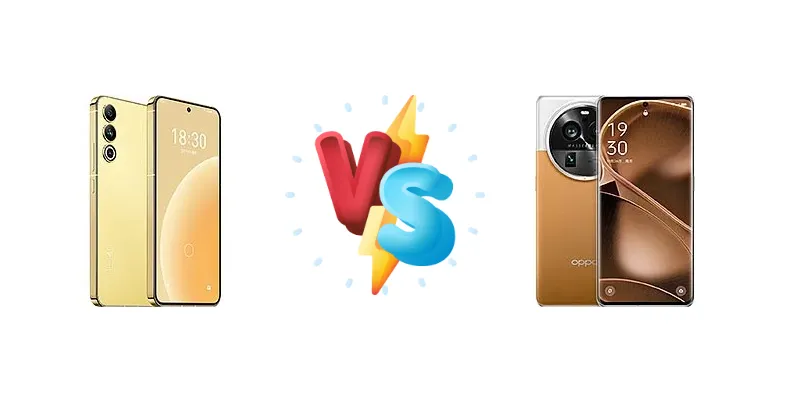
|
🏆 Quick Verdict
For most users, the Oppo Find X6 Pro emerges as the stronger contender. Its significantly faster 100W wired and 50W wireless charging, coupled with a brighter display, provide tangible benefits. While the Meizu 20 is a capable device, the X6 Pro’s charging and display advantages justify its price premium.
| PHONES | ||
|---|---|---|
| Phone Names | Meizu 20 | Oppo Find X6 Pro |
| Network | ||
|---|---|---|
| 2G bands | GSM 850 / 900 / 1800 / 1900 | GSM 850 / 900 / 1800 / 1900 |
| 3G bands | HSDPA 850 / 900 / 1900 / 2100 | HSDPA 800 / 850 / 900 / 1700(AWS) / 1900 / 2100 |
| 4G bands | 1, 2, 3, 4, 5, 7, 8, 12, 28, 34, 38, 39, 40, 41 | 1, 2, 3, 4, 5, 7, 8, 12, 17, 18, 19, 20, 26, 28, 34, 38, 39, 40, 41, 66 |
| 5G bands | 1, 3, 5, 8, 28, 38, 41, 77, 78 SA/NSA | 1, 3, 5, 7, 8, 20, 28, 38, 40, 41, 66, 77, 78, 79 SA/NSA |
| Speed | HSPA, LTE, 5G | HSPA, LTE, 5G |
| Technology | GSM / HSPA / LTE / 5G | GSM / CDMA / HSPA / CDMA2000 / LTE / 5G |
| - | CDMA2000 1x | |
| Launch | ||
|---|---|---|
| Announced | 2023, March 30 | 2023, March 21 |
| Status | Available. Released 2023, May 22 | Available. Released 2023, March 24 |
| Body | ||
|---|---|---|
| Build | - | Glass front (Gorilla Glass Victus 2), glass back (Gorilla Glass 5) or eco leather back, aluminum frame |
| Dimensions | 157.9 x 73.5 x 8 mm (6.22 x 2.89 x 0.31 in) | 164.8 x 76.2 x 9.1 mm or 9.5 mm |
| SIM | Nano-SIM + Nano-SIM | Nano-SIM + Nano-SIM |
| Weight | 190 g (6.70 oz) | 216 g or 218 g (7.62 oz) |
| IP54 | IP68 dust/water resistant (up to 1.5m for 30 min) | |
| Display | ||
|---|---|---|
| Protection | - | Corning Gorilla Glass Victus 2 |
| Resolution | 1080 x 2400 pixels, 20:9 ratio (~402 ppi density) | 1440 x 3168 pixels (~510 ppi density) |
| Size | 6.55 inches, 103.6 cm2 (~89.2% screen-to-body ratio) | 6.82 inches, 113.0 cm2 (~90.0% screen-to-body ratio) |
| Type | OLED, 1B colors, 144Hz, 500 nits (typ), 800 nits (HBM) | LTPO3 AMOLED, 1B colors, 120Hz, Dolby Vision, HDR10+, 800 nits (typ), 1500 nits (HBM), 2500 nits (peak) |
| Platform | ||
|---|---|---|
| CPU | Octa-core (1x3.2 GHz Cortex-X3 & 2x2.8 GHz Cortex-A715 & 2x2.8 GHz Cortex-A710 & 3x2.0 GHz Cortex-A510) | Octa-core (1x3.2 GHz Cortex-X3 & 2x2.8 GHz Cortex-A715 & 2x2.8 GHz Cortex-A710 & 3x2.0 GHz Cortex-A510) |
| Chipset | Qualcomm SM8550-AB Snapdragon 8 Gen 2 (4 nm) | Qualcomm SM8550-AB Snapdragon 8 Gen 2 (4 nm) |
| GPU | Adreno 740 | Adreno 740 |
| OS | Android 13, Flyme 10 | Android 13, up to 4 major Android upgrades, ColorOS 14 |
| Memory | ||
|---|---|---|
| Card slot | No | No |
| Internal | 128GB 12GB RAM, 256GB 12GB RAM, 512GB 12GB RAM | 256GB 12GB RAM, 256GB 16GB RAM, 512GB 16GB RAM |
| UFS 4.0 UFS 3.1 - 128GB only | UFS 4.0 | |
| Main Camera | ||
|---|---|---|
| Features | Ring-LED flash, panorama, HDR | Laser AF, color spectrum sensor, Hasselblad Color Calibration, LED flash, HDR, panorama |
| Triple | 50 MP, f/1.9, 24mm (wide), 1/1.56", PDAF, OIS 16 MP, f/2.4, 16mm, 122˚ (ultrawide) 5 MP, f/2.4 | 50 MP, f/1.8, 23mm (wide), 1.0"-type, 1.6µm, dual pixel PDAF, OIS 50 MP, f/2.6, 65mm (periscope telephoto), 1/1.56", 1.0µm, 2.8x optical zoom, multi-directional PDAF, OIS 50 MP, f/2.2, 15mm, 110˚ (ultrawide), 1/1.56", 1.0µm, multi-directional PDAF |
| Video | 8K, 4K, 1080p; gyro-EIS | 4K@30/60fps, 1080p@30/60/240fps; gyro-EIS; HDR, 10‑bit video, Dolby Vision |
| Selfie camera | ||
|---|---|---|
| Features | HDR | Panorama |
| Single | 32 MP, f/2.5, (wide) | 32 MP, f/2.4, 21mm (wide), 1/2.74", 0.8µm, PDAF |
| Video | Yes | 4K@30fps, gyro-EIS |
| Sound | ||
|---|---|---|
| 3.5mm jack | No | No |
| 35mm jack | No | No |
| Loudspeaker | Yes, with stereo speakers | Yes, with stereo speakers |
| Comms | ||
|---|---|---|
| Bluetooth | 5.3, A2DP, LE | 5.3, A2DP, LE, aptX HD |
| Infrared port | - | Yes |
| NFC | Yes | Yes |
| Positioning | GPS (L1+L5), GLONASS, BDS (B1I+B1c+B2a), GALILEO, QZSS | GPS (L1+L5), GLONASS (G1), BDS (B1I+B1c+B2a), GALILEO (E1+E5a), QZSS (L1+L5) |
| Radio | No | No |
| USB | USB Type-C, OTG | USB Type-C 3.1, OTG |
| WLAN | Wi-Fi 802.11 а/b/g/n/ac/6e/7, dual-band | Wi-Fi 802.11 a/b/g/n/ac/6e/7, tri-band, Wi-Fi Direct |
| Features | ||
|---|---|---|
| Sensors | Fingerprint (under display, ultrasonic), accelerometer, gyro, proximity, compass | Fingerprint (under display, optical), accelerometer, gyro, proximity, compass |
| Battery | ||
|---|---|---|
| Charging | 67W wired, PD3 PPS, QC4+ | 100W wired, PD, 45% in 10 min, 100% in 30 min 50W wireless, 50% in 22 min, 100% in 51 min 10W reverse wireless |
| Type | Li-Po 4700 mAh | Li-Po 5000 mAh |
| Misc | ||
|---|---|---|
| Colors | Gray, Yellow, Mint, Rose Gold | Black, Green, Brown |
| Models | - | PGEM110, PGEM10 |
| Price | About 400 EUR | About 820 EUR |
| Tests | ||
|---|---|---|
| Battery life | - | Endurance rating 114h |
| Camera | - | Photo / Video |
| Display | - | Contrast ratio: Infinite (nominal) |
| Loudspeaker | - | -25.1 LUFS (Very good) |
| Performance | - | AnTuTu: 1294797 (v9) GeekBench: 4791 (v5.1), 5226 (v6) GFXBench: 60fps (ES 3.1 onscreen) |
Meizu 20
- Potentially cleaner software experience (Meizu)
- Snapdragon 8 Gen 2 performance
- 67W fast charging
- Slower charging compared to Oppo
- Missing display specifications
- Limited camera information
Oppo Find X6 Pro
- 100W wired and 50W wireless charging
- Brighter display (1318 nits)
- Infinite contrast ratio
- Potentially more aggressive thermal throttling
- Oppo’s ColorOS software (subjective)
- Higher price point
Display Comparison
The Oppo Find X6 Pro boasts a notably brighter display, reaching a measured 1318 nits. This is a significant advantage in direct sunlight, ensuring excellent visibility. While the Meizu 20’s display specifications aren’t provided, the X6 Pro’s brightness level suggests a superior outdoor viewing experience. Both devices likely utilize LTPO technology for adaptive refresh rates, conserving battery life, but the X6 Pro’s infinite contrast ratio (nominal) hints at deeper blacks and a more immersive visual experience. The lack of PWM frequency data for the Meizu 20 makes it difficult to assess its suitability for users sensitive to screen flicker, a potential concern.
Camera Comparison
Both devices are listed as having Photo/Video capabilities, but detailed camera specifications are absent for the Meizu 20. The Oppo Find X6 Pro is expected to feature a sophisticated camera system, likely including a large main sensor and advanced image processing algorithms. Without knowing the sensor sizes, apertures, or OIS implementation on the Meizu 20, it’s difficult to make a direct comparison. The inclusion of a 2MP macro camera on either device is unlikely to significantly impact image quality, serving primarily as a marketing feature.
Performance
Both the Meizu 20 and Oppo Find X6 Pro are powered by the Qualcomm SM8550-AB Snapdragon 8 Gen 2 (4 nm) chipset, featuring the same Octa-core CPU configuration. This means raw processing power will be virtually identical for most tasks. The 4nm fabrication process ensures excellent thermal efficiency, minimizing throttling during sustained workloads. However, Oppo’s typically aggressive thermal management strategies may lead to slightly more conservative performance curves compared to Meizu, which historically has been less restrictive. RAM specifications are missing for the Meizu 20, but both devices likely utilize LPDDR5x RAM for fast data access.
Battery Life
The Oppo Find X6 Pro’s charging capabilities are a clear standout. Its 100W wired charging can replenish the battery to 100% in just 30 minutes, with a 45% charge achievable in only 10 minutes. Furthermore, the 50W wireless charging (reaching 100% in 51 minutes) and 10W reverse wireless charging offer exceptional convenience. The Meizu 20’s 67W wired charging, while respectable, is considerably slower. Both devices have an endurance rating of 114h, suggesting similar battery life under typical usage, but the X6 Pro’s faster charging mitigates any potential concerns about battery drain.
Buying Guide
Buy the Meizu 20 if you prioritize a more streamlined software experience and are comfortable with slightly slower charging speeds. It’s a solid choice for users who value a clean Android interface and don’t require the absolute fastest charging available. Buy the Oppo Find X6 Pro if you demand the quickest possible charging – both wired and wireless – and appreciate a brighter, more vibrant display. This phone is ideal for power users and those who frequently find themselves needing to top up their battery quickly.