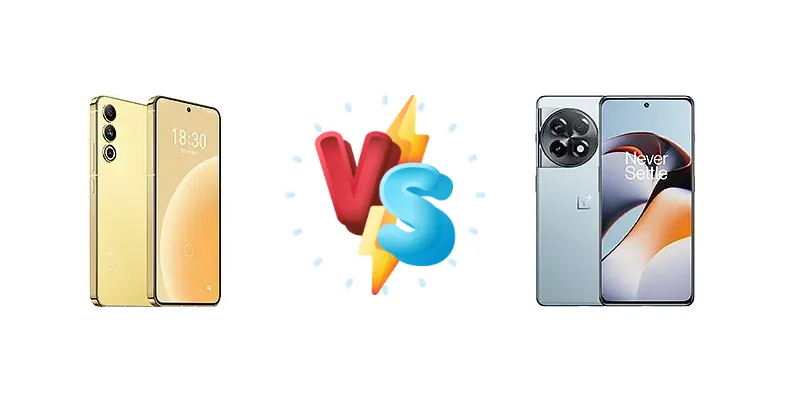
The Meizu 20 arrives as a flagship contender powered by the latest Snapdragon 8 Gen 2, while the OnePlus 11R offers a compelling value proposition with the Snapdragon 8+ Gen 1. This comparison dissects the core differences between these two devices, focusing on performance, charging speeds, and the user experience each chipset delivers.
🏆 Quick Verdict
For the average user prioritizing raw performance and future-proofing, the Meizu 20 takes the lead thanks to the Snapdragon 8 Gen 2. However, the OnePlus 11R’s 100W charging and competitive price make it a strong choice for those seeking a balance between power and affordability.
| Network |
|---|
| 2G bands | GSM 850 / 900 / 1800 / 1900 | GSM 850 / 900 / 1800 / 1900 |
| 3G bands | HSDPA 850 / 900 / 1900 / 2100 | HSDPA 850 / 900 / 1700(AWS) / 2100 |
| 4G bands | 1, 2, 3, 4, 5, 7, 8, 12, 28, 34, 38, 39, 40, 41 | 1, 3, 4, 5, 8, 28, 34, 38, 39, 40, 41 |
| 5G bands | 1, 3, 5, 8, 28, 38, 41, 77, 78 SA/NSA | 1, 3, 5, 8, 28, 40, 41, 77, 78 SA/NSA |
| Speed | HSPA, LTE, 5G | HSPA, LTE (3CA), 5G |
| Technology | GSM / HSPA / LTE / 5G | GSM / CDMA / HSPA / LTE / 5G |
| | - | CDMA 800 |
| Launch |
|---|
| Announced | 2023, March 30 | 2023, February 07 |
| Status | Available. Released 2023, May 22 | Available. Released 2023, February 21 |
| Body |
|---|
| Build | - | Glass front, glass back (Gorilla Glass 5), plastic frame |
| Dimensions | 157.9 x 73.5 x 8 mm (6.22 x 2.89 x 0.31 in) | 163.4 x 74.3 x 8.7 mm (6.43 x 2.93 x 0.34 in) |
| SIM | Nano-SIM + Nano-SIM | Nano-SIM + Nano-SIM |
| Weight | 190 g (6.70 oz) | 204 g (7.20 oz) |
| | IP54 | - |
| Display |
|---|
| Resolution | 1080 x 2400 pixels, 20:9 ratio (~402 ppi density) | 1240 x 2772 pixels, 20:9 ratio (~451 ppi density) |
| Size | 6.55 inches, 103.6 cm2 (~89.2% screen-to-body ratio) | 6.74 inches, 109.2 cm2 (~90.0% screen-to-body ratio) |
| Type | OLED, 1B colors, 144Hz, 500 nits (typ), 800 nits (HBM) | Fluid AMOLED, 1B colors, 120Hz, HDR10+, 1450 nits (peak) |
| Platform |
|---|
| CPU | Octa-core (1x3.2 GHz Cortex-X3 & 2x2.8 GHz Cortex-A715 & 2x2.8 GHz Cortex-A710 & 3x2.0 GHz Cortex-A510) | Octa-core (1x3.0 GHz Cortex-X2 & 3x2.5 GHz Cortex-A710 & 4x1.80 GHz Cortex-A510) |
| Chipset | Qualcomm SM8550-AB Snapdragon 8 Gen 2 (4 nm) | Qualcomm SM8475 Snapdragon 8+ Gen 1 (4 nm) |
| GPU | Adreno 740 | Adreno 730 |
| OS | Android 13, Flyme 10 | Android 13, upgradable to Android 15, OxygenOS 15 |
| Memory |
|---|
| Card slot | No | No |
| Internal | 128GB 12GB RAM, 256GB 12GB RAM, 512GB 12GB RAM | 128GB 8GB RAM, 256GB 16GB RAM, 512GB 18GB RAM |
| | UFS 4.0
UFS 3.1 - 128GB only | UFS 3.1 |
| Main Camera |
|---|
| Features | Ring-LED flash, panorama, HDR | Color spectrum sensor, LED flash, HDR, panorama |
| Single | - | 16 MP, f/2.4, 24mm (wide), 1/3.09", 1.0µm |
| Triple | 50 MP, f/1.9, 24mm (wide), 1/1.56", PDAF, OIS
16 MP, f/2.4, 16mm, 122˚ (ultrawide)
5 MP, f/2.4 | 50 MP, f/1.8, 24mm (wide), 1/1.56", 1.0µm, multi-directional PDAF, OIS
8 MP, f/2.2, 120˚ (ultrawide), 1/4.0", 1.12µm
2 MP (macro) |
| Video | 8K, 4K, 1080p; gyro-EIS | 4K@30/60fps, 1080p@30/60/240fps, gyro-EIS |
| Selfie camera |
|---|
| Features | HDR | HDR |
| Single | 32 MP, f/2.5, (wide) | 16 MP, f/2.4, 24mm (wide), 1/3.09", 1.0µm |
| Video | Yes | 1080p@30fps |
| Sound |
|---|
| 3.5mm jack | No | No |
| 35mm jack | No | No |
| Loudspeaker | Yes, with stereo speakers | Yes, with stereo speakers |
| | - | 24-bit/192kHz audio |
| Comms |
|---|
| Bluetooth | 5.3, A2DP, LE | 5.3, A2DP, LE, aptX HD |
| Infrared port | - | Yes |
| NFC | Yes | Yes |
| Positioning | GPS (L1+L5), GLONASS, BDS (B1I+B1c+B2a), GALILEO, QZSS | GPS (L1+L5), GLONASS (G1), BDS (B1I+B1c+B2a), GALILEO (E1+E5a), QZSS (L1+L5) |
| Radio | No | No |
| USB | USB Type-C, OTG | USB Type-C 2.0 |
| WLAN | Wi-Fi 802.11 а/b/g/n/ac/6e/7, dual-band | Wi-Fi 802.11 a/b/g/n/ac/6, dual-band |
| Features |
|---|
| Sensors | Fingerprint (under display, ultrasonic), accelerometer, gyro, proximity, compass | Fingerprint (under display, optical), accelerometer, gyro, proximity, compass |
| Battery |
|---|
| Charging | 67W wired, PD3 PPS, QC4+ | 100W wired |
| Type | Li-Po 4700 mAh | Li-Po 5000 mAh |
| Misc |
|---|
| Colors | Gray, Yellow, Mint, Rose Gold | Galactic Silver, Sonic Black, Solar Red |
| Models | - | CPH2487 |
| Price | About 400 EUR | About 600 EUR |
| SAR | - | 1.16 W/kg (head) 0.61 W/kg (body) |
Meizu 20
- Superior performance with Snapdragon 8 Gen 2
- Potentially better thermal management
- Likely more advanced camera system
- Slower charging speed (67W)
- Higher price point
OnePlus 11R
- Incredibly fast 100W charging
- Competitive price
- Excellent performance for the price
- Older Snapdragon 8+ Gen 1 chipset
- Potentially more thermal throttling under sustained load
Display Comparison
While specific display details are missing, both phones likely utilize AMOLED panels given their market positioning. The key difference will be in calibration and potentially refresh rate. The Meizu 20, being a flagship, may offer LTPO technology for adaptive refresh rates, improving battery life. The OnePlus 11R will likely focus on a high refresh rate (120Hz or higher) for smooth scrolling and gaming. Bezels are expected to be minimal on both, but the Meizu 20’s design language may prioritize a more symmetrical aesthetic.
Camera Comparison
Without detailed camera specs, it’s difficult to make a definitive judgment. However, the Meizu 20, as a flagship, is expected to feature a more advanced camera system with a larger primary sensor and potentially more sophisticated image processing algorithms. The OnePlus 11R will likely offer a capable camera setup, but may prioritize value over absolute image quality. Expect both phones to offer a range of shooting modes, but the Meizu 20 may excel in low-light performance and dynamic range.
Performance
The Meizu 20’s Snapdragon 8 Gen 2 (4nm) represents a significant architectural leap over the OnePlus 11R’s Snapdragon 8+ Gen 1 (4nm). The Gen 2 features a new CPU configuration – 1x3.2 GHz Cortex-X3, 2x2.8 GHz Cortex-A715, 2x2.8 GHz Cortex-A710, and 3x2.0 GHz Cortex-A510 – offering improved single-core and multi-core performance compared to the 1x3.0 GHz Cortex-X2, 3x2.5 GHz Cortex-A710, and 4x1.80 GHz Cortex-A510 in the 11R. The Gen 2’s more efficient 4nm process also translates to better thermal management, reducing the likelihood of sustained throttling during demanding tasks. Gamers and power users will see a noticeable advantage with the Meizu 20.
Battery Life
The OnePlus 11R’s 100W wired charging is a major advantage, allowing for a full charge in under 30 minutes. The Meizu 20’s 67W charging, while still fast, is significantly slower. This difference is crucial for users who prioritize minimizing downtime. While battery capacity isn’t specified, the Snapdragon 8 Gen 2’s improved efficiency in the Meizu 20 could offset the OnePlus 11R’s potentially larger battery, resulting in comparable real-world battery life despite the charging speed disparity.
Buying Guide
Buy the Meizu 20 if you demand the absolute best performance available in an Android phone, prioritize the latest technology, and are willing to pay a premium. Buy the OnePlus 11R if you want excellent performance for gaming and everyday tasks, value incredibly fast charging, and are looking for a more budget-friendly flagship experience.
Frequently Asked Questions
❓ Will the Snapdragon 8+ Gen 1 in the OnePlus 11R struggle with demanding games like Genshin Impact after extended play sessions?
The Snapdragon 8+ Gen 1 is a capable chipset, but it is more prone to thermal throttling than the Snapdragon 8 Gen 2. While the OnePlus 11R will likely handle Genshin Impact well initially, you may experience frame drops or reduced performance after 30-60 minutes of continuous gameplay. The Meizu 20’s superior thermal management should provide a more consistent gaming experience.
❓ How much faster is the charging on the OnePlus 11R compared to the Meizu 20 in real-world usage?
The OnePlus 11R’s 100W charging can take the battery from 0% to 100% in approximately 25-30 minutes. The Meizu 20’s 67W charging will likely take around 45-60 minutes for a full charge. This means you can quickly top up the OnePlus 11R during short breaks, while the Meizu 20 requires a longer charging period.
❓ Does the Meizu 20's Snapdragon 8 Gen 2 offer a noticeable improvement in everyday tasks like browsing and social media compared to the OnePlus 11R?
While both phones will feel incredibly responsive for everyday tasks, the Snapdragon 8 Gen 2 in the Meizu 20 provides a slight edge in processing speed. This translates to marginally faster app loading times and smoother multitasking. However, the difference is unlikely to be noticeable for most casual users.