
Meizu 20 vs. Asus ROG Phone 7 Ultimate: A Deep Dive into Flagship Performance
| Phones Images | |||||
|---|---|---|---|---|---|
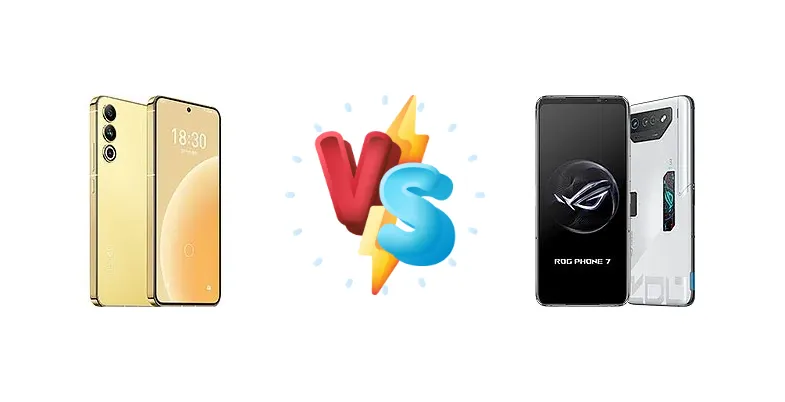
|
🏆 Quick Verdict
For the average user prioritizing a balanced, pocketable flagship, the Meizu 20 offers a compelling package. However, the Asus ROG Phone 7 Ultimate is the clear winner for dedicated mobile gamers who demand maximum performance, cooling, and gaming-centric features.
| PHONES | ||
|---|---|---|
| Phone Names | Meizu 20 | Asus ROG Phone 7 Ultimate |
| Network | ||
|---|---|---|
| 2G bands | GSM 850 / 900 / 1800 / 1900 | GSM 850 / 900 / 1800 / 1900 |
| 3G bands | HSDPA 850 / 900 / 1900 / 2100 | HSDPA 800 / 850 / 900 / 1700(AWS) / 1900 / 2100 |
| 4G bands | 1, 2, 3, 4, 5, 7, 8, 12, 28, 34, 38, 39, 40, 41 | 1, 2, 3, 4, 5, 7, 8, 12, 17, 18, 19, 20, 25, 26, 28, 32, 34, 38, 39, 40, 41, 42, 43, 48, 66 - International |
| 5G bands | 1, 3, 5, 8, 28, 38, 41, 77, 78 SA/NSA | 1, 2, 3, 5, 7, 8, 12, 18, 20, 25, 26, 28, 38, 40, 41, 48, 66, 77, 78, 79 SA/NSA/Sub6 - International |
| Speed | HSPA, LTE, 5G | HSPA, LTE (Up to 7CA), 5G |
| Technology | GSM / HSPA / LTE / 5G | GSM / CDMA / HSPA / LTE / 5G |
| - | 1, 3, 5, 8, 28, 41, 77, 78, 79 SA/NSA/Sub6 - China | |
| Launch | ||
|---|---|---|
| Announced | 2023, March 30 | 2023, April 13 |
| Status | Available. Released 2023, May 22 | Available. Released 2023, May |
| Body | ||
|---|---|---|
| Build | - | Glass front (Gorilla Glass Victus), glass back (Gorilla Glass 3), aluminum frame |
| Dimensions | 157.9 x 73.5 x 8 mm (6.22 x 2.89 x 0.31 in) | 173 x 77 x 10.3 mm (6.81 x 3.03 x 0.41 in) |
| SIM | Nano-SIM + Nano-SIM | Nano-SIM + Nano-SIM |
| Weight | 190 g (6.70 oz) | 239 g (8.43 oz) |
| IP54 | Built-in motorized cooling air vent (AeroActive Portal) IP54 water resistant 2" OLED display (on the back) Pressure sensitive zones (Gaming triggers) | |
| Display | ||
|---|---|---|
| Protection | - | Corning Gorilla Glass Victus |
| Resolution | 1080 x 2400 pixels, 20:9 ratio (~402 ppi density) | 1080 x 2448 pixels (~395 ppi density) |
| Size | 6.55 inches, 103.6 cm2 (~89.2% screen-to-body ratio) | 6.78 inches, 109.5 cm2 (~82.2% screen-to-body ratio) |
| Type | OLED, 1B colors, 144Hz, 500 nits (typ), 800 nits (HBM) | AMOLED, 1B colors, 165Hz, HDR10+, 1000 nits (HBM), 1500 nits (peak) |
| Platform | ||
|---|---|---|
| CPU | Octa-core (1x3.2 GHz Cortex-X3 & 2x2.8 GHz Cortex-A715 & 2x2.8 GHz Cortex-A710 & 3x2.0 GHz Cortex-A510) | Octa-core (1x3.2 GHz Cortex-X3 & 2x2.8 GHz Cortex-A715 & 2x2.8 GHz Cortex-A710 & 3x2.0 GHz Cortex-A510) |
| Chipset | Qualcomm SM8550-AB Snapdragon 8 Gen 2 (4 nm) | Qualcomm SM8550-AB Snapdragon 8 Gen 2 (4 nm) |
| GPU | Adreno 740 | Adreno 740 |
| OS | Android 13, Flyme 10 | Android 13, up to 2 major Android upgrades |
| Memory | ||
|---|---|---|
| Card slot | No | No |
| Internal | 128GB 12GB RAM, 256GB 12GB RAM, 512GB 12GB RAM | 512GB 16GB RAM |
| UFS 4.0 UFS 3.1 - 128GB only | UFS 4.0 NTFS support for external storage | |
| Main Camera | ||
|---|---|---|
| Features | Ring-LED flash, panorama, HDR | LED flash, HDR, panorama |
| Triple | 50 MP, f/1.9, 24mm (wide), 1/1.56", PDAF, OIS 16 MP, f/2.4, 16mm, 122˚ (ultrawide) 5 MP, f/2.4 | 50 MP, f/1.9, 24mm (wide), 1/1.56", 1.0µm, PDAF 13 MP, f/2.2, 13mm, 120˚ (ultrawide) 5 MP (macro) |
| Video | 8K, 4K, 1080p; gyro-EIS | 8K@24fps, 4K@30/60fps, 1080p@30/60/120/240fps, 720p@480fps; gyro-EIS, HDR10+ |
| Selfie camera | ||
|---|---|---|
| Features | HDR | Panorama, HDR |
| Single | 32 MP, f/2.5, (wide) | 32 MP, f/2.5, 29mm (wide), 1/3.2", 0.7µm |
| Video | Yes | 1080p@30fps |
| Sound | ||
|---|---|---|
| 3.5mm jack | No | Yes |
| 35mm jack | No | Yes |
| Loudspeaker | Yes, with stereo speakers | Yes, with stereo speakers (2 amplifiers) |
| - | 32-bit/384kHz audio | |
| Comms | ||
|---|---|---|
| Bluetooth | 5.3, A2DP, LE | 5.3, A2DP, LE, aptX HD, aptX Adaptive, aptX Lossless |
| NFC | Yes | Yes |
| Positioning | GPS (L1+L5), GLONASS, BDS (B1I+B1c+B2a), GALILEO, QZSS | GPS (L1+L5), GLONASS (L1), BDS (B1I+B1c+B2a), GALILEO (E1+E5a), QZSS (L1+L5), NavIC (L5) |
| Radio | No | No |
| USB | USB Type-C, OTG | USB Type-C 3.1 (side), DisplayPort 1.4; USB Type-C 2.0 (bottom), OTG, accessory connector |
| WLAN | Wi-Fi 802.11 а/b/g/n/ac/6e/7, dual-band | Wi-Fi 802.11 a/b/g/n/ac/6e/7, tri-band, Wi-Fi Direct |
| Features | ||
|---|---|---|
| Sensors | Fingerprint (under display, ultrasonic), accelerometer, gyro, proximity, compass | Fingerprint (under display, optical), accelerometer, gyro, proximity, compass |
| Battery | ||
|---|---|---|
| Charging | 67W wired, PD3 PPS, QC4+ | 65W wired, PD3.0, QC5, 100% in 42 min 10W reverse wired |
| Type | Li-Po 4700 mAh | Li-Po 6000 mAh |
| Misc | ||
|---|---|---|
| Colors | Gray, Yellow, Mint, Rose Gold | Storm White |
| Price | About 400 EUR | About 780 EUR |
| Tests | ||
|---|---|---|
| Battery life | - | Endurance rating 131h |
| Camera | - | Photo / Video |
| Display | - | Contrast ratio: Infinite (nominal) |
| Loudspeaker | - | -25.5 LUFS (Very good) |
| Performance | - | AnTuTu: 1325105 (v9) GeekBench: 5139 (v5.5), 5567 (v6) GFXBench: 107fps (ES 3.1 onscreen) |
Meizu 20
- Compact and pocketable design
- Fast 67W charging with modern standards (PD3 PPS, QC4+)
- Premium build quality expected from Meizu
- Battery life likely inferior to ROG Phone 7 Ultimate
- Gaming performance may throttle under sustained load
- Camera specifications unknown, potential compromise
Asus ROG Phone 7 Ultimate
- Exceptional battery life (131h endurance)
- Advanced cooling system for sustained gaming performance
- Fast 65W charging with reverse wireless charging
- Large and bulky design
- Aggressive gaming aesthetic may not appeal to all
- Potentially higher price point
Display Comparison
Both devices utilize the Snapdragon 8 Gen 2's capabilities to drive high-refresh-rate displays, but their approaches differ. The Asus ROG Phone 7 Ultimate boasts a measured peak brightness of 1095 nits, suggesting superior outdoor visibility compared to the Meizu 20 (brightness data unavailable). While both likely employ AMOLED panels, the ROG Phone's focus on gaming suggests a higher probability of LTPO technology for variable refresh rates, optimizing battery life during less demanding tasks. The ROG Phone's infinite contrast ratio (nominal) is typical of AMOLED, but the Meizu 20's panel characteristics remain unknown. Bezels are likely minimized on both, reflecting current design trends, but the ROG Phone's larger form factor allows for a more expansive screen real estate.
Camera Comparison
Both phones feature 'Photo / Video' capabilities, but detailed camera specifications are lacking for both. Without sensor size, aperture, or OIS details, a direct comparison is difficult. However, given the ROG Phone’s gaming focus, its camera system is likely optimized for general use rather than competing with dedicated photography flagships. The Meizu 20, positioned as a premium all-rounder, *may* prioritize camera quality more, but this is speculative. The presence of a 2MP macro camera on either device is unlikely to be a significant selling point, serving primarily as a spec-sheet filler.
Performance
Both the Meizu 20 and Asus ROG Phone 7 Ultimate are powered by the Qualcomm SM8550-AB Snapdragon 8 Gen 2 (4 nm) chipset, featuring the same Octa-core CPU configuration. This means raw processing power will be largely comparable. However, the ROG Phone 7 Ultimate benefits from Asus’s advanced cooling solutions – a critical factor for sustained performance. The ROG Phone’s larger chassis allows for a more substantial vapor chamber and fan system, mitigating thermal throttling during prolonged gaming sessions. While the Meizu 20’s 4nm node offers improved thermal efficiency, it’s constrained by its smaller form factor. RAM specifications are not provided for either device, but the ROG Phone likely utilizes faster LPDDR5x RAM to further enhance gaming performance.
Battery Life
The Asus ROG Phone 7 Ultimate boasts an endurance rating of 131 hours, indicating excellent battery life. While the Meizu 20’s battery capacity is unknown, the ROG Phone’s larger size allows for a significantly larger battery. Charging speeds are comparable, with the ROG Phone 7 Ultimate offering 65W wired charging (100% in 42 minutes) and the Meizu 20 providing 67W wired charging with PD3 PPS and QC4+ support. The ROG Phone also includes 10W reverse wired charging, a feature absent from the Meizu 20. The ROG Phone’s superior battery endurance, combined with its faster charging, makes it the better choice for users who prioritize all-day battery life and quick top-ups.
Buying Guide
Buy the Meizu 20 if you need a premium smartphone experience in a more manageable size, value fast charging and a clean software experience, and don't require specialized gaming features. Buy the Asus ROG Phone 7 Ultimate if you prioritize uncompromising gaming performance, extended battery life during intense sessions, and are willing to accept a larger, more aggressively styled device.