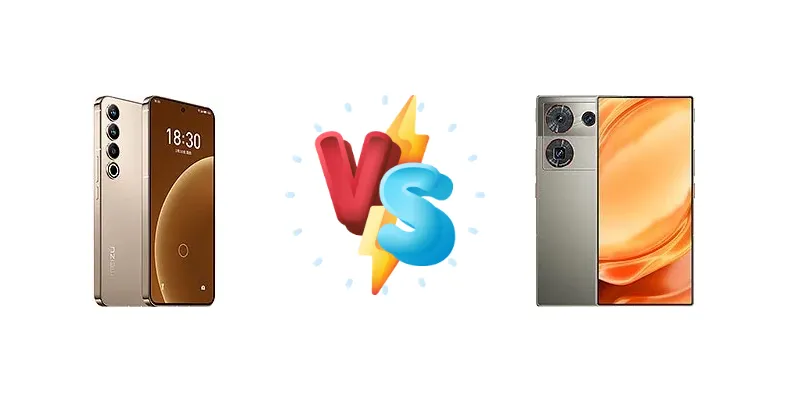
The Meizu 20 Pro and ZTE Nubia Z50 Ultra are both premium smartphones packing the latest Snapdragon 8 Gen 2 chipset. But beyond the shared silicon, these phones offer distinct experiences. This comprehensive comparison dives deep into their features to help you choose the right device for your needs.
🏆 Quick Verdict
Both phones deliver flagship performance thanks to the Snapdragon 8 Gen 2. The Nubia Z50 Ultra likely edges out the Meizu 20 Pro with its superior camera system and potentially a more refined software experience, but Meizu's design and charging speeds are compelling.
| Network |
|---|
| 2G bands | GSM 850 / 900 / 1800 / 1900 | GSM 850 / 900 / 1800 / 1900 |
| 3G bands | HSDPA 850 / 900 / 1900 / 2100 | HSDPA 850 / 900 / 1700(AWS) / 1900 / 2100 |
| 4G bands | 1, 2, 3, 4, 5, 7, 8, 12, 28, 34, 38, 39, 40, 41 | LTE |
| 5G bands | 1, 3, 5, 8, 28, 38, 41, 77, 78, 79 SA/NSA | SA/NSA |
| Speed | HSPA, LTE, 5G | HSPA, LTE, 5G |
| Technology | GSM / HSPA / LTE / 5G | GSM / CDMA / HSPA / CDMA2000 / LTE / 5G |
| | - | CDMA2000 1x |
| Launch |
|---|
| Announced | 2023, March 30 | 2023, March 07 |
| Status | Available. Released 2023, June 20 | Available. Released 2023, March 14 |
| Body |
|---|
| Dimensions | 164.2 x 76.4 x 7.8 mm (6.46 x 3.01 x 0.31 in) | 163.9 x 76.3 x 8.3 mm (6.45 x 3.00 x 0.33 in) |
| SIM | Nano-SIM + Nano-SIM | Nano-SIM + Nano-SIM |
| Weight | 209 g (7.37 oz) | 228 g (8.04 oz) |
| | IP54 | - |
| Display |
|---|
| Resolution | 1440 x 3200 pixels, 20:9 ratio (~515 ppi density) | 1116 x 2480 pixels, 20:9 ratio (~400 ppi density) |
| Size | 6.81 inches, 112.0 cm2 (~89.3% screen-to-body ratio) | 6.8 inches, 111.6 cm2 (~89.3% screen-to-body ratio) |
| Type | LTPO OLED, 120Hz, HDR10+, 500 nits (typ), 1800 nits (peak) | AMOLED, 1B colors, 120Hz, HDR10+, 1500 nits (peak) |
| Platform |
|---|
| CPU | Octa-core (1x3.2 GHz Cortex-X3 & 2x2.8 GHz Cortex-A715 & 2x2.8 GHz Cortex-A710 & 3x2.0 GHz Cortex-A510) | Octa-core (1x3.2 GHz Cortex-X3 & 2x2.8 GHz Cortex-A715 & 2x2.8 GHz Cortex-A710 & 3x2.0 GHz Cortex-A510) |
| Chipset | Qualcomm SM8550-AB Snapdragon 8 Gen 2 (4 nm) | Qualcomm SM8550-AB Snapdragon 8 Gen 2 (4 nm) |
| GPU | Adreno 740 | Adreno 740 |
| OS | Android 13, Flyme 10 | Android 13, MyOS 13 |
| Memory |
|---|
| Card slot | No | No |
| Internal | 128GB 12GB RAM, 256GB 12GB RAM, 512GB 12GB RAM | 256GB 8GB RAM, 256GB 12GB RAM, 512GB 12GB RAM, 1TB 16GB RAM |
| | UFS 4.0 - 512GB | UFS 4.0 |
| Main Camera |
|---|
| Features | Ring-LED flash, panorama, HDR | Laser AF, Ring-LED, dual-tone flash, panorama, HDR |
| Single | - | 16 MP, f/2.0, 26mm (wide), 1/2.8", 1.22µm, under display |
| Triple | 50 MP, f/1.9, (wide), PDAF, OIS
50 MP f/1.9, (telephoto), PDAF, 2x optical zoom
50 MP, f/2.2, 129˚ (ultrawide) | 64 MP, f/1.6, 35mm (standard), 1/1.73", 0.8µm, PDAF, OIS
64 MP, f/3.3, 85mm (periscope telephoto), 1/2.0", PDAF, OIS, 3.3x optical zoom (vs. 26mm cam)
50 MP, f/2.X, 14mm, 116˚ (ultrawide), PDAF |
| Video | 8K, 4K, 1080p; gyro-EIS | 8K@30fps, 4K@30/60/120fps, 1080p@30/60fps, gyro-EIS, HDR10, 10‑bit video |
| Selfie camera |
|---|
| Features | HDR | HDR |
| Single | 32 MP, f/2.5, (wide) | 16 MP, f/2.0, 26mm (wide), 1/2.8", 1.22µm, under display |
| Video | Yes | 1080p@30fps |
| Sound |
|---|
| 3.5mm jack | No | No |
| 35mm jack | No | No |
| Loudspeaker | Yes, with stereo speakers | Yes, with stereo speakers |
| | - | 24-bit/192kHz audio |
| Comms |
|---|
| Bluetooth | 5.3, A2DP, LE | 5.3, A2DP, LE Audio, aptX HD, aptX Adaptive, aptX Lossless |
| Infrared port | Yes | Yes |
| NFC | Yes | Yes |
| Positioning | GPS (L1+L5), GLONASS, BDS (B1I+B1c+B2a), GALILEO, QZSS | GPS (L1+L5), GLONASS (L1+L2+L5), GALILEO, BDS |
| Radio | No | No |
| USB | USB Type-C | USB Type-C 3.1, OTG |
| WLAN | Wi-Fi 802.11 а/b/g/n/ac/6e/7, tri-band | Wi-Fi 802.11 a/b/g/n/ac/6e, dual-band, Wi-Fi Direct |
| Features |
|---|
| Sensors | Fingerprint (under display, ultrasonic), accelerometer, gyro, proximity, compass | Fingerprint (under display, optical), accelerometer, gyro, proximity, compass |
| Battery |
|---|
| Charging | 80W wired, PD3 PPS, QC4+
50W wireless | 80W wired, PD3.0, QC4 |
| Type | Li-Po 5000 mAh | Li-Po 5000 mAh |
| Misc |
|---|
| Colors | Gray, Gold, Silver | Black, Silver, Starry Sky |
| Models | - | NX712J |
| Price | About 530 EUR | About 540 EUR |
Meizu 20 Pro
- Unique design and build quality
- Fast 80W wired and 50W wireless charging
- Snapdragon 8 Gen 2 performance
- High-quality AMOLED display
- Software support may be limited compared to other brands
- Camera performance likely trails the Nubia Z50 Ultra
- Availability may be restricted in some regions
ZTE nubia Z50 Ultra
- Exceptional camera system with potential 200MP sensor
- Potentially larger display with under-display camera
- Snapdragon 8 Gen 2 performance
- Strong software optimization
- Design may be less distinctive
- Wireless charging speed is slower (80W)
- ZTE's brand recognition is lower in some markets
Display Comparison
Both phones feature high-quality AMOLED displays with 120Hz refresh rates. The Nubia Z50 Ultra is expected to have a slightly larger display (around 6.8 inches) compared to the Meizu 20 Pro (around 6.7 inches). Color accuracy and brightness are likely comparable, offering vibrant visuals and excellent outdoor visibility. The Nubia Z50 Ultra may have under-display camera technology for a truly full-screen experience.
Camera Comparison
The Nubia Z50 Ultra is expected to have a significantly more advanced camera system, potentially featuring a 200MP main sensor and improved image processing algorithms. The Meizu 20 Pro likely has a capable camera setup, but it's unlikely to match the Nubia's capabilities in low-light conditions or overall image quality. Video recording capabilities should be excellent on both devices.
Performance
Performance is virtually identical, as both devices utilize the Snapdragon 8 Gen 2. Expect blazing-fast speeds for gaming, multitasking, and demanding applications. Thermal management will be a key differentiator, with each manufacturer employing different cooling solutions. Real-world performance will depend on software optimization.
Battery Life
Both phones offer 80W wired charging, ensuring quick top-ups. The Meizu 20 Pro also includes 50W wireless charging, a notable advantage. Battery capacity is likely similar (around 4800-5000mAh), suggesting comparable battery life under typical usage.
Buying Guide
The Meizu 20 Pro is ideal for users who appreciate unique design aesthetics and fast-charging capabilities. The ZTE Nubia Z50 Ultra is a better choice for photography enthusiasts and those seeking a more mainstream Android experience with a focus on camera quality and potentially a larger display.
Frequently Asked Questions
❓ Which phone has better battery life?
Both offer similar battery capacity, but the Meizu 20 Pro's wireless charging provides added convenience. Overall battery life will depend on usage patterns.
❓ Is the Meizu 20 Pro worth buying if I'm not a fan of ZTE?
The Meizu 20 Pro offers a unique design and fast charging, which might appeal to users seeking something different. However, consider the potential limitations of software support and camera performance compared to other brands.