
Meizu 20 Pro vs Xiaomi 13 Ultra: The Ultimate Showdown
| Phones Images | |||||
|---|---|---|---|---|---|
|
🏆 Quick Verdict
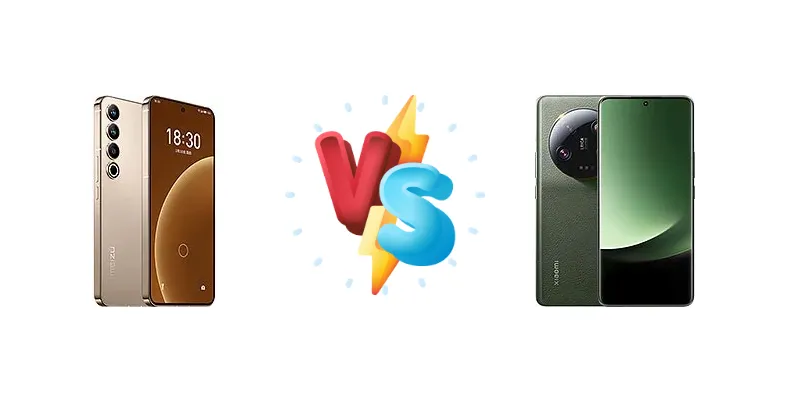
The Xiaomi 13 Ultra emerges as the overall winner thanks to its superior camera system, faster charging, and longer battery life. However, the Meizu 20 Pro offers a unique, premium design and a potentially more streamlined software experience for those seeking something different.
| PHONES | ||
|---|---|---|
| Phone Names | Meizu 20 Pro | Xiaomi 13 Ultra |
| Network | ||
|---|---|---|
| 2G bands | GSM 850 / 900 / 1800 / 1900 | GSM 850 / 900 / 1800 / 1900 |
| 3G bands | HSDPA 850 / 900 / 1900 / 2100 | HSDPA 800 / 850 / 900 / 1700(AWS) / 1900 / 2100 |
| 4G bands | 1, 2, 3, 4, 5, 7, 8, 12, 28, 34, 38, 39, 40, 41 | 1, 2, 3, 4, 5, 7, 8, 18, 19, 20, 26, 28, 38, 40, 41, 66 - International |
| 5G bands | 1, 3, 5, 8, 28, 38, 41, 77, 78, 79 SA/NSA | 1, 3, 5, 7, 8, 20, 28, 38, 40, 41, 77, 78, 79 SA/NSA - International |
| Speed | HSPA, LTE, 5G | HSPA, LTE, 5G |
| Technology | GSM / HSPA / LTE / 5G | GSM / CDMA / HSPA / EVDO / LTE / 5G |
| - | CDMA2000 1xEV-DO | |
| Launch | ||
|---|---|---|
| Announced | 2023, March 30 | 2023, April 18 |
| Status | Available. Released 2023, June 20 | Available. Released 2023, April 21 |
| Body | ||
|---|---|---|
| Build | - | Glass front (Gorilla Glass Victus), eco leather back, aluminum frame |
| Dimensions | 164.2 x 76.4 x 7.8 mm (6.46 x 3.01 x 0.31 in) | 163.2 x 74.6 x 9.1 mm (6.43 x 2.94 x 0.36 in) |
| SIM | Nano-SIM + Nano-SIM | Nano-SIM + Nano-SIM |
| Weight | 209 g (7.37 oz) | 227 g (8.01 oz) |
| IP54 | IP68 dust/water resistant (up to 1.5m for 30 min) | |
| Display | ||
|---|---|---|
| Protection | - | Corning Gorilla Glass Victus |
| Resolution | 1440 x 3200 pixels, 20:9 ratio (~515 ppi density) | 1440 x 3200 pixels, 20:9 ratio (~522 ppi density) |
| Size | 6.81 inches, 112.0 cm2 (~89.3% screen-to-body ratio) | 6.73 inches, 108.9 cm2 (~89.5% screen-to-body ratio) |
| Type | LTPO OLED, 120Hz, HDR10+, 500 nits (typ), 1800 nits (peak) | LTPO AMOLED, 68B colors, 120Hz, Dolby Vision, HDR10+, 1300 nits (HBM), 2600 nits (peak) |
| Platform | ||
|---|---|---|
| CPU | Octa-core (1x3.2 GHz Cortex-X3 & 2x2.8 GHz Cortex-A715 & 2x2.8 GHz Cortex-A710 & 3x2.0 GHz Cortex-A510) | Octa-core (1x3.2 GHz Cortex-X3 & 2x2.8 GHz Cortex-A715 & 2x2.8 GHz Cortex-A710 & 3x2.0 GHz Cortex-A510) |
| Chipset | Qualcomm SM8550-AB Snapdragon 8 Gen 2 (4 nm) | Qualcomm SM8550-AB Snapdragon 8 Gen 2 (4 nm) |
| GPU | Adreno 740 | Adreno 740 |
| OS | Android 13, Flyme 10 | Android 13, upgradable to Android 14, HyperOS |
| Memory | ||
|---|---|---|
| Card slot | No | No |
| Internal | 128GB 12GB RAM, 256GB 12GB RAM, 512GB 12GB RAM | 256GB 12GB RAM, 512GB 12GB RAM, 512GB 16GB RAM, 1TB 16GB RAM |
| UFS 4.0 - 512GB | UFS 4.0 | |
| Main Camera | ||
|---|---|---|
| Features | Ring-LED flash, panorama, HDR | Laser AF, color spectrum sensor, Leica lenses, Dual-LED flash, HDR, panorama, 67mm filter ring holder (optional) |
| Quad | - | 50 MP, f/1.9 or f/4.0, 23mm (wide), 1.0"-type, 1.6µm, dual pixel PDAF, OIS 50 MP, f/1.8, 75mm (telephoto), 1/2.51", 0.7µm, dual pixel PDAF, OIS, 3.2x optical zoom 50 MP, f/3.0, 120mm (periscope telephoto), 1/2.51", 0.7µm, dual pixel PDAF, OIS, 5x optical zoom 50 MP, f/1.8, 12mm, 122˚ (ultrawide), 1/2.51", 0.7µm, dual pixel PDAF TOF 3D, (depth) |
| Triple | 50 MP, f/1.9, (wide), PDAF, OIS 50 MP f/1.9, (telephoto), PDAF, 2x optical zoom 50 MP, f/2.2, 129˚ (ultrawide) | - |
| Video | 8K, 4K, 1080p; gyro-EIS | 8K@24fps, 4K@24/30/60fps, 1080p@30/60/120/240/480/960/1920fps, gyro-EIS, Dolby Vision HDR 10-bit rec. (4K@60fps, 1080p) |
| Selfie camera | ||
|---|---|---|
| Features | HDR | HDR, panorama |
| Single | 32 MP, f/2.5, (wide) | 32 MP, f/2.0, 22mm (wide), 1/3.14", 0.7µm |
| Video | Yes | 1080p@30/60fps, gyro-EIS |
| Sound | ||
|---|---|---|
| 3.5mm jack | No | No |
| 35mm jack | No | No |
| Loudspeaker | Yes, with stereo speakers | Yes, with stereo speakers |
| - | 24-bit/192kHz audio | |
| Comms | ||
|---|---|---|
| Bluetooth | 5.3, A2DP, LE | 5.3, A2DP, LE, aptX HD, aptX Adaptive |
| Infrared port | Yes | Yes |
| NFC | Yes | Yes |
| Positioning | GPS (L1+L5), GLONASS, BDS (B1I+B1c+B2a), GALILEO, QZSS | GPS (L1+L5), GLONASS (L1), BDS (B1I+B1c+B2a), GALILEO (E1+E5a), QZSS (L1+L5), NavIC (L5) |
| Radio | No | No |
| USB | USB Type-C | USB Type-C 3.2, DisplayPort, OTG |
| WLAN | Wi-Fi 802.11 а/b/g/n/ac/6e/7, tri-band | Wi-Fi 802.11 a/b/g/n/ac/6e/7, tri-band, Wi-Fi Direct |
| Features | ||
|---|---|---|
| Sensors | Fingerprint (under display, ultrasonic), accelerometer, gyro, proximity, compass | Fingerprint (under display, optical), accelerometer, proximity, gyro, compass, barometer |
| - | Virtual proximity sensing | |
| Battery | ||
|---|---|---|
| Charging | 80W wired, PD3 PPS, QC4+ 50W wireless | 90W wired, PD3.0, QC4, 100% in 35 min 50W wireless, 100% in 49 min 10W reverse wireless |
| Type | Li-Po 5000 mAh | Li-Po 5000 mAh |
| Misc | ||
|---|---|---|
| Colors | Gray, Gold, Silver | Black, Olive Green, White, Orange, Yellow, Blue |
| Models | - | 2304FPN6DC, 2304FPN6DG |
| Price | About 530 EUR | € 797.98 / $ 389.69 |
| SAR EU | - | 0.99 W/kg (head) 1.00 W/kg (body) |
Meizu 20 Pro
- Unique and premium design
- Clean and streamlined software (FlymeOS)
- Fast 80W wired charging
- Excellent performance with Snapdragon 8 Gen 2
- Camera not as advanced as Xiaomi 13 Ultra
- Shorter battery life
- Less widely available
- Wireless charging speed is slower
Xiaomi 13 Ultra
- Exceptional camera system with large sensor
- Longer battery life
- Faster 90W wired and 50W wireless charging
- Reverse wireless charging
- High peak brightness display
- MIUI software can be bloated
- Design may not appeal to everyone
- Potentially higher price
Display Comparison
Both phones feature excellent AMOLED displays with 120Hz refresh rates. The Xiaomi 13 Ultra boasts a significantly higher peak brightness (1207 nits) compared to the Meizu 20 Pro, making it easier to see in direct sunlight. The Meizu 20 Pro may offer slightly more accurate color calibration, but the Xiaomi's brightness advantage is noticeable.
Camera Comparison
This is where the Xiaomi 13 Ultra truly shines. Its multi-camera system, featuring a large 1-inch sensor, offers exceptional image quality, versatility, and low-light performance. The Meizu 20 Pro's camera is competent, but it can't match the Xiaomi's overall capabilities. Xiaomi's camera also offers more advanced features and computational photography.
Performance
Powered by the Snapdragon 8 Gen 2, both devices deliver blazing-fast performance. Expect smooth multitasking, lag-free gaming, and effortless handling of demanding applications. Real-world performance differences are likely to be minimal, as both phones have ample RAM and efficient cooling systems.
Battery Life
The Xiaomi 13 Ultra has a clear advantage in battery life, consistently achieving longer active use times and endurance ratings. Its faster wired (90W) and wireless (50W) charging speeds also provide a significant convenience boost. The Meizu 20 Pro's 80W wired charging is still fast, but the Xiaomi's charging times are quicker.
Buying Guide
The Meizu 20 Pro is ideal for users who prioritize design, a clean software experience, and don't need the absolute best camera capabilities. The Xiaomi 13 Ultra is the choice for photography enthusiasts, power users, and those who value long battery life and rapid charging.