
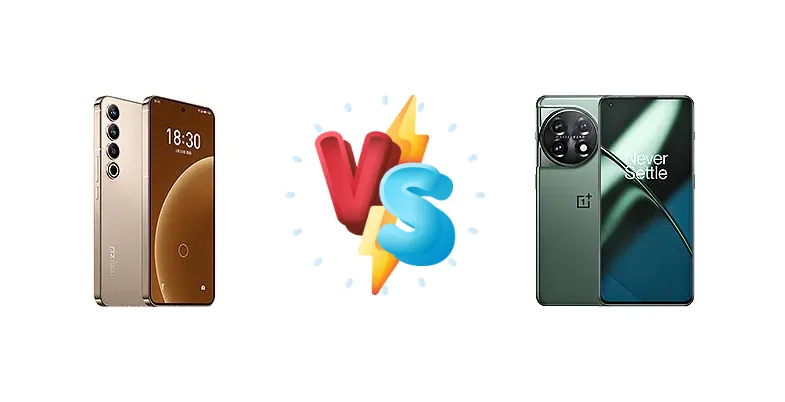
Meizu 20 Pro vs OnePlus 11: A Detailed Flagship Showdown
| Phones Images | |||||
|---|---|---|---|---|---|
|
🏆 Quick Verdict
The OnePlus 11 emerges as the slightly stronger overall package thanks to its faster charging, potentially better software support, and established ecosystem. However, the Meizu 20 Pro offers a unique design and potentially a more refined user experience for those seeking something different. It's a close call!
| PHONES | ||
|---|---|---|
| Phone Names | Meizu 20 Pro | OnePlus 11 |
| Network | ||
|---|---|---|
| 2G bands | GSM 850 / 900 / 1800 / 1900 | GSM 850 / 900 / 1800 / 1900 |
| 3G bands | HSDPA 850 / 900 / 1900 / 2100 | HSDPA 800 / 850 / 900 / 1700(AWS) / 1900 / 2100 |
| 4G bands | 1, 2, 3, 4, 5, 7, 8, 12, 28, 34, 38, 39, 40, 41 | 1, 2, 3, 4, 5, 7, 8, 12, 13, 17, 18, 19, 20, 25, 26, 28, 30, 32, 38, 39, 41, 40, 46, 48, 66, 71 - International |
| 5G bands | 1, 3, 5, 8, 28, 38, 41, 77, 78, 79 SA/NSA | 1, 2, 3, 5, 7, 8, 20, 25, 28, 30, 38, 40, 41, 66, 71, 75, 77, 78 SA/NSA - International |
| Speed | HSPA, LTE, 5G | HSPA, LTE, 5G |
| Technology | GSM / HSPA / LTE / 5G | GSM / CDMA / HSPA / EVDO / LTE / 5G |
| - | 1, 3, 5, 7, 8, 20, 28, 38, 40, 41, 66, 77, 78 SA/NSA - China | |
| Launch | ||
|---|---|---|
| Announced | 2023, March 30 | 2023, January 04 |
| Status | Available. Released 2023, June 20 | Available. Released 2023, January 09 |
| Body | ||
|---|---|---|
| Build | - | Glass front (Gorilla Glass Victus), glass back (Gorilla Glass 5), aluminum frame |
| Dimensions | 164.2 x 76.4 x 7.8 mm (6.46 x 3.01 x 0.31 in) | 163.1 x 74.1 x 8.5 mm (6.42 x 2.92 x 0.33 in) |
| SIM | Nano-SIM + Nano-SIM | · Nano-SIM· Nano-SIM + Nano-SIM + eSIM (max 2 at a time) |
| Weight | 209 g (7.37 oz) | 205 g (7.23 oz) |
| IP54 | IP64 | |
| Display | ||
|---|---|---|
| Protection | - | Corning Gorilla Glass Victus |
| Resolution | 1440 x 3200 pixels, 20:9 ratio (~515 ppi density) | 1440 x 3216 pixels, 20:9 ratio (~525 ppi density) |
| Size | 6.81 inches, 112.0 cm2 (~89.3% screen-to-body ratio) | 6.7 inches, 108.4 cm2 (~89.7% screen-to-body ratio) |
| Type | LTPO OLED, 120Hz, HDR10+, 500 nits (typ), 1800 nits (peak) | LTPO3 Fluid AMOLED, 1B colors, 120Hz, Dolby Vision, HDR10+, 500 nits (typ), 800 nits (HBM), 1300 nits (peak) |
| - | Always-on display | |
| Platform | ||
|---|---|---|
| CPU | Octa-core (1x3.2 GHz Cortex-X3 & 2x2.8 GHz Cortex-A715 & 2x2.8 GHz Cortex-A710 & 3x2.0 GHz Cortex-A510) | Octa-core (1x3.2 GHz Cortex-X3 & 2x2.8 GHz Cortex-A715 & 2x2.8 GHz Cortex-A710 & 3x2.0 GHz Cortex-A510) |
| Chipset | Qualcomm SM8550-AB Snapdragon 8 Gen 2 (4 nm) | Qualcomm SM8550-AB Snapdragon 8 Gen 2 (4 nm) |
| GPU | Adreno 740 | Adreno 740 |
| OS | Android 13, Flyme 10 | Android 13, upgradable to Android 15, OxygenOS 15 (International), ColorOS 14 (China) |
| Memory | ||
|---|---|---|
| Card slot | No | No |
| Internal | 128GB 12GB RAM, 256GB 12GB RAM, 512GB 12GB RAM | 128GB 8GB RAM, 256GB 12GB RAM, 256GB 16GB RAM, 512GB 16GB RAM |
| UFS 4.0 - 512GB | UFS 3.1 - 128GB only UFS 4.0 | |
| Main Camera | ||
|---|---|---|
| Features | Ring-LED flash, panorama, HDR | Hasselblad Color Calibration, color spectrum sensor, Dual-LED flash, HDR, panorama |
| Single | - | 16 MP, f/2.5, 25mm (wide), 1.0µm |
| Triple | 50 MP, f/1.9, (wide), PDAF, OIS 50 MP f/1.9, (telephoto), PDAF, 2x optical zoom 50 MP, f/2.2, 129˚ (ultrawide) | 50 MP, f/1.8, 24mm (wide), 1/1.56", 1.0µm, multi-directional PDAF, OIS 32 MP, f/2.0, 48mm (telephoto), 1/2.74", PDAF, 2x optical zoom 48 MP, f/2.2, 115˚, (ultrawide), 1/2.0", AF |
| Video | 8K, 4K, 1080p; gyro-EIS | 8K@24fps, 4K@30/60fps, 1080p@30/60/240fps, Auto HDR, gyro-EIS |
| Selfie camera | ||
|---|---|---|
| Features | HDR | HDR, panorama |
| Single | 32 MP, f/2.5, (wide) | 16 MP, f/2.5, 25mm (wide), 1.0µm |
| Video | Yes | 1080p@30fps, gyro-EIS |
| Sound | ||
|---|---|---|
| 3.5mm jack | No | No |
| 35mm jack | No | No |
| Loudspeaker | Yes, with stereo speakers | Yes, with stereo speakers |
| - | 24-bit/192kHz audio | |
| Comms | ||
|---|---|---|
| Bluetooth | 5.3, A2DP, LE | 5.3, A2DP, LE, aptX HD |
| Infrared port | Yes | - |
| NFC | Yes | Yes |
| Positioning | GPS (L1+L5), GLONASS, BDS (B1I+B1c+B2a), GALILEO, QZSS | GPS (L1+L5), GLONASS (G1), BDS (B1I+B1c+B2a), GALILEO (E1+E5a), QZSS (L1+L5) |
| Radio | No | No |
| USB | USB Type-C | USB Type-C 2.0, OTG |
| WLAN | Wi-Fi 802.11 а/b/g/n/ac/6e/7, tri-band | Wi-Fi 802.11 a/b/g/n/ac/6/7, dual-band, Wi-Fi Direct |
| Features | ||
|---|---|---|
| Sensors | Fingerprint (under display, ultrasonic), accelerometer, gyro, proximity, compass | Fingerprint (under display, optical), accelerometer, gyro, proximity, compass |
| Battery | ||
|---|---|---|
| Charging | 80W wired, PD3 PPS, QC4+ 50W wireless | 100W wired, PD, 50% in 10 min, 100% in 25 min - International 80W wired, PD - USA |
| Type | Li-Po 5000 mAh | Li-Po 5000 mAh |
| Misc | ||
|---|---|---|
| Colors | Gray, Gold, Silver | Titan Black, Eternal Green, Jupiter Rock |
| Models | - | PHB110, CPH2449, CPH2447, CPH2451 |
| Price | About 530 EUR | $ 379.99 / ₹ 33,990 |
| SAR | - | 1.19 W/kg (head) 0.99 W/kg (body) |
| Tests | ||
|---|---|---|
| Battery life | - | Endurance rating 108h |
| Camera | - | Photo / Video |
| Display | - | Contrast ratio: Infinite (nominal) |
| Loudspeaker | - | -25.2 LUFS (Very good) |
| Performance | - | AnTuTu: 1140661 (v9) GeekBench: 4899 (v5.1) GFXBench: 57fps (ES 3.1 onscreen) |
Meizu 20 Pro
- Unique design
- Potentially cleaner Android experience (FlymeOS)
- Fast charging (80W wired, 50W wireless)
- Snapdragon 8 Gen 2 performance
- Less established brand
- Limited camera details
- FlymeOS update consistency can be a concern
- Availability may be limited
OnePlus 11
- Extremely fast charging (100W/80W)
- Excellent camera system (Hasselblad tuned)
- Reliable software experience (OxygenOS/ColorOS)
- Strong community support
- Design may be less distinctive
- Software bloatware can be present
- Display brightness could be higher on some models
Display Comparison
Both phones feature excellent displays, but the OnePlus 11 boasts a higher measured brightness (767 nits vs unspecified for Meizu 20 Pro). The OnePlus 11's 'Infinite' contrast ratio suggests deep blacks and vibrant colors, though this is a nominal value. Meizu typically focuses on color accuracy, so expect a more natural look. Ultimately, both offer a premium viewing experience.
Camera Comparison
Camera details are limited for the Meizu 20 Pro. The OnePlus 11 is known for its Hasselblad-tuned camera system, offering excellent image quality and versatile shooting modes. Expect strong performance in various lighting conditions and impressive video recording capabilities. The Meizu 20 Pro likely focuses on a balanced camera setup, but without more specifics, it's difficult to directly compare.
Performance
Powered by the Snapdragon 8 Gen 2, both phones deliver flagship-level performance. Expect smooth multitasking, demanding gaming, and effortless app navigation. Real-world performance differences will likely be minimal, though OnePlus's OxygenOS (or ColorOS depending on region) is often optimized for speed and responsiveness. Meizu's FlymeOS may have a different feel, potentially prioritizing customization.
Battery Life
The OnePlus 11 shines here with its incredibly fast charging – 100W wired (International) or 80W (USA). It can reach 50% in just 10 minutes and 100% in 25 minutes. The Meizu 20 Pro offers 80W wired and 50W wireless charging, which is still fast but not as impressive as the OnePlus 11. Both phones have a good endurance rating, with the OnePlus 11 showing 11:05h of active use and 108h of standby.
Buying Guide
The Meizu 20 Pro is ideal for users who appreciate unique design aesthetics, a potentially cleaner Android experience (depending on Meizu's FlymeOS updates), and are willing to explore a less mainstream brand. The OnePlus 11 is a great choice for those prioritizing fast charging, a reliable software experience, and a strong community support.