
Meizu 20 Pro vs Huawei P60 Pro: The Ultimate Showdown
| Phones Images | |||||
|---|---|---|---|---|---|
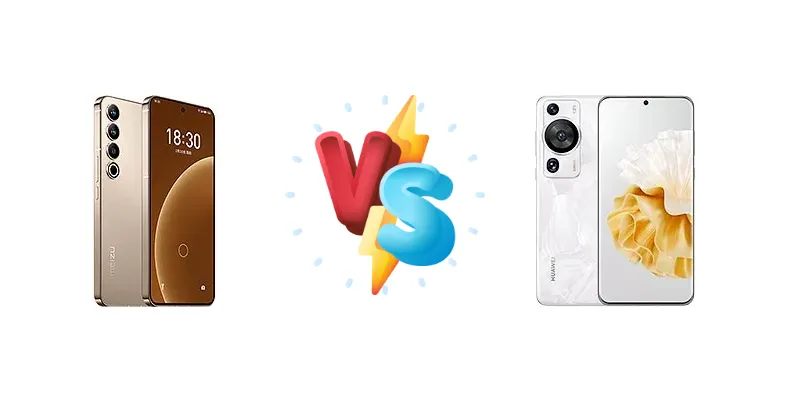
|
🏆 Quick Verdict
The Meizu 20 Pro boasts the newer Snapdragon 8 Gen 2 for superior performance, while the Huawei P60 Pro shines with exceptional battery life and a renowned camera system. Ultimately, the choice depends on your priorities: raw power or long-lasting photography.
| PHONES | ||
|---|---|---|
| Phone Names | Meizu 20 Pro | Huawei P60 Pro |
| Network | ||
|---|---|---|
| 2G bands | GSM 850 / 900 / 1800 / 1900 | GSM 850 / 900 / 1800 / 1900 |
| 3G bands | HSDPA 850 / 900 / 1900 / 2100 | HSDPA 800 / 850 / 900 / 1700(AWS) / 1900 / 2100 |
| 4G bands | 1, 2, 3, 4, 5, 7, 8, 12, 28, 34, 38, 39, 40, 41 | 1, 2, 3, 4, 5, 7, 8, 12, 13, 17, 18, 19, 20, 26, 28, 32, 34, 38, 39, 40, 41, 66 - International |
| 5G bands | 1, 3, 5, 8, 28, 38, 41, 77, 78, 79 SA/NSA | - |
| Speed | HSPA, LTE, 5G | HSPA, LTE |
| Technology | GSM / HSPA / LTE / 5G | GSM / CDMA / HSPA / CDMA2000 / LTE |
| - | 1, 2, 3, 4, 5, 7, 8, 12, 17, 18, 19, 20, 26, 28, 34, 38, 39, 40, 41 - China | |
| Launch | ||
|---|---|---|
| Announced | 2023, March 30 | 2023, March 23 |
| Status | Available. Released 2023, June 20 | Available. Released 2023, March 31 |
| Body | ||
|---|---|---|
| Dimensions | 164.2 x 76.4 x 7.8 mm (6.46 x 3.01 x 0.31 in) | 161 x 74.5 x 8.3 mm (6.34 x 2.93 x 0.33 in) |
| SIM | Nano-SIM + Nano-SIM | · Nano-SIM· Nano-SIM + Nano-SIM |
| Weight | 209 g (7.37 oz) | 200 g (7.05 oz) |
| IP54 | IP68 dust/water resistant (up to 1.5m for 30 min) | |
| Display | ||
|---|---|---|
| Protection | - | Kunlun Glass |
| Resolution | 1440 x 3200 pixels, 20:9 ratio (~515 ppi density) | 1220 x 2700 pixels (~444 ppi density) |
| Size | 6.81 inches, 112.0 cm2 (~89.3% screen-to-body ratio) | 6.67 inches, 107.7 cm2 (~89.8% screen-to-body ratio) |
| Type | LTPO OLED, 120Hz, HDR10+, 500 nits (typ), 1800 nits (peak) | LTPO OLED, 1B colors, 120Hz |
| Platform | ||
|---|---|---|
| CPU | Octa-core (1x3.2 GHz Cortex-X3 & 2x2.8 GHz Cortex-A715 & 2x2.8 GHz Cortex-A710 & 3x2.0 GHz Cortex-A510) | Octa-core (1x3.19 GHz Cortex-X2 & 3x2.75 GHz Cortex-A710 & 4x2.0 GHz Cortex-A510) |
| Chipset | Qualcomm SM8550-AB Snapdragon 8 Gen 2 (4 nm) | Qualcomm SM8475 Snapdragon 8+ Gen 1 4G (4 nm) |
| GPU | Adreno 740 | Adreno 730 |
| OS | Android 13, Flyme 10 | HarmonyOS 3.1 (China), EMUI 13.1 (Europe), no Google Play Services |
| Memory | ||
|---|---|---|
| Card slot | No | Nano Memory (uses shared SIM slot) |
| Internal | 128GB 12GB RAM, 256GB 12GB RAM, 512GB 12GB RAM | 256GB 8GB RAM, 256GB 12GB RAM, 512GB 12GB RAM |
| UFS 4.0 - 512GB | UFS | |
| Main Camera | ||
|---|---|---|
| Features | Ring-LED flash, panorama, HDR | Laser AF, color spectrum sensor, LED flash, HDR, panorama |
| Triple | 50 MP, f/1.9, (wide), PDAF, OIS 50 MP f/1.9, (telephoto), PDAF, 2x optical zoom 50 MP, f/2.2, 129˚ (ultrawide) | 48 MP, f/1.4-f/4.0, 25mm (wide), PDAF, OIS 48 MP, f/2.1, 90mm (telephoto), PDAF, sensor-shift OIS, 3.5x optical zoom 13 MP, f/2.2, 13mm (ultrawide), AF |
| Video | 8K, 4K, 1080p; gyro-EIS | 4K@30/60fps, 1080p@30/60fps, 1080p@960fps; gyro-EIS, HDR Vivid |
| Selfie camera | ||
|---|---|---|
| Features | HDR | Panorama, HDR |
| Single | 32 MP, f/2.5, (wide) | 13 MP, f/2.4, (ultrawide) |
| Video | Yes | 4K@30/60fps, 1080p@30fps, HDR Vivid |
| Sound | ||
|---|---|---|
| 3.5mm jack | No | No |
| 35mm jack | No | No |
| Loudspeaker | Yes, with stereo speakers | Yes, with stereo speakers |
| Comms | ||
|---|---|---|
| Bluetooth | 5.3, A2DP, LE | 5.2, A2DP, LE |
| Infrared port | Yes | Yes |
| NFC | Yes | Yes |
| Positioning | GPS (L1+L5), GLONASS, BDS (B1I+B1c+B2a), GALILEO, QZSS | GPS (L1+L5), GLONASS (B1I+B1c+B2a), BDS (B1I+B1c+B2a), GALILEO (E1+E5a), QZSS (L1+L5), NavIC |
| Radio | No | No |
| USB | USB Type-C | USB Type-C 3.1, OTG |
| WLAN | Wi-Fi 802.11 а/b/g/n/ac/6e/7, tri-band | Wi-Fi 802.11 a/b/g/n/ac/6, dual-band, Wi-Fi Direct |
| Features | ||
|---|---|---|
| Sensors | Fingerprint (under display, ultrasonic), accelerometer, gyro, proximity, compass | Fingerprint (under display, optical), accelerometer, gyro, proximity, compass |
| - | BDS Satellite Message | |
| Battery | ||
|---|---|---|
| Charging | 80W wired, PD3 PPS, QC4+ 50W wireless | 88W wired 50W wireless Reverse wireless |
| Type | Li-Po 5000 mAh | Li-Po 4815 mAh |
| Misc | ||
|---|---|---|
| Colors | Gray, Gold, Silver | Black, Green, Violet, Rococo Pearl |
| Models | - | MNA-AL00, MNA-LX9 |
| Price | About 530 EUR | € 738.50 |
| Tests | ||
|---|---|---|
| Battery life | - | Endurance rating 96h |
| Camera | - | Photo / Video |
| Display | - | Contrast ratio: Infinite (nominal) |
| Loudspeaker | - | -27.3 LUFS (Good) |
| Performance | - | AnTuTu: 1030473 (v9) GeekBench: 4422 (v6) GFXBench: 65fps (ES 3.1 onscreen) |
Meizu 20 Pro
- Latest Snapdragon 8 Gen 2 chipset
- Fast 80W wired and 50W wireless charging
- Premium design and build quality
- Potentially excellent display (details pending)
- Camera may not match Huawei's level
- Battery life potentially shorter than P60 Pro
- Software support may be less extensive than Huawei
Huawei P60 Pro
- Exceptional battery life (96h endurance rating)
- Renowned camera system
- High peak brightness display (1135 nits)
- Reverse wireless charging
- Snapdragon 8+ Gen 1 (older chipset)
- 4G connectivity only
- Potential software limitations due to geopolitical factors
Display Comparison
Both phones feature excellent displays. The Huawei P60 Pro boasts a measured peak brightness of 1135 nits and an impressive (though nominal) infinite contrast ratio, suggesting vibrant colors and deep blacks. The Meizu 20 Pro's display is expected to be similarly high quality, though specific brightness figures are less readily available. Expect both to offer smooth scrolling thanks to high refresh rates.
Camera Comparison
Huawei has a long-standing reputation for exceptional mobile photography, and the P60 Pro continues that legacy. While the Meizu 20 Pro's camera is expected to be good, the P60 Pro's image processing and hardware are likely to deliver superior results, particularly in challenging lighting conditions. Expect excellent detail, dynamic range, and color accuracy from the P60 Pro.
Performance
The Meizu 20 Pro holds a clear advantage here. Its Snapdragon 8 Gen 2 chipset is significantly more powerful than the P60 Pro's Snapdragon 8+ Gen 1. This translates to faster app loading, smoother multitasking, and better gaming performance. While the P60 Pro is still capable, the 20 Pro offers a noticeable performance boost.
Battery Life
The Huawei P60 Pro dominates in battery life, boasting an impressive endurance rating of 96 hours. The Meizu 20 Pro's battery capacity is likely smaller, and while its 80W wired charging is fast, it can't match the P60 Pro's longevity.
Buying Guide
The Meizu 20 Pro is ideal for power users and gamers who demand the latest and greatest performance. The Huawei P60 Pro is perfect for photography enthusiasts and those prioritizing battery endurance and a premium design.