
Meizu 20 Infinity vs OnePlus 11R: A Detailed Performance and Feature Comparison
| Phones Images | |||||
|---|---|---|---|---|---|
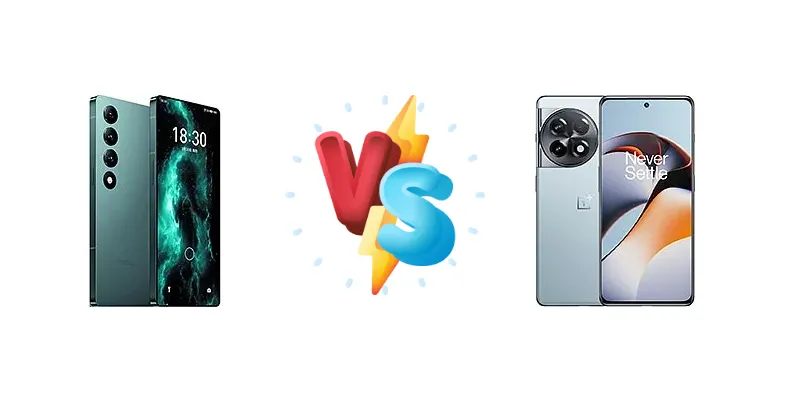
|
🏆 Quick Verdict
For users prioritizing raw performance and future-proofing, the Meizu 20 Infinity takes the lead thanks to its Snapdragon 8 Gen 2. However, the OnePlus 11R’s 100W charging and potentially lower price make it a strong contender for those seeking a balance of speed and value.
| PHONES | ||
|---|---|---|
| Phone Names | Meizu 20 Infinity | OnePlus 11R |
| Network | ||
|---|---|---|
| 2G bands | GSM 850 / 900 / 1800 / 1900 | GSM 850 / 900 / 1800 / 1900 |
| 3G bands | HSDPA 850 / 900 / 1700(AWS) / 1900 / 2100 | HSDPA 850 / 900 / 1700(AWS) / 2100 |
| 4G bands | 1, 2, 3, 4, 5, 7, 8, 12, 13, 17, 18, 19, 20, 26, 34, 38, 39, 40, 41, 42 | 1, 3, 4, 5, 8, 28, 34, 38, 39, 40, 41 |
| 5G bands | 1, 3, 5, 7, 8, 28, 38, 40, 41, 66, 77, 78, 79 SA/NSA | 1, 3, 5, 8, 28, 40, 41, 77, 78 SA/NSA |
| Speed | HSPA, LTE, 5G | HSPA, LTE (3CA), 5G |
| Technology | GSM / HSPA / LTE / 5G | GSM / CDMA / HSPA / LTE / 5G |
| - | CDMA 800 | |
| Launch | ||
|---|---|---|
| Announced | 2023, March 30 | 2023, February 07 |
| Status | Available. Released 2023, June 12 | Available. Released 2023, February 21 |
| Body | ||
|---|---|---|
| Build | - | Glass front, glass back (Gorilla Glass 5), plastic frame |
| Dimensions | 163.4 x 73.3 x 8.2 mm (6.43 x 2.89 x 0.32 in) | 163.4 x 74.3 x 8.7 mm (6.43 x 2.93 x 0.34 in) |
| SIM | Nano-SIM + Nano-SIM | Nano-SIM + Nano-SIM |
| Weight | 215 g (7.58 oz) | 204 g (7.20 oz) |
| Display | ||
|---|---|---|
| Resolution | 1368 x 3192 pixels, 21:9 ratio (~511 ppi density) | 1240 x 2772 pixels, 20:9 ratio (~451 ppi density) |
| Size | 6.79 inches, 107.7 cm2 (~89.9% screen-to-body ratio) | 6.74 inches, 109.2 cm2 (~90.0% screen-to-body ratio) |
| Type | LTPO OLED, 1B colors, 120Hz, 600 nits (typ), 1800 nits (peak) | Fluid AMOLED, 1B colors, 120Hz, HDR10+, 1450 nits (peak) |
| Platform | ||
|---|---|---|
| CPU | Octa-core (1x3.2 GHz Cortex-X3 & 2x2.8 GHz Cortex-A715 & 2x2.8 GHz Cortex-A710 & 3x2.0 GHz Cortex-A510) | Octa-core (1x3.0 GHz Cortex-X2 & 3x2.5 GHz Cortex-A710 & 4x1.80 GHz Cortex-A510) |
| Chipset | Qualcomm SM8550-AB Snapdragon 8 Gen 2 (4 nm) | Qualcomm SM8475 Snapdragon 8+ Gen 1 (4 nm) |
| GPU | Adreno 740 | Adreno 730 |
| OS | Android 13, Flyme 10 | Android 13, upgradable to Android 15, OxygenOS 15 |
| Memory | ||
|---|---|---|
| Card slot | No | No |
| Internal | 256GB 12GB RAM, 512GB 12GB RAM, 1TB 16GB RAM | 128GB 8GB RAM, 256GB 16GB RAM, 512GB 18GB RAM |
| UFS 4.0 | UFS 3.1 | |
| Main Camera | ||
|---|---|---|
| Features | LED flash, panorama, HDR | Color spectrum sensor, LED flash, HDR, panorama |
| Single | - | 16 MP, f/2.4, 24mm (wide), 1/3.09", 1.0µm |
| Triple | 50 MP, f/1.8, 23mm (wide), 1/1.56", PDAF, OIS 12 MP f/2.0, 50mm (telephoto), 1/2.9", PDAF, OIS, optical zoom 12 MP, f/2.2, 13mm, 122˚ (ultrawide), 1/2.55" | 50 MP, f/1.8, 24mm (wide), 1/1.56", 1.0µm, multi-directional PDAF, OIS 8 MP, f/2.2, 120˚ (ultrawide), 1/4.0", 1.12µm 2 MP (macro) |
| Video | 8K, 4K, 1080p; gyro-EIS | 4K@30/60fps, 1080p@30/60/240fps, gyro-EIS |
| Selfie camera | ||
|---|---|---|
| Features | HDR | HDR |
| Single | 32 MP, f/2.4, (wide) | 16 MP, f/2.4, 24mm (wide), 1/3.09", 1.0µm |
| Video | Yes | 1080p@30fps |
| Sound | ||
|---|---|---|
| 3.5mm jack | No | No |
| 35mm jack | No | No |
| Loudspeaker | Yes, with stereo speakers | Yes, with stereo speakers |
| - | 24-bit/192kHz audio | |
| Comms | ||
|---|---|---|
| Bluetooth | 5.3, A2DP, LE | 5.3, A2DP, LE, aptX HD |
| Infrared port | - | Yes |
| NFC | Yes | Yes |
| Positioning | GPS (L1+L5), GLONASS, BDS, GALILEO | GPS (L1+L5), GLONASS (G1), BDS (B1I+B1c+B2a), GALILEO (E1+E5a), QZSS (L1+L5) |
| Radio | No | No |
| USB | USB Type-C | USB Type-C 2.0 |
| WLAN | Wi-Fi 802.11 а/b/g/n/ac/6e/7, tri-band | Wi-Fi 802.11 a/b/g/n/ac/6, dual-band |
| Features | ||
|---|---|---|
| Sensors | Fingerprint (under display, optical), accelerometer, gyro, proximity, compass, barometer | Fingerprint (under display, optical), accelerometer, gyro, proximity, compass |
| Ultra Wideband (UWB) support | - | |
| Battery | ||
|---|---|---|
| Charging | 65W wired, PD PPS, QC4 50W wireless | 100W wired |
| Type | Li-Po 4800 mAh | Li-Po 5000 mAh |
| Misc | ||
|---|---|---|
| Colors | Gray, Green, Silver | Galactic Silver, Sonic Black, Solar Red |
| Models | - | CPH2487 |
| Price | About 820 EUR | About 600 EUR |
| SAR | - | 1.16 W/kg (head) 0.61 W/kg (body) |
Meizu 20 Infinity
- Superior CPU performance with Snapdragon 8 Gen 2
- More efficient architecture for better thermal management
- 50W wireless charging support
- Slower wired charging (65W vs 100W)
- Potentially higher price point
OnePlus 11R
- Ultra-fast 100W wired charging
- Strong performance from Snapdragon 8+ Gen 1
- Likely more affordable price
- Less powerful CPU compared to Snapdragon 8 Gen 2
- No wireless charging support
Display Comparison
Context data lacks display specifics, but given the Meizu 20 Infinity’s flagship positioning, it likely features a higher-resolution and potentially brighter panel than the OnePlus 11R. The 4nm Snapdragon 8 Gen 2 in the Meizu will generate less heat, potentially allowing for sustained peak brightness. The OnePlus 11R, while likely offering a vibrant AMOLED display, may need to throttle brightness more aggressively under load. Bezels are expected to be minimal on both, reflecting current design trends.
Camera Comparison
Without detailed camera specs, it’s difficult to make a definitive comparison. However, given the Meizu’s flagship status, it’s reasonable to expect a more sophisticated camera system with a larger main sensor and potentially more advanced image processing algorithms. The OnePlus 11R likely offers a capable camera, but may prioritize value over outright image quality. The absence of telephoto lens details on both phones suggests a focus on wide and ultrawide photography.
Performance
The Meizu 20 Infinity’s Snapdragon 8 Gen 2 (4nm) represents a significant architectural leap over the OnePlus 11R’s Snapdragon 8+ Gen 1 (4nm). The Gen 2 utilizes the newer Cortex-X3 prime core clocked at 3.2 GHz, compared to the 8+ Gen 1’s Cortex-X2 at 3.0 GHz. This, combined with improvements to the A715/A710 cores, translates to a noticeable performance advantage in CPU-intensive tasks. While both chips are 4nm, the Gen 2’s architecture is more efficient, leading to better thermal management and sustained performance. The OnePlus 11R’s 3x2.5 GHz A710 cores offer a strong mid-range performance boost, but the Meizu’s overall architecture is superior. The Meizu likely benefits from faster LPDDR5x RAM, further enhancing performance.
Battery Life
The OnePlus 11R’s 100W wired charging is a clear advantage, promising significantly faster charging times than the Meizu 20 Infinity’s 65W. While the Meizu compensates with 50W wireless charging – a feature absent on the 11R – the convenience of ultra-fast wired charging is a major draw for many users. The actual battery capacity isn’t specified, but the Meizu’s more efficient Snapdragon 8 Gen 2 should translate to comparable or even better battery life despite potentially having a smaller battery cell.
Buying Guide
Buy the Meizu 20 Infinity if you demand the absolute best performance for demanding tasks like gaming and video editing, and value the benefits of the latest Snapdragon chipset. Buy the OnePlus 11R if you prioritize incredibly fast charging, a smooth user experience, and are looking for a high-performance phone without necessarily needing the bleeding edge of processor technology.