
Meizu 20 Infinity vs Infinix Note 30 Pro: Clash of the Titans
| Phones Images | |||||
|---|---|---|---|---|---|
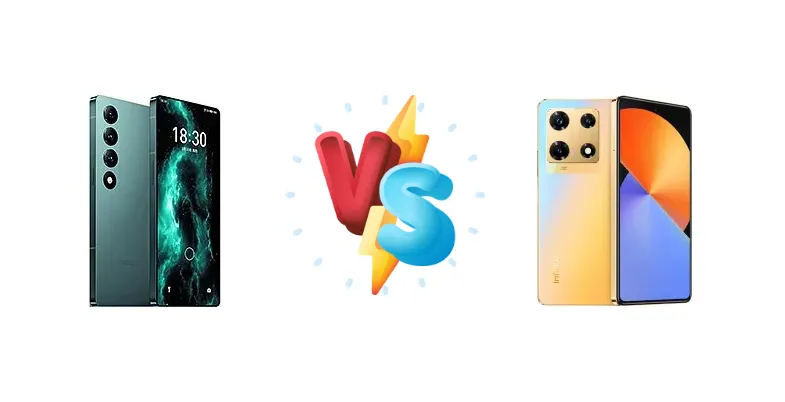
|
🏆 Quick Verdict
The Meizu 20 Infinity boasts significantly superior performance thanks to its Snapdragon 8 Gen 2 chipset. However, the Infinix Note 30 Pro offers incredible value with its fast charging and reverse wireless capabilities. The Meizu wins on power, but the Infinix excels in affordability.
| PHONES | ||
|---|---|---|
| Phone Names | Meizu 20 Infinity | Infinix Note 30 Pro |
| Network | ||
|---|---|---|
| 2G bands | GSM 850 / 900 / 1800 / 1900 | GSM 850 / 900 / 1800 / 1900 |
| 3G bands | HSDPA 850 / 900 / 1700(AWS) / 1900 / 2100 | HSDPA 850 / 900 / 1700(AWS) / 1900 / 2100 |
| 4G bands | 1, 2, 3, 4, 5, 7, 8, 12, 13, 17, 18, 19, 20, 26, 34, 38, 39, 40, 41, 42 | 1, 2, 3, 4, 5, 7, 8, 12, 17, 20, 28, 38, 40, 41, 66 |
| 5G bands | 1, 3, 5, 7, 8, 28, 38, 40, 41, 66, 77, 78, 79 SA/NSA | - |
| Speed | HSPA, LTE, 5G | HSPA, LTE |
| Technology | GSM / HSPA / LTE / 5G | GSM / HSPA / LTE |
| Launch | ||
|---|---|---|
| Announced | 2023, March 30 | 2023, May 22 |
| Status | Available. Released 2023, June 12 | Available. Released 2023, May 22 |
| Body | ||
|---|---|---|
| Build | - | Glass front, plastic frame, glass back |
| Dimensions | 163.4 x 73.3 x 8.2 mm (6.43 x 2.89 x 0.32 in) | 162.7 x 76 x 8.2 mm (6.41 x 2.99 x 0.32 in) |
| SIM | Nano-SIM + Nano-SIM | Nano-SIM + Nano-SIM |
| Weight | 215 g (7.58 oz) | 203 g (7.16 oz) |
| - | IP53 | |
| Display | ||
|---|---|---|
| Resolution | 1368 x 3192 pixels, 21:9 ratio (~511 ppi density) | 1080 x 2400 pixels, 20:9 ratio (~395 ppi density) |
| Size | 6.79 inches, 107.7 cm2 (~89.9% screen-to-body ratio) | 6.67 inches, 107.4 cm2 (~86.9% screen-to-body ratio) |
| Type | LTPO OLED, 1B colors, 120Hz, 600 nits (typ), 1800 nits (peak) | AMOLED, 1B colors, 120Hz, 900 nits (peak) |
| - | * the display diagonal size and resolution is unconfirmed | |
| Platform | ||
|---|---|---|
| CPU | Octa-core (1x3.2 GHz Cortex-X3 & 2x2.8 GHz Cortex-A715 & 2x2.8 GHz Cortex-A710 & 3x2.0 GHz Cortex-A510) | Octa-core (2x2.2 GHz Cortex-A76 & 6x2.0 GHz Cortex-A55) |
| Chipset | Qualcomm SM8550-AB Snapdragon 8 Gen 2 (4 nm) | Mediatek Helio G99 (6 nm) |
| GPU | Adreno 740 | Mali-G57 MC2 |
| OS | Android 13, Flyme 10 | Android 13, XOS 13 |
| Memory | ||
|---|---|---|
| Card slot | No | microSDXC (dedicated slot) |
| Internal | 256GB 12GB RAM, 512GB 12GB RAM, 1TB 16GB RAM | 256GB 8GB RAM |
| UFS 4.0 | - | |
| Main Camera | ||
|---|---|---|
| Features | LED flash, panorama, HDR | Quad-LED flash, HDR, panorama |
| Triple | 50 MP, f/1.8, 23mm (wide), 1/1.56", PDAF, OIS 12 MP f/2.0, 50mm (telephoto), 1/2.9", PDAF, OIS, optical zoom 12 MP, f/2.2, 13mm, 122˚ (ultrawide), 1/2.55" | 108 MP, (wide), 1/1.67", PDAF 2 MP (macro) Auxiliary lens |
| Video | 8K, 4K, 1080p; gyro-EIS | 1440p@30fps, 1080p@30fps |
| Selfie camera | ||
|---|---|---|
| Features | HDR | LED flash, HDR |
| Single | 32 MP, f/2.4, (wide) | 32 MP, f/2.0, (wide), 1/2.8" |
| Video | Yes | 1080p@30fps |
| Sound | ||
|---|---|---|
| 3.5mm jack | No | Yes |
| 35mm jack | No | Yes |
| Loudspeaker | Yes, with stereo speakers | Yes, with dual speakers |
| - | Sound by JBL 24-bit/192kHz audio | |
| Comms | ||
|---|---|---|
| Bluetooth | 5.3, A2DP, LE | Yes |
| NFC | Yes | Yes (market/region dependent) |
| Positioning | GPS (L1+L5), GLONASS, BDS, GALILEO | GPS |
| Radio | No | FM radio |
| USB | USB Type-C | USB Type-C 2.0, OTG |
| WLAN | Wi-Fi 802.11 а/b/g/n/ac/6e/7, tri-band | Wi-Fi 802.11 a/b/g/n/ac, dual-band, Wi-Fi Direct |
| Features | ||
|---|---|---|
| Sensors | Fingerprint (under display, optical), accelerometer, gyro, proximity, compass, barometer | Fingerprint (side-mounted), accelerometer, gyro, proximity, compass |
| Ultra Wideband (UWB) support | - | |
| Battery | ||
|---|---|---|
| Charging | 65W wired, PD PPS, QC4 50W wireless | 68W wired, PD3.0, 80% in 30 min 15W wireless Reverse wireless |
| Type | Li-Po 4800 mAh | 5000 mAh |
| Misc | ||
|---|---|---|
| Colors | Gray, Green, Silver | Magic Black, Variable Gold |
| Models | - | X678B |
| Price | About 820 EUR | - |
Meizu 20 Infinity
- Flagship Snapdragon 8 Gen 2 Chipset
- Premium Design and Build Quality
- Likely Superior Camera System
- Fast Charging (65W)
- Higher Price Point
- Potential Software Quirks (Meizu's Flyme OS)
- Less Focus on Budget Features
Infinix Note 30 Pro
- Excellent Value for Money
- Fast Charging (68W)
- Reverse Wireless Charging
- Decent Performance for the Price
- Mid-Range Performance
- Likely Inferior Camera Quality
- Less Premium Build Materials
- Potentially Less Refined Software
Display Comparison
The Meizu 20 Infinity likely features a high-resolution AMOLED display with a 120Hz refresh rate, offering vibrant colors and smooth scrolling. The Infinix Note 30 Pro probably has an AMOLED display as well, but likely with a lower resolution and potentially a 120Hz refresh rate. Expect the Meizu to have better brightness and color accuracy.
Camera Comparison
While specific camera specs are needed, the Meizu 20 Infinity, being a flagship, likely has a more advanced camera system with better image processing and low-light performance. The Infinix Note 30 Pro will likely offer a decent camera setup for the price, but it won't compete with the Meizu's capabilities. Expect better dynamic range and detail on the Meizu.
Performance
This is where the Meizu 20 Infinity truly shines. The Snapdragon 8 Gen 2 is a flagship chipset, delivering exceptional performance for gaming, multitasking, and demanding applications. The Infinix Note 30 Pro's Helio G99 is a capable mid-range chip, but it won't match the Meizu's power. Expect noticeable lag in demanding tasks on the Infinix.
Battery Life
The Infinix Note 30 Pro has a clear advantage in charging speed with its 68W wired charging. The Meizu 20 Infinity's 65W wired charging is still fast, but slightly slower. Both offer wireless charging, with the Infinix adding reverse wireless charging. Battery capacity is likely similar, but the Infinix's faster charging gives it an edge in convenience.
Buying Guide
The Meizu 20 Infinity is for users who prioritize raw performance, a premium design, and don't mind paying a premium price. The Infinix Note 30 Pro is ideal for budget-conscious buyers who want a feature-rich phone with fast charging and reverse wireless charging, sacrificing some performance.