
Meizu 20 Infinity vs Huawei Mate 50 RS Porsche Design: A Generational Performance Gap?
| Phones Images | |||||
|---|---|---|---|---|---|
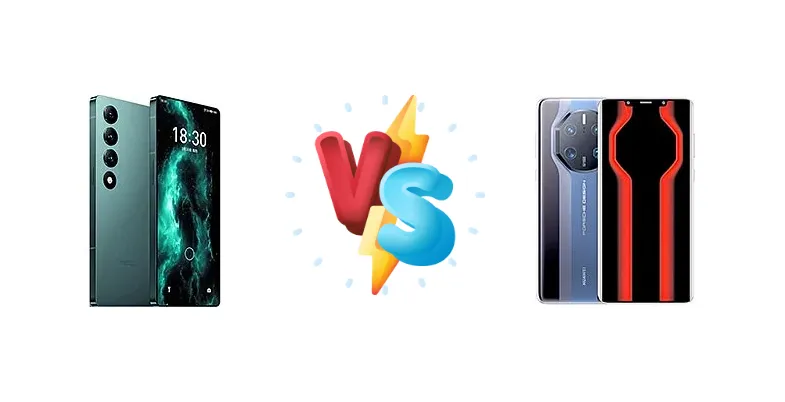
|
🏆 Quick Verdict
For most users, the Meizu 20 Infinity emerges as the stronger choice. The Snapdragon 8 Gen 2 offers a clear performance advantage, coupled with potentially better thermal management. While the Mate 50 RS Porsche Design boasts a distinctive design and brand cachet, its older chipset limits its long-term potential.
| PHONES | ||
|---|---|---|
| Phone Names | Meizu 20 Infinity | Huawei Mate 50 RS Porsche Design |
| Network | ||
|---|---|---|
| 2G bands | GSM 850 / 900 / 1800 / 1900 | GSM 850 / 900 / 1800 / 1900 |
| 3G bands | HSDPA 850 / 900 / 1700(AWS) / 1900 / 2100 | HSDPA 800 / 850 / 900 / 1700(AWS) / 1900 / 2100 |
| 4G bands | 1, 2, 3, 4, 5, 7, 8, 12, 13, 17, 18, 19, 20, 26, 34, 38, 39, 40, 41, 42 | 1, 2, 3, 4, 5, 7, 8, 12, 17, 18, 19, 20, 26, 28, 34, 38, 39, 40, 41 |
| 5G bands | 1, 3, 5, 7, 8, 28, 38, 40, 41, 66, 77, 78, 79 SA/NSA | - |
| Speed | HSPA, LTE, 5G | HSPA, LTE |
| Technology | GSM / HSPA / LTE / 5G | GSM / CDMA / HSPA / CDMA2000 / LTE |
| - | CDMA2000 1x | |
| Launch | ||
|---|---|---|
| Announced | 2023, March 30 | 2022, September 06 |
| Status | Available. Released 2023, June 12 | Available. Released 2022, September 21 |
| Body | ||
|---|---|---|
| Build | - | Glass front, ceramic back, aluminum frame |
| Dimensions | 163.4 x 73.3 x 8.2 mm (6.43 x 2.89 x 0.32 in) | 162.1 x 75.5 x 9.9 mm (6.38 x 2.97 x 0.39 in) |
| SIM | Nano-SIM + Nano-SIM | · Nano-SIM· Nano-SIM + Nano-SIM |
| Weight | 215 g (7.58 oz) | 232 g (8.18 oz) |
| - | IP68 dust/water resistant (up to 6m for 30 min) | |
| Display | ||
|---|---|---|
| Protection | - | Huawei Kunlun Glass |
| Resolution | 1368 x 3192 pixels, 21:9 ratio (~511 ppi density) | 1212 x 2616 pixels, 19.5:9 ratio (~428 ppi density) |
| Size | 6.79 inches, 107.7 cm2 (~89.9% screen-to-body ratio) | 6.74 inches, 111.8 cm2 (~91.3% screen-to-body ratio) |
| Type | LTPO OLED, 1B colors, 120Hz, 600 nits (typ), 1800 nits (peak) | OLED, 1B colors, 120Hz |
| Platform | ||
|---|---|---|
| CPU | Octa-core (1x3.2 GHz Cortex-X3 & 2x2.8 GHz Cortex-A715 & 2x2.8 GHz Cortex-A710 & 3x2.0 GHz Cortex-A510) | Octa-core (1x3.19 GHz Cortex-X2 & 3x2.75 GHz Cortex-A710 & 4x2.0 GHz Cortex-A510) |
| Chipset | Qualcomm SM8550-AB Snapdragon 8 Gen 2 (4 nm) | Qualcomm SM8475 Snapdragon 8+ Gen 1 4G (4 nm) |
| GPU | Adreno 740 | Adreno 730 |
| OS | Android 13, Flyme 10 | HarmonyOS 3.0 |
| Memory | ||
|---|---|---|
| Card slot | No | Nano Memory (uses shared SIM slot) |
| Internal | 256GB 12GB RAM, 512GB 12GB RAM, 1TB 16GB RAM | 512GB 12GB RAM |
| UFS 4.0 | UFS 3.1 | |
| Main Camera | ||
|---|---|---|
| Features | LED flash, panorama, HDR | Laser AF, color spectrum sensor, LED flash, panorama, HDR |
| Single | - | 13 MP, f/2.4, 18mm (ultrawide) TOF 3D, (depth/biometrics sensor) |
| Triple | 50 MP, f/1.8, 23mm (wide), 1/1.56", PDAF, OIS 12 MP f/2.0, 50mm (telephoto), 1/2.9", PDAF, OIS, optical zoom 12 MP, f/2.2, 13mm, 122˚ (ultrawide), 1/2.55" | 50 MP, f/1.4-f/4.0, 24mm (wide), PDAF, OIS 48 MP, f/3.0, 90mm (periscope telephoto macro), PDAF, OIS, 3.5x optical zoom 13 MP, f/2.2, 13mm, 120˚ (ultrawide), PDAF |
| Video | 8K, 4K, 1080p; gyro-EIS | 4K@30/60fps, 1080p@30/60/120/240/480fps, 720p@960fps, 720p@3840fps, HDR, gyro-EIS |
| Selfie camera | ||
|---|---|---|
| Features | HDR | HDR, panorama |
| Single | 32 MP, f/2.4, (wide) | 13 MP, f/2.4, 18mm (ultrawide) TOF 3D, (depth/biometrics sensor) |
| Video | Yes | 4K@30/60fps, 1080p@30/60/240fps |
| Sound | ||
|---|---|---|
| 3.5mm jack | No | No |
| 35mm jack | No | No |
| Loudspeaker | Yes, with stereo speakers | Yes, with stereo speakers |
| - | 32-bit/384kHz audio | |
| Comms | ||
|---|---|---|
| Bluetooth | 5.3, A2DP, LE | 5.2, A2DP, LE |
| Infrared port | - | Yes |
| NFC | Yes | Yes |
| Positioning | GPS (L1+L5), GLONASS, BDS, GALILEO | GPS (L1+L5), GLONASS (L1), BDS (B1I+B1c+B2a), GALILEO (E1+E5a), QZSS (L1+L5), NavIC (L5) |
| Radio | No | No |
| USB | USB Type-C | USB Type-C 3.1, OTG, Display Port 1.2 |
| WLAN | Wi-Fi 802.11 а/b/g/n/ac/6e/7, tri-band | Wi-Fi 802.11 a/b/g/n/ac/6, dual-band, Wi-Fi Direct |
| Features | ||
|---|---|---|
| Sensors | Fingerprint (under display, optical), accelerometer, gyro, proximity, compass, barometer | Face ID, fingerprint (under display, optical), accelerometer, gyro, proximity, barometer, compass |
| Ultra Wideband (UWB) support | BDS Satellite Message (sending only) | |
| Battery | ||
|---|---|---|
| Charging | 65W wired, PD PPS, QC4 50W wireless | 66W wired 50W wireless 5W reverse wireless |
| Type | Li-Po 4800 mAh | Li-Po 4700 mAh |
| Misc | ||
|---|---|---|
| Colors | Gray, Green, Silver | Ink Blue, Purple |
| Models | - | DCO-AL00 |
| Price | About 820 EUR | About 1880 EUR |
Meizu 20 Infinity
- Superior Performance: Snapdragon 8 Gen 2 offers a significant performance boost.
- Better Efficiency: 4nm process leads to improved thermal management and battery life.
- Faster Charging Standards: PD PPS and QC4 offer wider compatibility.
- Lacks Reverse Wireless Charging: No option to charge accessories wirelessly.
- Brand Recognition: Meizu has less global brand recognition than Huawei.
Huawei Mate 50 RS Porsche Design
- Unique Design: Porsche Design aesthetic offers a distinctive look.
- Variable Aperture Camera: Offers creative control over depth of field.
- Reverse Wireless Charging: Convenient for topping up accessories.
- Older Chipset: Snapdragon 8+ Gen 1 is outperformed by the 8 Gen 2.
- Limited 4G Connectivity: The 4G modem is a significant limitation in many markets.
Display Comparison
While both devices are expected to feature high-quality OLED panels, specific details like peak brightness and refresh rates aren't provided. However, the Meizu 20 Infinity, being a newer device, likely benefits from advancements in panel technology, potentially offering higher peak brightness and more efficient LTPO for variable refresh rates. The Mate 50 RS Porsche Design, while still excellent, will likely lag behind in these areas. Bezels are expected to be minimal on both, reflecting their flagship status.
Camera Comparison
Without detailed camera specs, a direct comparison is difficult. However, the Mate 50 RS Porsche Design is known for its variable aperture camera system, a feature not present in the Meizu 20 Infinity. Both devices support 50W wireless charging, but the Meizu 20 Infinity adds PD PPS and QC4 support for wider compatibility and potentially faster wired charging speeds. The Mate 50 RS also offers 5W reverse wireless charging, a convenience feature absent in the Meizu 20 Infinity.
Performance
The core difference lies in the chipsets. The Meizu 20 Infinity’s Snapdragon 8 Gen 2 (4nm) boasts a more modern CPU architecture – Cortex-X3 vs the Mate 50 RS’s Cortex-X2 – and a higher clock speed (3.2 GHz vs 3.19 GHz). This translates to faster single-core performance, crucial for responsive UI and app loading. The Snapdragon 8 Gen 2 also features an improved GPU, offering a significant leap in graphics performance. The 4nm process node of the 8 Gen 2 provides better thermal efficiency, reducing the likelihood of throttling during sustained workloads compared to the 4nm Snapdragon 8+ Gen 1 in the Mate 50 RS. The Meizu 20 Infinity also benefits from potentially faster LPDDR5x RAM, further enhancing performance.
Battery Life
Both phones offer 50W wireless charging and comparable wired charging speeds (65W vs 66W). The actual 0-100% times will depend on battery capacity, which isn't specified. However, the Snapdragon 8 Gen 2’s superior efficiency in the Meizu 20 Infinity could translate to longer real-world battery life despite potentially having a similar capacity to the Mate 50 RS Porsche Design. The Mate 50 RS’s 5W reverse wireless charging is a niche feature, useful for topping up accessories but not a major factor for most users.
Buying Guide
Buy the Meizu 20 Infinity if you prioritize raw performance, future-proofing, and the latest Android features. It’s ideal for demanding gamers, power users, and those who want the fastest possible experience. Buy the Huawei Mate 50 RS Porsche Design if you value a unique, luxury design, are heavily invested in the Huawei ecosystem, and don't require the absolute peak in processing power. The Porsche Design aesthetic and brand recognition are key selling points.