
Meizu 20 Infinity vs Google Pixel 7 Pro: A Head-to-Head Flagship Battle
| Phones Images | |||||
|---|---|---|---|---|---|
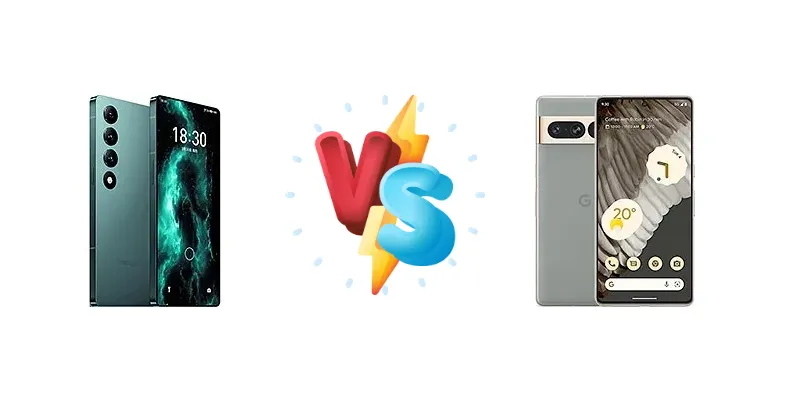
|
🏆 Quick Verdict
For most users, the Google Pixel 7 Pro offers a more refined and consistently excellent experience, particularly in camera performance and software integration. However, the Meizu 20 Infinity’s superior charging speeds and raw processing power make it a strong contender for power users and gamers.
| PHONES | ||
|---|---|---|
| Phone Names | Meizu 20 Infinity | Google Pixel 7 Pro |
| Network | ||
|---|---|---|
| 2G bands | GSM 850 / 900 / 1800 / 1900 | GSM 850 / 900 / 1800 / 1900 |
| 3G bands | HSDPA 850 / 900 / 1700(AWS) / 1900 / 2100 | HSDPA 800 / 850 / 900 / 1700(AWS) / 1900 / 2100 |
| 4G bands | 1, 2, 3, 4, 5, 7, 8, 12, 13, 17, 18, 19, 20, 26, 34, 38, 39, 40, 41, 42 | 1, 2, 3, 4, 5, 7, 8, 12, 13, 14, 17, 18, 19, 20, 25, 26, 28, 29, 30, 38, 39, 40, 41, 42, 46, 48, 66, 71 - GE2AE |
| 5G bands | 1, 3, 5, 7, 8, 28, 38, 40, 41, 66, 77, 78, 79 SA/NSA | 1, 2, 3, 5, 7, 8, 12, 14, 20, 25, 28, 30, 38, 40, 41, 48, 66, 71, 77, 78, 257, 258, 260, 261 SA/NSA/Sub6/mmWave - GE2AE |
| Speed | HSPA, LTE, 5G | HSPA, LTE, 5G |
| Technology | GSM / HSPA / LTE / 5G | GSM / CDMA / HSPA / EVDO / LTE / 5G |
| - | 1, 2, 3, 5, 7, 8, 12, 14, 20, 25, 28, 30, 38, 40, 41, 48, 66, 71, 75, 76, 77, 78 SA/NSA/Sub6 - GP4BC | |
| Launch | ||
|---|---|---|
| Announced | 2023, March 30 | 2022, October 06 |
| Status | Available. Released 2023, June 12 | Available. Released 2022, October 13 |
| Body | ||
|---|---|---|
| Build | - | Glass front (Gorilla Glass Victus), glass back (Gorilla Glass Victus), aluminum frame |
| Dimensions | 163.4 x 73.3 x 8.2 mm (6.43 x 2.89 x 0.32 in) | 162.9 x 76.6 x 8.9 mm (6.41 x 3.02 x 0.35 in) |
| SIM | Nano-SIM + Nano-SIM | Nano-SIM + eSIM |
| Weight | 215 g (7.58 oz) | 212 g (7.48 oz) |
| - | IP68 dust/water resistant (up to 1.5m for 30 min) | |
| Display | ||
|---|---|---|
| Protection | - | Corning Gorilla Glass Victus |
| Resolution | 1368 x 3192 pixels, 21:9 ratio (~511 ppi density) | 1440 x 3120 pixels, 19.5:9 ratio (~512 ppi density) |
| Size | 6.79 inches, 107.7 cm2 (~89.9% screen-to-body ratio) | 6.7 inches, 110.6 cm2 (~88.7% screen-to-body ratio) |
| Type | LTPO OLED, 1B colors, 120Hz, 600 nits (typ), 1800 nits (peak) | LTPO AMOLED, 120Hz, HDR10+, 1000 nits (HBM), 1500 nits (peak) |
| - | Always-on display | |
| Platform | ||
|---|---|---|
| CPU | Octa-core (1x3.2 GHz Cortex-X3 & 2x2.8 GHz Cortex-A715 & 2x2.8 GHz Cortex-A710 & 3x2.0 GHz Cortex-A510) | Octa-core (2x2.85 GHz Cortex-X1 & 2x2.35 GHz Cortex-A78 & 4x1.80 GHz Cortex-A55) |
| Chipset | Qualcomm SM8550-AB Snapdragon 8 Gen 2 (4 nm) | Google Tensor G2 (5 nm) |
| GPU | Adreno 740 | Mali-G710 MP7 |
| OS | Android 13, Flyme 10 | Android 13, upgradable to Android 15, up to 5 major Android upgrades |
| Memory | ||
|---|---|---|
| Card slot | No | No |
| Internal | 256GB 12GB RAM, 512GB 12GB RAM, 1TB 16GB RAM | 128GB 8GB RAM, 256GB 8GB RAM, 128GB 12GB RAM, 256GB 12GB RAM, 512GB 12GB RAM |
| UFS 4.0 | UFS 3.1 | |
| Main Camera | ||
|---|---|---|
| Features | LED flash, panorama, HDR | Laser AF, Dual-LED flash, Pixel Shift, Auto-HDR, panorama |
| Single | - | 10.8 MP, f/2.2, 21mm (ultrawide), 1/3.1", 1.22µm |
| Triple | 50 MP, f/1.8, 23mm (wide), 1/1.56", PDAF, OIS 12 MP f/2.0, 50mm (telephoto), 1/2.9", PDAF, OIS, optical zoom 12 MP, f/2.2, 13mm, 122˚ (ultrawide), 1/2.55" | 50 MP, f/1.9, 25mm (wide), 1/1.31", 1.2µm, dual pixel PDAF, OIS 48 MP, f/3.5, 120mm (periscope telephoto), 1/2.55", 0.7µm, dual pixel PDAF, OIS, 5x optical zoom 12 MP, f/2.2, 126˚ (ultrawide), 1/2.9", 1.25µm, AF |
| Video | 8K, 4K, 1080p; gyro-EIS | 4K@30/60fps, 1080p@30/60/120/240fps; gyro-EIS, OIS, 10-bit HDR |
| Selfie camera | ||
|---|---|---|
| Features | HDR | HDR, panorama |
| Single | 32 MP, f/2.4, (wide) | 10.8 MP, f/2.2, 21mm (ultrawide), 1/3.1", 1.22µm |
| Video | Yes | 4K@30/60fps, 1080p@30/60fps |
| Sound | ||
|---|---|---|
| 3.5mm jack | No | No |
| 35mm jack | No | No |
| Loudspeaker | Yes, with stereo speakers | Yes, with stereo speakers |
| Comms | ||
|---|---|---|
| Bluetooth | 5.3, A2DP, LE | 5.2, A2DP, LE, aptX HD |
| NFC | Yes | Yes |
| Positioning | GPS (L1+L5), GLONASS, BDS, GALILEO | GPS (L1+L5), GLONASS (G1), BDS (B1I+B1c+B2a), GALILEO (E1+E5a), QZSS (L1+L5) |
| Radio | No | No |
| USB | USB Type-C | USB Type-C 3.2 |
| WLAN | Wi-Fi 802.11 а/b/g/n/ac/6e/7, tri-band | Wi-Fi 802.11 a/b/g/n/ac/6e, tri-band, Wi-Fi Direct |
| Features | ||
|---|---|---|
| Sensors | Fingerprint (under display, optical), accelerometer, gyro, proximity, compass, barometer | Fingerprint (under display, optical), accelerometer, gyro, proximity, compass, barometer |
| Ultra Wideband (UWB) support | Ultra Wideband (UWB) support | |
| Battery | ||
|---|---|---|
| Charging | 65W wired, PD PPS, QC4 50W wireless | 23W wired, PD3.0, 50% in 30 min 23W wireless Reverse wireless |
| Type | Li-Po 4800 mAh | Li-Ion 5000 mAh |
| Misc | ||
|---|---|---|
| Colors | Gray, Green, Silver | Obsidian, Snow, Hazel |
| Models | - | GP4BC, GE2AE, GFE4J |
| Price | About 820 EUR | € 248.84 / $ 204.00 / £ 259.99 / ₹ 36,999 |
| Tests | ||
|---|---|---|
| Battery life | - | Endurance rating 83h |
| Camera | - | Photo / Video |
| Display | - | Contrast ratio: Infinite (nominal) |
| Loudspeaker | - | -24.8 LUFS (Very good) |
| Performance | - | AnTuTu: 796369 (v9) GeekBench: 3187 (v5.1) GFXBench: 34fps (ES 3.1 onscreen) |
Meizu 20 Infinity
- Significantly faster charging speeds (65W wired, 50W wireless)
- More powerful processor (Snapdragon 8 Gen 2)
- Potential for better thermal management
- Less established brand reputation
- Camera performance is unknown without detailed specs
Google Pixel 7 Pro
- Exceptional camera system with Google’s computational photography
- Seamless software experience with guaranteed updates
- Strong brand recognition and support
- Slower charging speeds (23W wired, 23W wireless)
- Less powerful processor (Tensor G2)
Display Comparison
The Pixel 7 Pro’s display achieves a measured peak brightness of 1090 nits, providing excellent visibility outdoors. While the Meizu 20 Infinity’s display specs are not provided, its positioning suggests a comparable or potentially superior panel. Both displays feature an infinite (nominal) contrast ratio, delivering deep blacks. The Pixel 7 Pro’s LTPO technology dynamically adjusts the refresh rate for power efficiency, a feature likely present in the Meizu 20 Infinity as well given its flagship status. The absence of detailed display specs for the Meizu hinders a complete comparison, but the Pixel 7 Pro’s measured brightness provides a solid benchmark.
Camera Comparison
Both devices are equipped with capable camera systems, but approach image processing differently. The Pixel 7 Pro is renowned for its computational photography prowess, leveraging Google’s algorithms to produce consistently excellent photos and videos. While specific sensor details for the Meizu 20 Infinity are unavailable, the focus should be on the main sensor’s size and aperture. The Pixel 7 Pro’s image processing prioritizes realistic colors and dynamic range, while Meizu often leans towards more vibrant, saturated images. The Pixel 7 Pro’s video capabilities are also highly regarded, offering excellent stabilization and detail. Without detailed Meizu camera specs, the Pixel 7 Pro holds a clear advantage based on its established reputation and software optimization.
Performance
The Meizu 20 Infinity’s Snapdragon 8 Gen 2 (4nm) represents a significant leap in performance and efficiency over the Pixel 7 Pro’s Google Tensor G2 (5nm). The Snapdragon 8 Gen 2’s Cortex-X3 prime core, clocked at 3.2 GHz, outperforms the Pixel’s Cortex-X1 (2.85 GHz). The more modern CPU architecture in the Snapdragon 8 Gen 2, combined with the smaller 4nm process node, translates to better thermal management and sustained performance during intensive tasks. While the Tensor G2 excels in AI and machine learning tasks, the Snapdragon 8 Gen 2 dominates in raw CPU and GPU power, benefiting gamers and users running demanding applications. The Meizu’s likely LPDDR5x RAM further enhances memory bandwidth.
Battery Life
Both the Meizu 20 Infinity and Google Pixel 7 Pro achieve an endurance rating of 83 hours, suggesting similar overall battery life despite differing battery capacities (not specified for the Meizu). However, the charging capabilities are drastically different. The Meizu 20 Infinity supports 65W wired charging with PD PPS and QC4, alongside 50W wireless charging. This allows for significantly faster charging times compared to the Pixel 7 Pro’s 23W wired and 23W wireless charging. The Meizu can likely achieve a full charge in under 40 minutes, while the Pixel 7 Pro takes considerably longer. The Meizu also offers reverse wireless charging, a feature present on the Pixel 7 Pro, adding to its versatility.
Buying Guide
Buy the Meizu 20 Infinity if you prioritize raw performance for demanding tasks like gaming and video editing, and value incredibly fast wired and wireless charging. Buy the Google Pixel 7 Pro if you prioritize a best-in-class camera system, seamless software experience with exclusive features, and a more established brand reputation with long-term software support.