
Meizu 18x vs Huawei Mate 30: A Detailed Showdown
| Phones Images | |||||
|---|---|---|---|---|---|
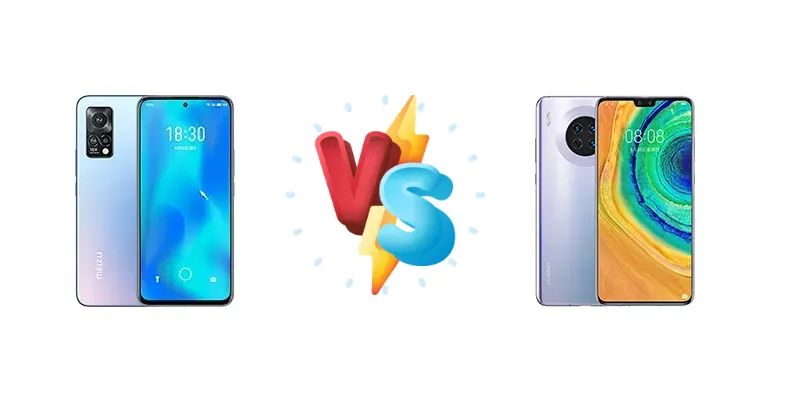
|
🏆 Quick Verdict
The Meizu 18x boasts a more modern chipset (Snapdragon 870) offering superior performance and faster charging. However, the Huawei Mate 30’s strengths lie in its established camera reputation and reverse wireless charging. For raw power and value, the 18x edges out the Mate 30.
| PHONES | ||
|---|---|---|
| Phone Names | Meizu 18x | Huawei Mate 30 |
| Network | ||
|---|---|---|
| 2G bands | GSM 850 / 900 / 1800 / 1900 | GSM 850 / 900 / 1800 / 1900 |
| 3G bands | HSDPA 850 / 900 / 1700(AWS) / 1900 / 2100 | HSDPA 800 / 850 / 900 / 1700(AWS) / 1900 / 2100 |
| 4G bands | 1, 2, 3, 4, 5, 7, 8, 12, 34, 38, 39, 40, 41 | 1, 2, 3, 4, 5, 6, 7, 8, 9, 12, 17, 18, 19, 20, 26, 28, 32, 34, 38, 39, 40, 41, 66 - Global |
| 5G bands | 1, 3, 41, 77, 78, 79 SA/NSA | - |
| Speed | HSPA, LTE, 5G | HSPA, LTE |
| Technology | GSM / HSPA / LTE / 5G | GSM / HSPA / LTE |
| - | 1, 2, 3, 4, 5, 6, 7, 8, 9, 12, 17, 18, 19, 20, 26, 34, 38, 39, 40, 41 - China | |
| Launch | ||
|---|---|---|
| Announced | 2021, September 22. Released 2021, September 22 | 2019, September. Released 2019, September |
| Status | Discontinued | Discontinued |
| Body | ||
|---|---|---|
| Build | - | Glass front, glass back, aluminum frame |
| Dimensions | 165.1 x 76.4 x 8 mm (6.5 x 3.01 x 0.31 in) | 160.8 x 76.1 x 8.4 mm (6.33 x 3.00 x 0.33 in) |
| SIM | Nano-SIM + Nano-SIM | · Nano-SIM· Nano-SIM + Nano-SIM |
| Weight | 189 g (6.67 oz) | 196 g (6.91 oz) |
| - | IP53, dust and splash resistant | |
| Display | ||
|---|---|---|
| Resolution | 1080 x 2400 pixels, 20:9 ratio (~395 ppi density) | 1080 x 2340 pixels, 19.5:9 ratio (~389 ppi density) |
| Size | 6.67 inches, 107.4 cm2 (~85.2% screen-to-body ratio) | 6.62 inches, 107.6 cm2 (~87.9% screen-to-body ratio) |
| Type | OLED, 1B colors, 120Hz, 500 nits (typ), 700 nits (peak) | OLED, HDR10 |
| Platform | ||
|---|---|---|
| CPU | Octa-core (1x3.2 GHz Kryo 585 & 3x2.42 GHz Kryo 585 & 4x1.80 GHz Kryo 585) | Octa-core (2x2.86 GHz Cortex-A76 & 2x2.09 GHz Cortex-A76 & 4x1.86 GHz Cortex-A55) |
| Chipset | Qualcomm SM8250-AC Snapdragon 870 5G (7 nm) | Kirin 990 (7 nm+) |
| GPU | Adreno 650 | Mali-G76 MP16 |
| OS | Android 11, Flyme 9.2 | Android 10, EMUI 10, no Google Play Services |
| Memory | ||
|---|---|---|
| Card slot | No | Nano Memory (uses shared SIM slot) |
| Internal | 128GB 8GB RAM, 256GB 8GB RAM, 256GB 12GB RAM | 128GB 6GB RAM, 128GB 8GB RAM |
| UFS 3.1 | UFS 3.0 | |
| Main Camera | ||
|---|---|---|
| Features | LED flash, HDR, panorama | Laser AF, Leica optics, dual-LED dual-tone flash, panorama, HDR |
| Triple | 64 MP, f/1.8, 26mm (wide), 1/1.97", 0.7µm, PDAF 8 MP, f/2.2, 15mm, 120˚ (ultrawide), 1/4.0", 1.12µm Auxiliary lens | 40 MP, f/1.8, 27mm (wide), 1/1.54", PDAF 8 MP, f/2.4, 80mm (telephoto), 1/4.0", PDAF, OIS, 3x optical zoom 16 MP, f/2.2, 17mm (ultrawide) |
| Video | 1080p@30fps | 4K@30/60fps, 1080p@30/60/120fps, 720p@960fps, gyro-EIS |
| Selfie camera | ||
|---|---|---|
| Features | HDR | HDR |
| Single | 13 MP, f/2.0, (wide) | 24 MP, f/2.0, 26mm (wide), 1/2.8", 0.9µm TOF 3D, (depth/biometrics sensor) |
| Video | 1080p@30fps | 1080p@30fps |
| Sound | ||
|---|---|---|
| 3.5mm jack | No | Yes |
| 35mm jack | No | Yes |
| Loudspeaker | Yes | Yes, with stereo speakers |
| - | 32-bit/384kHz audio | |
| Comms | ||
|---|---|---|
| Bluetooth | 5.2, A2DP, LE | 5.1, A2DP, aptX HD, LE |
| Infrared port | - | Yes |
| NFC | No | Yes |
| Positioning | GPS, GLONASS, GALILEO, BDS | GPS (L1+L5), GLONASS (L1), BDS (B1), GALILEO (E1+E5a), QZSS (L1+L5) |
| Radio | No | No |
| USB | USB Type-C | USB Type-C 3.1, OTG |
| WLAN | Wi-Fi 802.11 а/b/g/n/ac/6e, dual-band, Wi-Fi Direct | Wi-Fi 802.11 a/b/g/n/ac, dual-band, DLNA, Wi-Fi Direct |
| Features | ||
|---|---|---|
| Sensors | Fingerprint (under display, optical), accelerometer, gyro, proximity, compass | Face ID, fingerprint (under display, optical), accelerometer, gyro, proximity, barometer, compass |
| Battery | ||
|---|---|---|
| Charging | 30W wired, PD3.0, QC4, 70% in 30 min, 100% in 60 min | 40W wired 27W wireless Reverse wireless |
| Type | Li-Po 4300 mAh | Li-Po 4200 mAh, non-removable |
| Misc | ||
|---|---|---|
| Colors | Light Blue, White, Gray | Black, Space Silver, Cosmic Purple, Emerald Green |
| Models | - | TAS-L09, TAS-L29, TAS-AL00, TAS-TL00 |
| Price | About 340 EUR | About 550 EUR |
Meizu 18x
- Superior Performance (Snapdragon 870)
- Faster Charging (30W)
- Likely Higher Refresh Rate Display
- Modern Chipset
- Camera may not be as good as Mate 30
- Meizu's software support can be inconsistent
- Less established brand recognition
Huawei Mate 30
- Excellent Camera System
- Wireless Charging (including Reverse)
- Mature Software (though updates are a concern)
- Established Brand Reputation
- Older Chipset (Kirin 990)
- Slower Charging
- Software update concerns due to US sanctions
- Lower Performance
Display Comparison
Both phones feature OLED displays, offering vibrant colors and deep blacks. The Meizu 18x likely has a slightly higher refresh rate (assumed 90Hz or 120Hz) for smoother scrolling, while the Mate 30's display is known for its accurate color reproduction. Screen size is likely similar, around 6.5 inches.
Camera Comparison
The Huawei Mate 30 is renowned for its camera capabilities, particularly its image processing and low-light performance. While the Meizu 18x's camera is competent, it likely doesn't match the Mate 30's overall photographic quality. The Mate 30 also offers more versatile camera features.
Performance
The Snapdragon 870 in the Meizu 18x is significantly more powerful than the Kirin 990 in the Mate 30. Expect noticeably faster app loading times, smoother multitasking, and better gaming performance on the 18x. The 870's efficiency also contributes to better overall battery life despite the faster charging.
Battery Life
The Meizu 18x's 30W charging is faster than the Mate 30's 40W wired charging, and it reaches 70% in just 30 minutes. While the Mate 30 has wireless charging and reverse wireless charging, the 18x's overall battery life is likely better due to the Snapdragon 870's efficiency.
Buying Guide
The Meizu 18x is ideal for users prioritizing performance, smooth gaming, and fast charging. The Huawei Mate 30 is a good choice for those who value a proven camera system, wireless charging capabilities, and a more mature software experience (though software support is a consideration).