
Meizu 18s vs Xiaomi Redmi K40 Pro+: A Deep Dive into Snapdragon 888 Performance
| Phones Images | |||||
|---|---|---|---|---|---|
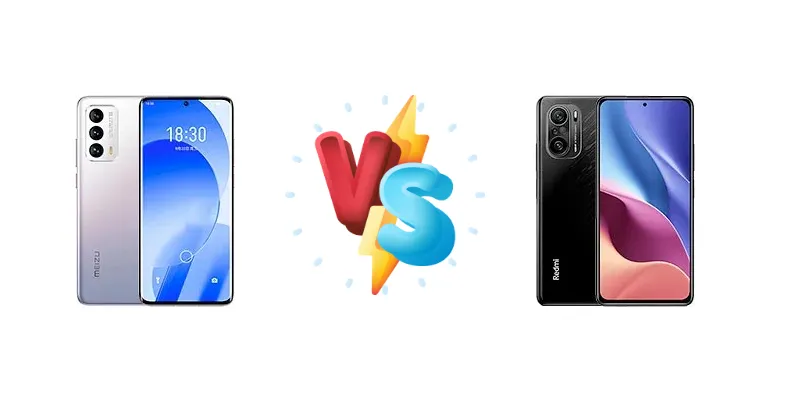
|
🏆 Quick Verdict
For most users, the Meizu 18s emerges as the slightly stronger choice. The Snapdragon 888+ offers a marginal performance uplift and potentially better sustained performance under load, while the 36W charging is marginally faster. However, the Redmi K40 Pro+ remains a compelling option, especially if found at a significantly lower price.
| PHONES | ||
|---|---|---|
| Phone Names | Meizu 18s | Xiaomi Redmi K40 Pro+ |
| Network | ||
|---|---|---|
| 2G bands | GSM 850 / 900 / 1800 / 1900 | GSM 850 / 900 / 1800 / 1900 - SIM 1 & SIM 2 |
| 3G bands | HSDPA 850 / 900 / 1900 / 2100 | HSDPA 850 / 900 / 1700(AWS) / 1900 / 2100 |
| 4G bands | 1, 3, 4, 5, 7, 8, 34, 38, 39, 40, 41 | 1, 2, 3, 4, 5, 7, 8, 12, 17, 18, 19, 20, 26, 28, 34, 38, 39, 40, 41, 42 |
| 5G bands | 1, 3, 41, 77, 78, 79 SA/NSA | 1, 3, 28, 41, 77, 78 SA/NSA/Sub6 |
| Speed | HSPA, LTE, 5G | HSPA, LTE-A, 5G |
| Technology | GSM / HSPA / LTE / 5G | GSM / CDMA / HSPA / CDMA2000 / LTE / 5G |
| - | CDMA2000 1x | |
| Launch | ||
|---|---|---|
| Announced | 2021, September 22. Released 2021, September 23 | 2021, February 25 |
| Status | Discontinued | Available. Released 2021, March 04 |
| Body | ||
|---|---|---|
| Dimensions | 152.4 x 69.2 x 8.2 mm (6.00 x 2.72 x 0.32 in) | 163.7 x 76.4 x 7.8 mm (6.44 x 3.01 x 0.31 in) |
| SIM | Nano-SIM + Nano-SIM | Dual SIM (Nano-SIM, dual stand-by) |
| Weight | 162 g (5.71 oz) | 196 g (6.91 oz) |
| - | IP53, dust and splash resistant | |
| Display | ||
|---|---|---|
| Protection | - | Corning Gorilla Glass 5 |
| Resolution | 1440 x 3200 pixels, 20:9 ratio (~563 ppi density) | 1080 x 2400 pixels, 20:9 ratio (~395 ppi density) |
| Size | 6.2 inches, 93.8 cm2 (~88.9% screen-to-body ratio) | 6.67 inches, 107.4 cm2 (~85.9% screen-to-body ratio) |
| Type | Super AMOLED, 120Hz, HDR10+, 420 nits (typ), 1300 nits (peak) | Super AMOLED, 120Hz, HDR10+, 1300 nits (peak) |
| Platform | ||
|---|---|---|
| CPU | Octa-core (1x3.0 GHz Cortex-X1 & 3x2.42 GHz Cortex-A78 & 4x1.80 GHz Cortex-A55) | Octa-core (1x2.84 GHz Cortex-X1 & 3x2.42 GHz Cortex-A78 & 4x1.80 GHz Cortex-A55) |
| Chipset | Qualcomm SM8350 Snapdragon 888+ 5G (5 nm) | Qualcomm SM8350 Snapdragon 888 5G (5 nm) |
| GPU | Adreno 660 | Adreno 660 |
| OS | Android 11, Flyme 9.2 | Android 11, MIUI 12 |
| Memory | ||
|---|---|---|
| Card slot | No | No |
| Internal | 128GB 8GB RAM, 256GB 8GB RAM, 256GB 12GB RAM | 256GB 12GB RAM |
| UFS 3.1 | UFS 3.1 | |
| Main Camera | ||
|---|---|---|
| Features | Dual-LED dual-tone flash, HDR, panorama | LED flash, HDR, panorama |
| Single | - | 20 MP, f/2.5, (wide), 1/3.4", 0.8µm |
| Triple | 64 MP, f/1.6, 26mm (wide), 1/1.73", 0.8µm, PDAF, OIS 8 MP f/2.4, 79mm (telephoto), 1/4.4", 1.0µm, PDAF, 3x optical zoom 16 MP, f/2.2, 15mm, 122˚ (ultrawide), 1/3.0", 1.0µm | 108 MP, f/1.8, 26mm (wide), 1/1.52", 0.7µm, PDAF 8 MP, f/2.2, 119˚ (ultrawide) 5 MP, f/2.4, 50mm (macro), 1/5.0", 1.12µm |
| Video | 4K@30/60fps, 1080p; gyro-EIS | 8K@30fps, 4K@30/60fps, 1080p@30/60/120/240/960fps, gyro-EIS, HDR10+ |
| Selfie camera | ||
|---|---|---|
| Features | HDR | HDR |
| Single | 20 MP, f/2.2, 26mm (wide), 1/3.4", 0.8µm | 20 MP, f/2.5, (wide), 1/3.4", 0.8µm |
| Video | 1080p@30fps | 1080p@30fps, 720p@120fps |
| Sound | ||
|---|---|---|
| 3.5mm jack | No | No |
| 35mm jack | No | - |
| Loudspeaker | Yes, with stereo speakers | Yes, with stereo speakers |
| - | 24-bit/192kHz audio | |
| Comms | ||
|---|---|---|
| Bluetooth | 5.2, A2DP, LE | 5.2, A2DP, LE |
| Infrared port | - | Yes |
| NFC | Yes | Yes |
| Positioning | GPS (L1+L5), GLONASS, BDS, GALILEO, QZSS | GPS (L1+L5), GLONASS (G1), BDS (B1I+B1c+B2a), GALILEO (E1+E5a), QZSS (L1+L5), NavIC (L5) |
| Radio | No | No |
| USB | USB Type-C | USB Type-C 2.0, OTG |
| WLAN | Wi-Fi 802.11 а/b/g/n/ac/6e, dual-band, Wi-Fi Direct | Wi-Fi 802.11 a/b/g/n/ac/6e, dual-band, Wi-Fi Direct |
| Features | ||
|---|---|---|
| Sensors | Fingerprint (under display, ultrasonic), accelerometer, gyro, proximity, compass | Fingerprint (side-mounted), accelerometer, gyro, proximity, compass, color spectrum, barometer |
| Battery | ||
|---|---|---|
| Charging | 36W wired, PD3.0, QC3, 80% in 33 min, 100% in 55 min | 33W wired, PD3.0, QC3, 100% in 52 min (advertised) |
| Type | Li-Po 4000 mAh | Li-Po 4520 mAh, non-removable |
| Misc | ||
|---|---|---|
| Colors | Light Blue, White, Aurora, Pink/Violet | Black, White, Aurora |
| Price | About 490 EUR | About 470 EUR |
Meizu 18s
- Slightly faster Snapdragon 888+ processor
- Marginally faster 36W charging
- Potentially better thermal management
- Likely higher price point
- May have less aggressive camera hardware (depending on sensor)
Xiaomi Redmi K40 Pro+
- Potentially better camera hardware (if equipped with 108MP sensor)
- Generally more affordable
- Strong value proposition
- Slightly slower Snapdragon 888 processor
- Slower 33W charging
Display Comparison
While display specs aren't provided, both phones likely feature AMOLED panels, standard for this class. The key difference lies in potential panel calibration and refresh rate implementation. Meizu historically focuses on color accuracy, while Xiaomi often prioritizes vibrant, punchy colors. The absence of LTPO technology in either device suggests both will rely on variable refresh rates to conserve battery, but the efficiency of those implementations remains unknown. Bezels are likely comparable, given the similar overall design language of flagship phones from this era.
Camera Comparison
Camera details are absent, but both phones likely feature multi-camera systems. The Redmi K40 Pro+ is known for its Samsung 108MP main sensor, a significant advantage if present. The Meizu 18s likely employs a smaller, but potentially higher-quality sensor, focusing on image processing and computational photography. Lens apertures and OIS (Optical Image Stabilization) are crucial factors; wider apertures (lower f-number) perform better in low light. Without specific sensor details, it's difficult to definitively declare a winner, but the Redmi's potential 108MP sensor gives it an edge in detail capture.
Performance
The core distinction here is the chipset: the Meizu 18s utilizes the Snapdragon 888+ 5G, clocked at 3.0 GHz on its Cortex-X1 prime core, versus the Redmi K40 Pro+'s Snapdragon 888 with a 2.84 GHz Cortex-X1. While both are 5nm chips, the 888+ benefits from slightly higher clock speeds and improved thermal management. Both share the same Cortex-A78 and A55 core configuration. In practice, this translates to a small but measurable performance advantage for the 18s in sustained workloads. Both devices likely utilize LPDDR5 RAM, but the speed (e.g., 6400 Mbps) isn't specified, impacting overall system responsiveness. Thermal throttling will be a factor for both, but the 888+'s improvements may mitigate it slightly on the Meizu.
Battery Life
Battery capacities are not provided, but both phones likely fall in the 4000-5000 mAh range. The charging speeds are a clear differentiator: the Meizu 18s supports 36W wired charging, achieving 80% charge in 33 minutes and 100% in 55 minutes. The Redmi K40 Pro+ offers 33W charging, reaching 100% in 52 minutes (advertised). While the difference isn't massive, the Meizu 18s offers a slightly faster top-up time. Real-world battery life will depend heavily on usage patterns and software optimization.
Buying Guide
Buy the Meizu 18s if you prioritize a more refined, compact flagship experience and want the best possible performance from the Snapdragon 888 family. Its slightly faster processor and charging are beneficial for power users. Buy the Xiaomi Redmi K40 Pro+ if you value maximizing value for money and don't mind a slightly less powerful processor; it's an excellent choice for gamers and multimedia consumers on a budget.