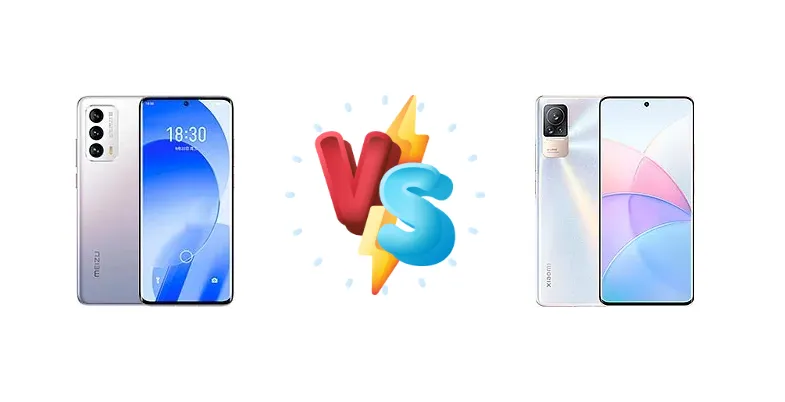
The smartphone market is brimming with options, making it tough to choose. Today, we're pitting two compelling contenders against each other: the Meizu 18s, boasting a flagship Snapdragon 888+, and the Xiaomi Civi 1S, known for its stylish design and efficient Snapdragon 778G+. Let's dive into a detailed comparison to see which phone reigns supreme.
🏆 Quick Verdict
The Meizu 18s offers significantly more raw power thanks to its Snapdragon 888+ chipset. However, the Xiaomi Civi 1S provides faster charging and a potentially more refined user experience. Ultimately, the choice depends on your priorities: performance or convenience.
| Network |
|---|
| 2G bands | GSM 850 / 900 / 1800 / 1900 | GSM 850 / 900 / 1800 / 1900 |
| 3G bands | HSDPA 850 / 900 / 1900 / 2100 | HSDPA 850 / 900 / 1700(AWS) / 1900 / 2100 |
| 4G bands | 1, 3, 4, 5, 7, 8, 34, 38, 39, 40, 41 | 1, 2, 3, 4, 5, 7, 8, 18, 19, 26, 34, 38, 39, 40, 41, 42 |
| 5G bands | 1, 3, 41, 77, 78, 79 SA/NSA | 1, 3, 5, 8, 28, 38, 41, 77, 78 SA/NSA |
| Speed | HSPA, LTE, 5G | HSPA, LTE, 5G |
| Technology | GSM / HSPA / LTE / 5G | GSM / CDMA / HSPA / CDMA2000 / LTE / 5G |
| | - | CDMA2000 1x |
| Launch |
|---|
| Announced | 2021, September 22. Released 2021, September 23 | 2022, April 21 |
| Status | Discontinued | Available. Released 2022, April 21 |
| Body |
|---|
| Build | - | Glass front (Gorilla Glass 5), glass back, aluminum frame |
| Dimensions | 152.4 x 69.2 x 8.2 mm (6.00 x 2.72 x 0.32 in) | 158.3 x 71.5 x 7 mm (6.23 x 2.81 x 0.28 in) |
| SIM | Nano-SIM + Nano-SIM | Nano-SIM + Nano-SIM |
| Weight | 162 g (5.71 oz) | 166 g (5.86 oz) |
| Display |
|---|
| Protection | - | Corning Gorilla Glass 5 |
| Resolution | 1440 x 3200 pixels, 20:9 ratio (~563 ppi density) | 1080 x 2400 pixels, 20:9 ratio (~402 ppi density) |
| Size | 6.2 inches, 93.8 cm2 (~88.9% screen-to-body ratio) | 6.55 inches, 103.6 cm2 (~91.5% screen-to-body ratio) |
| Type | Super AMOLED, 120Hz, HDR10+, 420 nits (typ), 1300 nits (peak) | OLED, 1B colors, Dolby Vision, HDR10+, 120Hz, 950 nits (peak) |
| Platform |
|---|
| CPU | Octa-core (1x3.0 GHz Cortex-X1 & 3x2.42 GHz Cortex-A78 & 4x1.80 GHz Cortex-A55) | Octa-core (1x2.5 GHz Cortex-A78 & 3x2.4 GHz Cortex-A78 & 4x1.9 GHz Cortex-A55) |
| Chipset | Qualcomm SM8350 Snapdragon 888+ 5G (5 nm) | Qualcomm SM7325-AE Snapdragon 778G+ 5G (6 nm) |
| GPU | Adreno 660 | Adreno 642L |
| OS | Android 11, Flyme 9.2 | Android 12, MIUI 13 |
| Memory |
|---|
| Card slot | No | No |
| Internal | 128GB 8GB RAM, 256GB 8GB RAM, 256GB 12GB RAM | 128GB 8GB RAM, 256GB 8GB RAM, 256GB 12GB RAM |
| | UFS 3.1 | UFS 2.2 |
| Main Camera |
|---|
| Features | Dual-LED dual-tone flash, HDR, panorama | Color spectrum sensor, LED flash, HDR, panorama |
| Single | - | 32 MP, 24mm (wide), 0.8µm, AF |
| Triple | 64 MP, f/1.6, 26mm (wide), 1/1.73", 0.8µm, PDAF, OIS
8 MP f/2.4, 79mm (telephoto), 1/4.4", 1.0µm, PDAF, 3x optical zoom
16 MP, f/2.2, 15mm, 122˚ (ultrawide), 1/3.0", 1.0µm | 64 MP, f/1.8, 26mm (wide), 1/1.97", 0.7µm, PDAF
8 MP, f/2.2, 120˚ (ultrawide), 1/4.0", 1.12µm
2 MP (macro) |
| Video | 4K@30/60fps, 1080p; gyro-EIS | 4K@30fps, 1080p@30/60/120fps, 720p@960fps; gyro-EIS |
| Selfie camera |
|---|
| Features | HDR | HDR, panorama |
| Single | 20 MP, f/2.2, 26mm (wide), 1/3.4", 0.8µm | 32 MP, 24mm (wide), 0.8µm, AF |
| Video | 1080p@30fps | 1080p@30/60fps |
| Sound |
|---|
| 3.5mm jack | No | No |
| 35mm jack | No | No |
| Loudspeaker | Yes, with stereo speakers | Yes, with stereo speakers |
| | - | 24-bit/192kHz audio |
| Comms |
|---|
| Bluetooth | 5.2, A2DP, LE | 5.2, A2DP, LE |
| Infrared port | - | Yes |
| NFC | Yes | Yes |
| Positioning | GPS (L1+L5), GLONASS, BDS, GALILEO, QZSS | GPS (L1+L5), GLONASS (L1), BDS (B1I+B1c+B2a), GALILEO (E1+E5a), QZSS (L1+L5), NavIC (L5) |
| Radio | No | No |
| USB | USB Type-C | USB Type-C 2.0, OTG |
| WLAN | Wi-Fi 802.11 а/b/g/n/ac/6e, dual-band, Wi-Fi Direct | Wi-Fi 802.11 a/b/g/n/ac/6, dual-band, Wi-Fi Direct |
| Features |
|---|
| Sensors | Fingerprint (under display, ultrasonic), accelerometer, gyro, proximity, compass | Fingerprint (under display, optical), accelerometer, gyro, proximity, compass |
| Battery |
|---|
| Charging | 36W wired, PD3.0, QC3, 80% in 33 min, 100% in 55 min | 55W wired, QC4, 100% in 45 min |
| Type | Li-Po 4000 mAh | Li-Po 4500 mAh |
| Misc |
|---|
| Colors | Light Blue, White, Aurora, Pink/Violet | Black, Blue, Pink, Silver |
| Price | About 490 EUR | About 330 EUR |
Meizu 18s
- Flagship Snapdragon 888+ performance
- Likely superior display quality
- Potentially better camera system
- Premium build quality
- Slower charging speed
- Meizu's software support can be inconsistent
- Availability may be limited
Xiaomi Civi 1S
- Faster 55W charging
- Sleek and stylish design
- Potentially more refined user experience
- Good value for money
- Less powerful chipset
- Camera may not match flagship performance
- May lack some advanced features
Display Comparison
The Meizu 18s typically features a vibrant AMOLED display with a high refresh rate (likely 90Hz or 120Hz, based on Meizu's past offerings), offering excellent color accuracy and smooth scrolling. The Xiaomi Civi 1S likely has an AMOLED display as well, but potentially with a slightly lower refresh rate (likely 90Hz). Both offer excellent viewing experiences, but the Meizu's flagship status suggests a slight edge in brightness and color reproduction.
Camera Comparison
While specific camera specs are missing, the Meizu 18s likely has a more advanced camera system due to its higher-end positioning. Expect better image quality, especially in low-light conditions, and potentially more advanced features like improved optical image stabilization (OIS). The Xiaomi Civi 1S is expected to have a competent camera setup, focusing on pleasing color science and ease of use. Detailed camera comparisons would require sample photos.
Performance
This is where the Meizu 18s truly shines. The Snapdragon 888+ is a flagship chipset, delivering significantly faster processing speeds and superior graphics performance compared to the Snapdragon 778G+ in the Xiaomi Civi 1S. Expect smoother multitasking, faster app loading times, and a much better gaming experience on the Meizu 18s. The Civi 1S is still capable, but it won't match the raw power of the 888+.
Battery Life
The Xiaomi Civi 1S takes the lead here with its 55W wired charging, significantly faster than the Meizu 18s' 36W charging. While both phones likely have similar battery capacities (around 4000-4500mAh), the Civi 1S will charge much quicker. Battery life itself will likely be comparable, depending on usage.
Buying Guide
The Meizu 18s is ideal for gamers, power users, and anyone who demands top-tier performance. The Xiaomi Civi 1S is a great choice for those prioritizing fast charging, a sleek design, and a smoother, more streamlined Android experience, especially if gaming isn't a primary concern.
Frequently Asked Questions
❓ Is the Meizu 18s worth the extra cost?
If you prioritize performance and don't mind potentially slower charging and less consistent software updates, the Meizu 18s is worth the investment. Otherwise, the Xiaomi Civi 1S offers excellent value.
❓ Which phone has better software support?
Xiaomi generally offers more consistent and timely software updates compared to Meizu. This is a factor to consider if you value long-term software support.