
Meizu 18s vs Xiaomi 11T Pro: A Deep Dive into Two Snapdragon 888 Flagships
| Phones Images | |||||
|---|---|---|---|---|---|
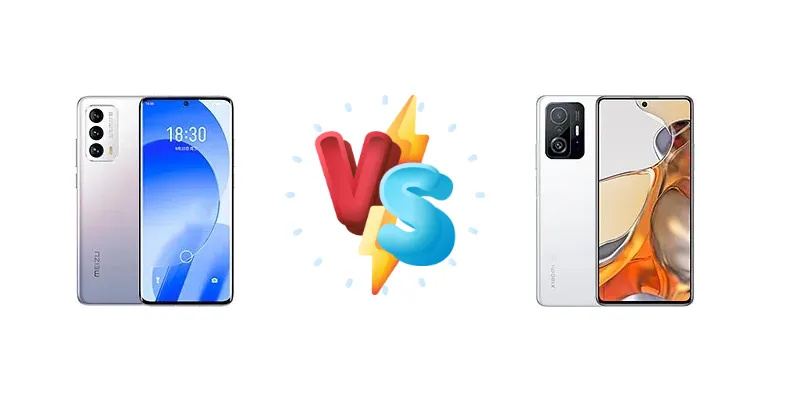
|
🏆 Quick Verdict
For most users, the Xiaomi 11T Pro emerges as the stronger choice. Its blistering 120W charging – fully charging the device in just 17 minutes – significantly outweighs the Meizu 18s’s 36W charging. While the Meizu offers a more compact design, the Xiaomi’s performance and charging capabilities provide a more compelling overall package.
| PHONES | ||
|---|---|---|
| Phone Names | Meizu 18s | Xiaomi 11T Pro |
| Network | ||
|---|---|---|
| 2G bands | GSM 850 / 900 / 1800 / 1900 | GSM 850 / 900 / 1800 / 1900 |
| 3G bands | HSDPA 850 / 900 / 1900 / 2100 | HSDPA 850 / 900 / 1700(AWS) / 1900 / 2100 |
| 4G bands | 1, 3, 4, 5, 7, 8, 34, 38, 39, 40, 41 | 1, 2, 3, 4, 5, 7, 8, 12, 13, 17, 18, 19, 20, 26, 28, 32, 38, 40, 41, 42, 66 |
| 5G bands | 1, 3, 41, 77, 78, 79 SA/NSA | 1, 3, 5, 7, 8, 20, 28, 38, 40, 41, 66, 77, 78 SA/NSA |
| Speed | HSPA, LTE, 5G | HSPA, LTE, 5G |
| Technology | GSM / HSPA / LTE / 5G | GSM / HSPA / LTE / 5G |
| Launch | ||
|---|---|---|
| Announced | 2021, September 22. Released 2021, September 23 | 2021, September 15 |
| Status | Discontinued | Available. Released 2021, October 05 |
| Body | ||
|---|---|---|
| Build | - | Glass front (Gorilla Glass Victus), aluminum frame, glass back |
| Dimensions | 152.4 x 69.2 x 8.2 mm (6.00 x 2.72 x 0.32 in) | 164.1 x 76.9 x 8.8 mm (6.46 x 3.03 x 0.35 in) |
| SIM | Nano-SIM + Nano-SIM | Nano-SIM + Nano-SIM |
| Weight | 162 g (5.71 oz) | 204 g (7.20 oz) |
| - | IP53, dust and splash resistant | |
| Display | ||
|---|---|---|
| Protection | - | Corning Gorilla Glass Victus |
| Resolution | 1440 x 3200 pixels, 20:9 ratio (~563 ppi density) | 1080 x 2400 pixels, 20:9 ratio (~395 ppi density) |
| Size | 6.2 inches, 93.8 cm2 (~88.9% screen-to-body ratio) | 6.67 inches, 107.4 cm2 (~85.1% screen-to-body ratio) |
| Type | Super AMOLED, 120Hz, HDR10+, 420 nits (typ), 1300 nits (peak) | AMOLED, Dolby Vision, 1B colors, 120Hz, HDR10+, 800 nits (typ), 1000 nits (peak) |
| Platform | ||
|---|---|---|
| CPU | Octa-core (1x3.0 GHz Cortex-X1 & 3x2.42 GHz Cortex-A78 & 4x1.80 GHz Cortex-A55) | Octa-core (1x2.84 GHz Cortex-X1 & 3x2.42 GHz Cortex-A78 & 4x1.80 GHz Cortex-A55) |
| Chipset | Qualcomm SM8350 Snapdragon 888+ 5G (5 nm) | Qualcomm SM8350 Snapdragon 888 5G (5 nm) |
| GPU | Adreno 660 | Adreno 660 |
| OS | Android 11, Flyme 9.2 | Android 11, upgradable to Android 13, MIUI 14 |
| Memory | ||
|---|---|---|
| Card slot | No | No |
| Internal | 128GB 8GB RAM, 256GB 8GB RAM, 256GB 12GB RAM | 128GB 8GB RAM, 256GB 8GB RAM, 256GB 12GB RAM |
| UFS 3.1 | UFS 3.1 | |
| Main Camera | ||
|---|---|---|
| Features | Dual-LED dual-tone flash, HDR, panorama | Dual-LED dual-tone flash, HDR, panorama |
| Single | - | 16 MP, f/2.5, (wide), 1/3.06", 1.0µm |
| Triple | 64 MP, f/1.6, 26mm (wide), 1/1.73", 0.8µm, PDAF, OIS 8 MP f/2.4, 79mm (telephoto), 1/4.4", 1.0µm, PDAF, 3x optical zoom 16 MP, f/2.2, 15mm, 122˚ (ultrawide), 1/3.0", 1.0µm | 108 MP, f/1.8, 26mm (wide), 1/1.52", 0.7µm, PDAF 8 MP, f/2.2, 120˚ (ultrawide), 1/4.0", 1.12µm 5 MP, f/2.4, 50mm (telephoto macro), 1/5.0", 1.12µm, AF |
| Video | 4K@30/60fps, 1080p; gyro-EIS | 8K@30fps, 4K@30/60fps, 1080p@30/60/120/240/960, HDR10+, gyro-EIS |
| Selfie camera | ||
|---|---|---|
| Features | HDR | - |
| Single | 20 MP, f/2.2, 26mm (wide), 1/3.4", 0.8µm | 16 MP, f/2.5, (wide), 1/3.06", 1.0µm |
| Video | 1080p@30fps | 1080p@30/60fps |
| Sound | ||
|---|---|---|
| 3.5mm jack | No | No |
| 35mm jack | No | No |
| Loudspeaker | Yes, with stereo speakers | Yes, with stereo speakers |
| - | Tuned by Harman Kardon 24-bit/192kHz audio | |
| Comms | ||
|---|---|---|
| Bluetooth | 5.2, A2DP, LE | 5.2, A2DP, LE, aptX HD, aptX Adaptive |
| Infrared port | - | Yes |
| NFC | Yes | Yes |
| Positioning | GPS (L1+L5), GLONASS, BDS, GALILEO, QZSS | GPS (L1+L5), GLONASS (G1), BDS (B1), GALILEO (E1+E5a), QZSS (L1+L5), NavIC |
| Radio | No | No |
| USB | USB Type-C | USB Type-C 2.0, OTG |
| WLAN | Wi-Fi 802.11 а/b/g/n/ac/6e, dual-band, Wi-Fi Direct | Wi-Fi 802.11 a/b/g/n/ac/6, dual-band, Wi-Fi Direct |
| Features | ||
|---|---|---|
| Sensors | Fingerprint (under display, ultrasonic), accelerometer, gyro, proximity, compass | Fingerprint (side-mounted), accelerometer, gyro, compass, barometer |
| Battery | ||
|---|---|---|
| Charging | 36W wired, PD3.0, QC3, 80% in 33 min, 100% in 55 min | 120W wired, PD3.0, QC3, 72% in 10 min, 100% in 17 min |
| Type | Li-Po 4000 mAh | Li-Po 5000 mAh |
| Misc | ||
|---|---|---|
| Colors | Light Blue, White, Aurora, Pink/Violet | Meteorite Gray, Moonlight White, Celestial Blue |
| Models | - | 2107113SG, 2107113SI, 2107113SR |
| Price | About 490 EUR | € 139.00 / $ 185.21 / £ 189.99 / ₹ 39,999 |
| SAR | - | 0.78 W/kg (head) 0.49 W/kg (body) |
| Tests | ||
|---|---|---|
| Battery life | - | Endurance rating 92h |
| Camera | - | Photo / Video |
| Display | - | Contrast ratio: Infinite (nominal) |
| Loudspeaker | - | -26.3 LUFS (Good) |
Meizu 18s
- More compact and pocketable design
- Potentially cleaner software experience
- Slightly faster processor (Snapdragon 888+)
- Significantly slower charging speed (36W)
- Display likely less bright than Xiaomi 11T Pro
- Limited camera details available
Xiaomi 11T Pro
- Blazing-fast 120W charging
- Brighter display for better outdoor visibility
- Potentially better thermal management due to larger size
- Larger and less comfortable for one-handed use
- Slightly slower processor (Snapdragon 888)
- Software may include more pre-installed apps
Display Comparison
The Xiaomi 11T Pro boasts a significantly brighter display, reaching a measured 837 nits, compared to an unspecified brightness for the Meizu 18s. While both feature an 'infinite' (nominal) contrast ratio, the higher peak brightness of the Xiaomi translates to better visibility in direct sunlight. The lack of LTPO technology on either device means refresh rate scaling isn't as power-efficient as on newer flagships, but both likely offer a smooth 120Hz experience. Bezels are likely comparable, given both phones aim for a premium aesthetic, but the Xiaomi’s larger screen size (6.67” vs. Meizu’s 6.1”) will inherently result in slightly wider bezels proportionally.
Camera Comparison
Both phones offer capable camera systems, but detailed sensor information is limited. Both are described as having 'Photo / Video' capabilities, lacking specifics. The Xiaomi 11T Pro’s larger size potentially allows for a larger main sensor, which generally translates to better low-light performance and dynamic range. Optical Image Stabilization (OIS) is likely present on both, but its effectiveness will depend on the specific implementation. The absence of details regarding secondary sensors (ultrawide, telephoto) makes a definitive comparison impossible, but focusing on the main sensor size and image processing algorithms will be key differentiators.
Performance
Both devices utilize the Qualcomm Snapdragon 888 series, but the Meizu 18s features the slightly more powerful Snapdragon 888+ 5G. The 888+ boasts a higher primary core clock speed (3.0 GHz vs 2.84 GHz on the 888), potentially offering a small performance edge in CPU-intensive tasks. Both share the same CPU core configuration (1x Cortex-X1, 3x Cortex-A78, 4x Cortex-A55). However, the Xiaomi 11T Pro’s larger size may allow for a more effective cooling solution, mitigating thermal throttling during sustained workloads. Both likely utilize LPDDR5 RAM, but the speed isn't specified, impacting overall system responsiveness.
Battery Life
The Xiaomi 11T Pro’s 120W charging is its standout feature, achieving 72% charge in just 10 minutes and a full charge in 17 minutes. This is dramatically faster than the Meizu 18s’s 36W charging, which takes 33 minutes to reach 80% and 55 minutes for a full charge. Both phones have an endurance rating of 92 hours, suggesting similar overall battery life despite the difference in charging speeds. This implies the Meizu 18s likely has a more efficient power draw or a slightly larger battery capacity, though the exact mAh isn't specified. The Xiaomi’s faster charging mitigates any potential battery life disadvantage.
Buying Guide
Buy the Meizu 18s if you prioritize a smaller, more pocketable flagship experience and appreciate a cleaner, less-bloated software experience. This phone is ideal for users who value one-handed usability and don't mind slightly slower charging. Buy the Xiaomi 11T Pro if you demand the fastest possible charging speeds, a brighter display, and don't mind a larger device. This is the phone for power users and those who frequently find themselves needing a quick battery top-up.