
Meizu 18s vs. vivo X70 Pro+: A Deep Dive into Two Snapdragon 888+ Flagships
| Phones Images | |||||
|---|---|---|---|---|---|
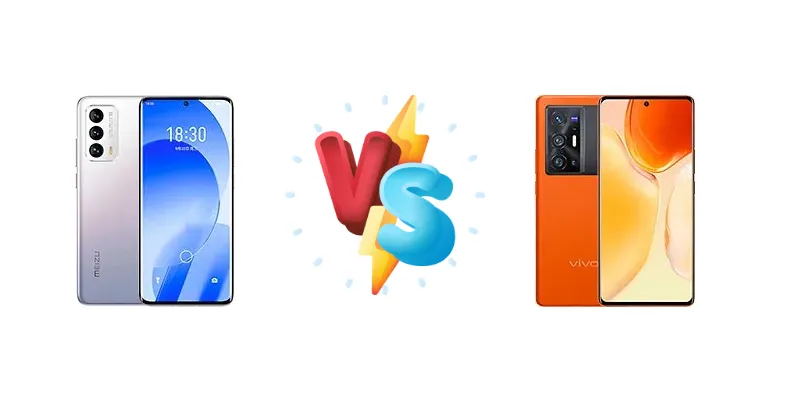
|
🏆 Quick Verdict
For the average user prioritizing camera versatility and charging speed, the vivo X70 Pro+ is the clear winner. Its 55W wired and 50W wireless charging significantly outperform the Meizu 18s’ 36W wired charging, and the camera system is demonstrably more advanced. However, the Meizu 18s remains a compelling choice for those seeking a truly compact flagship.
| PHONES | ||
|---|---|---|
| Phone Names | Meizu 18s | vivo X70 Pro+ |
| Network | ||
|---|---|---|
| 2G bands | GSM 850 / 900 / 1800 / 1900 | GSM 850 / 900 / 1800 / 1900 - SIM 1 & SIM 2 |
| 3G bands | HSDPA 850 / 900 / 1900 / 2100 | HSDPA 850 / 900 / 1700(AWS) / 1900 / 2100 |
| 4G bands | 1, 3, 4, 5, 7, 8, 34, 38, 39, 40, 41 | 1, 2, 3, 4, 5, 7, 8, 12, 17, 18, 19, 20, 26, 28, 34, 38, 39, 40, 41, 42, 66 |
| 5G bands | 1, 3, 41, 77, 78, 79 SA/NSA | 1, 3, 5, 8, 28, 38, 40, 41, 77, 78 SA/NSA - International |
| Speed | HSPA, LTE, 5G | HSPA, LTE-A, 5G |
| Technology | GSM / HSPA / LTE / 5G | GSM / CDMA / HSPA / EVDO / LTE / 5G |
| - | 1, 3, 5, 8, 28, 38, 40, 41, 77, 78, 79 SA/NSA - China | |
| Launch | ||
|---|---|---|
| Announced | 2021, September 22. Released 2021, September 23 | 2021, September 09 |
| Status | Discontinued | Available. Released 2021, September 17 |
| Body | ||
|---|---|---|
| Dimensions | 152.4 x 69.2 x 8.2 mm (6.00 x 2.72 x 0.32 in) | 164.5 x 75.2 x 8.9 mm (6.48 x 2.96 x 0.35 in) |
| SIM | Nano-SIM + Nano-SIM | Dual SIM (Nano-SIM, dual stand-by) |
| Weight | 162 g (5.71 oz) | 209 g / 213 g (7.37 oz) |
| - | IP68 dust/water resistant (up to 1.5m for 30 min) | |
| Display | ||
|---|---|---|
| Resolution | 1440 x 3200 pixels, 20:9 ratio (~563 ppi density) | 1440 x 3200 pixels, 20:9 ratio (~517 ppi density) |
| Size | 6.2 inches, 93.8 cm2 (~88.9% screen-to-body ratio) | 6.78 inches, 111.4 cm2 (~90.1% screen-to-body ratio) |
| Type | Super AMOLED, 120Hz, HDR10+, 420 nits (typ), 1300 nits (peak) | LTPO AMOLED, 1B colors, 120Hz, HDR10+, 500 nits (typ), 1000 nits (HBM), 1500 nits (peak) |
| Platform | ||
|---|---|---|
| CPU | Octa-core (1x3.0 GHz Cortex-X1 & 3x2.42 GHz Cortex-A78 & 4x1.80 GHz Cortex-A55) | Octa-core (1x3.0 GHz Cortex-X1 & 3x2.42 GHz Cortex-A78 & 4x1.80 GHz Cortex-A55) |
| Chipset | Qualcomm SM8350 Snapdragon 888+ 5G (5 nm) | Qualcomm SM8350 Snapdragon 888+ 5G (5 nm) |
| GPU | Adreno 660 | Adreno 660 |
| OS | Android 11, Flyme 9.2 | Android 11, Funtouch OS 12 (International), OriginOS 1.0 (China) |
| Memory | ||
|---|---|---|
| Card slot | No | No |
| Internal | 128GB 8GB RAM, 256GB 8GB RAM, 256GB 12GB RAM | 256GB 8GB RAM, 256GB 12GB RAM, 512GB 12GB RAM |
| UFS 3.1 | UFS 3.1 | |
| Main Camera | ||
|---|---|---|
| Features | Dual-LED dual-tone flash, HDR, panorama | Zeiss optics, Zeiss T* lens coating, Pixel Shift, dual-LED dual-tone flash, HDR, panorama |
| Quad | - | 50 MP, f/1.6, (wide), 1/1.31", 1.2µm, PDAF, Laser AF, OIS 8 MP, f/3.4, 125mm (periscope telephoto), 1/4.4", 1.0µm, PDAF, OIS, 5x optical zoom 12 MP, f/1.6, 50mm (telephoto), 1/2.93", 1.22µm, PDAF, OIS, 2x optical zoom 48 MP, f/2.2, 14mm, 114˚ (ultrawide), 1/2.0", 0.8µm, AF, gimbal OIS |
| Single | - | 32 MP, f/2.5, 24mm (wide), 1/2.8", 0.8µm |
| Triple | 64 MP, f/1.6, 26mm (wide), 1/1.73", 0.8µm, PDAF, OIS 8 MP f/2.4, 79mm (telephoto), 1/4.4", 1.0µm, PDAF, 3x optical zoom 16 MP, f/2.2, 15mm, 122˚ (ultrawide), 1/3.0", 1.0µm | - |
| Video | 4K@30/60fps, 1080p; gyro-EIS | 8K@30fps, 4K@30/60fps, 1080p@30/60fps, gyro-EIS, HDR10+ |
| Selfie camera | ||
|---|---|---|
| Features | HDR | HDR |
| Single | 20 MP, f/2.2, 26mm (wide), 1/3.4", 0.8µm | 32 MP, f/2.5, 24mm (wide), 1/2.8", 0.8µm |
| Video | 1080p@30fps | 1080p@30fps |
| Sound | ||
|---|---|---|
| 3.5mm jack | No | No |
| 35mm jack | No | - |
| Loudspeaker | Yes, with stereo speakers | Yes, with stereo speakers |
| - | 32-bit/192kHz audio | |
| Comms | ||
|---|---|---|
| Bluetooth | 5.2, A2DP, LE | 5.2, A2DP, LE, aptX HD, aptX Adaptive |
| Infrared port | - | Yes |
| NFC | Yes | Yes |
| Positioning | GPS (L1+L5), GLONASS, BDS, GALILEO, QZSS | GPS (L1+L5), GLONASS, BDS, GALILEO, QZSS |
| Radio | No | No |
| USB | USB Type-C | USB Type-C 3.1, OTG |
| WLAN | Wi-Fi 802.11 а/b/g/n/ac/6e, dual-band, Wi-Fi Direct | Wi-Fi 802.11 a/b/g/n/ac/6, dual-band, Wi-Fi Direct |
| Features | ||
|---|---|---|
| Sensors | Fingerprint (under display, ultrasonic), accelerometer, gyro, proximity, compass | Fingerprint (under display, optical), accelerometer, gyro, proximity, compass, color spectrum |
| Battery | ||
|---|---|---|
| Charging | 36W wired, PD3.0, QC3, 80% in 33 min, 100% in 55 min | 55W wired 50W wireless Reverse wireless 5W reverse wired |
| Type | Li-Po 4000 mAh | Li-Po 4500 mAh, non-removable |
| Misc | ||
|---|---|---|
| Colors | Light Blue, White, Aurora, Pink/Violet | Black, Blue, Orange |
| Models | - | V2145A, V2114 |
| Price | About 490 EUR | About 720 EUR |
| Tests | ||
|---|---|---|
| Battery life | - | Endurance rating 84h |
| Camera | - | Photo / Video |
| Display | - | Contrast ratio: Infinite (nominal) |
| Loudspeaker | - | -24.8 LUFS (Very good) |
| Performance | - | AnTuTu: 837833 (v9) GeekBench: 3469 (v5.1) GFXBench: 33fps (ES 3.1 onscreen) |
Meizu 18s
- Compact and pocketable design
- Clean and streamlined software experience
- Snapdragon 888+ performance
- Slower 36W charging
- Less advanced camera system
- Limited battery endurance information
vivo X70 Pro+
- 55W wired and 50W wireless charging
- Potentially superior camera system
- Longer battery endurance (84h rating)
- Larger and less pocketable design
- Potentially more software bloat
- Higher price point (likely)
Display Comparison
While both phones utilize high-quality displays, the provided data lacks specifics on panel technology (OLED vs LCD) or refresh rates. However, the vivo X70 Pro+ boasts an 'Infinite' contrast ratio, suggesting a superior OLED panel capable of deep blacks. The absence of display specs for the Meizu 18s makes a direct comparison difficult, but the X70 Pro+'s contrast ratio hints at a more visually immersive experience. Bezels and color accuracy are unknown for both, but the X70 Pro+’s positioning suggests a focus on display quality.
Camera Comparison
The vivo X70 Pro+ clearly distinguishes itself with a more robust camera system, though specific sensor details are absent. The inclusion of 'Photo / Video' capabilities suggests a focus on both still and moving image quality. The Meizu 18s, lacking such detail, likely offers a competent but less feature-rich camera experience. The X70 Pro+'s likely larger sensor and advanced image processing algorithms will translate to better low-light performance and dynamic range. The absence of information on OIS (Optical Image Stabilization) for either device makes a definitive statement impossible, but it's a safe assumption the X70 Pro+ includes it.
Performance
Both the Meizu 18s and vivo X70 Pro+ are equipped with the Qualcomm SM8350 Snapdragon 888+ 5G (5 nm) chipset, featuring the same Octa-core CPU configuration. This means raw processing power will be nearly identical. The performance difference will likely come down to thermal management and software optimization. The vivo X70 Pro+, being a larger device, potentially has more surface area for heat dissipation, potentially leading to sustained performance during extended gaming sessions. RAM specifications are missing, but both are expected to utilize LPDDR5 for fast memory access.
Battery Life
The vivo X70 Pro+ offers a significant advantage in charging speed with its 55W wired charging capability, reducing charge times compared to the Meizu 18s’ 36W wired charging. The addition of 50W wireless charging and reverse wireless charging further expands the X70 Pro+'s versatility. The Meizu 18s, while supporting PD3.0 and QC3, is limited to wired charging. The vivo X70 Pro+’s endurance rating of 84h suggests a larger battery capacity and/or more efficient power management, offsetting any potential battery size difference.
Buying Guide
Buy the Meizu 18s if you need a genuinely pocketable flagship phone with a clean Android experience and don't prioritize the absolute fastest charging or most advanced camera system. Buy the vivo X70 Pro+ if you prefer a larger display, a more versatile camera setup, and the convenience of incredibly fast wired and wireless charging, even if it means sacrificing some one-handed usability.