
Meizu 18s vs. Samsung Galaxy S21+ 5G: A Detailed Comparison of Two Android Flagships
| Phones Images | |||||
|---|---|---|---|---|---|
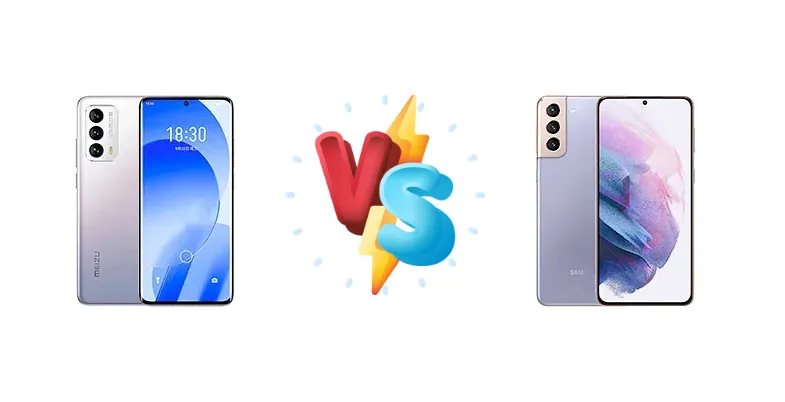
|
🏆 Quick Verdict
For users prioritizing raw processing power and a more compact design, the Meizu 18s is the clear winner. Its Snapdragon 888+ offers a slight edge in CPU and GPU performance. However, the Samsung Galaxy S21+ 5G remains a compelling option for those valuing wireless charging, a brighter display, and Samsung’s established software features.
| PHONES | ||
|---|---|---|
| Phone Names | Meizu 18s | Samsung Galaxy S21+ 5G |
| Network | ||
|---|---|---|
| 2G bands | GSM 850 / 900 / 1800 / 1900 | GSM 850 / 900 / 1800 / 1900 |
| 3G bands | HSDPA 850 / 900 / 1900 / 2100 | HSDPA 850 / 900 / 1700(AWS) / 1900 / 2100 |
| 4G bands | 1, 3, 4, 5, 7, 8, 34, 38, 39, 40, 41 | 1, 2, 3, 4, 5, 7, 8, 12, 13, 14, 18, 19, 20, 25, 26, 28, 30, 38, 39, 40, 41, 46, 48, 66, 71 - SM-G996U1 |
| 5G bands | 1, 3, 41, 77, 78, 79 SA/NSA | 2, 5, 25, 41, 66, 71, 260, 261 SA/NSA/Sub6/mmWave - SM-G996U1 |
| Speed | HSPA, LTE, 5G | HSPA 42.2/5.76 Mbps, LTE (7CA) Cat20 2000/200 Mbps, 5G (5+ Gbps DL) |
| Technology | GSM / HSPA / LTE / 5G | GSM / CDMA / HSPA / EVDO / LTE / 5G |
| - | 1, 3, 5, 7, 8, 20, 28, 38, 40, 41, 66, 77, 78 SA/NSA/Sub6 - SM-G996B | |
| Launch | ||
|---|---|---|
| Announced | 2021, September 22. Released 2021, September 23 | 2021, January 14 |
| Status | Discontinued | Available. Released 2021, January 29 |
| Body | ||
|---|---|---|
| Build | - | Glass front (Gorilla Glass Victus), glass back (Gorilla Glass Victus), aluminum frame |
| Dimensions | 152.4 x 69.2 x 8.2 mm (6.00 x 2.72 x 0.32 in) | 161.5 x 75.6 x 7.8 mm (6.36 x 2.98 x 0.31 in) |
| SIM | Nano-SIM + Nano-SIM | · Nano-SIM + eSIM· Nano-SIM + Nano-SIM + eSIM (max 2 at a time) |
| Weight | 162 g (5.71 oz) | 200 g (Sub6), 202 g (mmWave) (7.05 oz) |
| - | IP68 dust/water resistant (up to 1.5m for 30 min) | |
| Display | ||
|---|---|---|
| Protection | - | Corning Gorilla Glass Victus |
| Resolution | 1440 x 3200 pixels, 20:9 ratio (~563 ppi density) | 1080 x 2400 pixels, 20:9 ratio (~394 ppi density) |
| Size | 6.2 inches, 93.8 cm2 (~88.9% screen-to-body ratio) | 6.7 inches, 107.8 cm2 (~88.3% screen-to-body ratio) |
| Type | Super AMOLED, 120Hz, HDR10+, 420 nits (typ), 1300 nits (peak) | Dynamic AMOLED 2X, 120Hz, HDR10+, 1300 nits (peak) |
| - | Always-on display | |
| Platform | ||
|---|---|---|
| CPU | Octa-core (1x3.0 GHz Cortex-X1 & 3x2.42 GHz Cortex-A78 & 4x1.80 GHz Cortex-A55) | Octa-core (1x2.9 GHz Cortex-X1 & 3x2.80 GHz Cortex-A78 & 4x2.2 GHz Cortex-A55) - InternationalOcta-core (1x2.84 GHz Cortex-X1 & 3x2.42 GHz Cortex-A78 & 4x1.80 GHz Cortex-A55) - USA/China |
| Chipset | Qualcomm SM8350 Snapdragon 888+ 5G (5 nm) | Exynos 2100 (5 nm) - InternationalQualcomm SM8350 Snapdragon 888 5G (5 nm) - USA/China |
| GPU | Adreno 660 | Mali-G78 MP14 - InternationalAdreno 660 - USA/China |
| OS | Android 11, Flyme 9.2 | Android 11, up to 4 major Android upgrades, One UI 6.1 |
| Memory | ||
|---|---|---|
| Card slot | No | No |
| Internal | 128GB 8GB RAM, 256GB 8GB RAM, 256GB 12GB RAM | 128GB 8GB RAM, 256GB 8GB RAM |
| UFS 3.1 | UFS 3.1 | |
| Main Camera | ||
|---|---|---|
| Features | Dual-LED dual-tone flash, HDR, panorama | LED flash, auto-HDR, panorama |
| Triple | 64 MP, f/1.6, 26mm (wide), 1/1.73", 0.8µm, PDAF, OIS 8 MP f/2.4, 79mm (telephoto), 1/4.4", 1.0µm, PDAF, 3x optical zoom 16 MP, f/2.2, 15mm, 122˚ (ultrawide), 1/3.0", 1.0µm | 12 MP, f/1.8, 26mm (wide), 1/1.76", 1.8µm, dual pixel PDAF, OIS 64 MP, f/2.0, 29mm (telephoto), 1/1.72", 0.8µm, PDAF, OIS, 1.1x optical zoom, 3x hybrid zoom 12 MP, f/2.2, 13mm, 120˚ (ultrawide), 1/2.55" 1.4µm, Super Steady video |
| Video | 4K@30/60fps, 1080p; gyro-EIS | 8K@24fps, 4K@30/60fps, 1080p@30/60/120/240fps, HDR10+, stereo sound rec., gyro-EIS |
| Selfie camera | ||
|---|---|---|
| Features | HDR | HDR |
| Single | 20 MP, f/2.2, 26mm (wide), 1/3.4", 0.8µm | 10 MP, f/2.2, 26mm (wide), 1/3.24", 1.22µm, dual pixel PDAF |
| Video | 1080p@30fps | 4K@30/60fps, 1080p@30fps |
| Sound | ||
|---|---|---|
| 3.5mm jack | No | No |
| 35mm jack | No | No |
| Loudspeaker | Yes, with stereo speakers | Yes, with stereo speakers |
| - | 32-bit/384kHz audio Tuned by AKG | |
| Comms | ||
|---|---|---|
| Bluetooth | 5.2, A2DP, LE | 5.0, A2DP, LE |
| NFC | Yes | Yes |
| Positioning | GPS (L1+L5), GLONASS, BDS, GALILEO, QZSS | GPS, GLONASS, BDS, GALILEO |
| Radio | No | FM radio (Snapdragon model only; market/operator dependent) |
| USB | USB Type-C | USB Type-C 3.2, OTG |
| WLAN | Wi-Fi 802.11 а/b/g/n/ac/6e, dual-band, Wi-Fi Direct | Wi-Fi 802.11 a/b/g/n/ac/6, dual-band, Wi-Fi Direct |
| Features | ||
|---|---|---|
| Sensors | Fingerprint (under display, ultrasonic), accelerometer, gyro, proximity, compass | Fingerprint (under display, ultrasonic), accelerometer, gyro, proximity, compass, barometer |
| - | Samsung DeX, Samsung Wireless DeX (desktop experience support) Bixby natural language commands and dictation Samsung Pay (Visa, MasterCard certified) Ultra Wideband (UWB) support | |
| Battery | ||
|---|---|---|
| Charging | 36W wired, PD3.0, QC3, 80% in 33 min, 100% in 55 min | 25W wired, PD3.0 15W wireless (Qi) 4.5W reverse wireless |
| Type | Li-Po 4000 mAh | Li-Ion 4800 mAh |
| Misc | ||
|---|---|---|
| Colors | Light Blue, White, Aurora, Pink/Violet | Phantom Black, Phantom Silver, Phantom Violet, Phantom Pink, Phantom Gold, Phantom Red |
| Models | - | SM-G996B, SM-G996B/DS, SM-G996U, SM-G996U1, SM-G996W, SM-G996N, SM-G9960 |
| Price | About 490 EUR | $ 162.99 / £ 185.00 / € 199.00 |
| SAR | - | 0.65 W/kg (head) 0.95 W/kg (body) |
| SAR EU | - | 0.54 W/kg (head) 1.33 W/kg (body) |
| Tests | ||
|---|---|---|
| Battery life | - | Endurance rating 114h |
| Camera | - | Photo / Video |
| Display | - | Contrast ratio: Infinite (nominal) |
| Loudspeaker | - | -25.8 LUFS (Very good) |
| Performance | - | AnTuTu: 622276 (v8) GeekBench: 3476 (v5.1) GFXBench: 54fps (ES 3.1 onscreen) |
Meizu 18s
- Faster Snapdragon 888+ processor
- Faster 36W wired charging
- More compact form factor
- No wireless charging
- Less established brand recognition
Samsung Galaxy S21+ 5G
- Brighter display (883 nits)
- Wireless and reverse wireless charging
- Samsung’s software ecosystem
- Potential for Exynos thermal throttling (International version)
- Slower 25W wired charging
Display Comparison
The Samsung Galaxy S21+ 5G boasts a brighter display, reaching a measured 883 nits, compared to an unspecified peak brightness for the Meizu 18s. While the Meizu’s display quality is likely excellent, the S21+’s higher peak brightness translates to better visibility in direct sunlight. Both displays feature an 'infinite' (nominal) contrast ratio, typical of AMOLED panels. The S21+’s larger screen size also provides a more immersive viewing experience, though the Meizu’s smaller form factor may appeal to those who prefer one-handed use.
Camera Comparison
Both devices offer capable camera systems, but detailed sensor information beyond 'Photo/Video' is lacking for both. The S21+ likely benefits from Samsung’s extensive image processing algorithms and potentially larger sensor sizes, common in their flagship devices. The Meizu 18s, while potentially lacking the same level of software optimization, could offer a more natural image profile. Without specific sensor details, it’s difficult to definitively declare a winner; however, Samsung’s history suggests a more refined and versatile camera experience.
Performance
Both phones utilize the Qualcomm Snapdragon 888 series, but with key differences. The Meizu 18s features the Snapdragon 888+ 5G (5nm), while the S21+ comes with either the Exynos 2100 (5nm - International) or Snapdragon 888 5G (5nm - USA/China). The 888+ offers a slightly higher peak CPU clock speed (3.0 GHz vs 2.9/2.84 GHz) on its Cortex-X1 core, potentially leading to a marginal performance advantage in CPU-intensive tasks. However, the Exynos 2100 has historically faced criticism regarding thermal throttling under sustained load, a potential issue the Snapdragon 888+ in the Meizu 18s may mitigate. Both devices utilize Octa-core CPUs with similar core configurations (1x Cortex-X1, 3x Cortex-A78, 4x Cortex-A55).
Battery Life
The Samsung Galaxy S21+ 5G has an endurance rating of 114 hours, indicating respectable battery life. The Meizu 18s’ battery capacity is unspecified, but its 36W wired charging (PD3.0, QC3) is faster than the S21+’s 25W wired charging. The S21+ also supports 15W wireless charging and 4.5W reverse wireless charging, features absent on the Meizu 18s. The Meizu 18s claims 80% charge in 33 minutes and 100% in 55 minutes, while the S21+’s charging times are not specified. The faster wired charging of the Meizu 18s could offset a potentially smaller battery capacity for users who prioritize quick top-ups.
Buying Guide
Buy the Meizu 18s if you need a powerful, pocketable phone with a focus on performance and are comfortable with a less mainstream brand. It’s ideal for gamers and power users who want maximum bang for their buck. Buy the Samsung Galaxy S21+ 5G if you prefer a larger display, wireless charging capabilities, and the convenience of Samsung’s software ecosystem, even if it means paying a premium and potentially dealing with regional chipset variations.