
Meizu 18s vs Samsung Galaxy S20 5G: A Detailed Showdown
| Phones Images | |||||
|---|---|---|---|---|---|
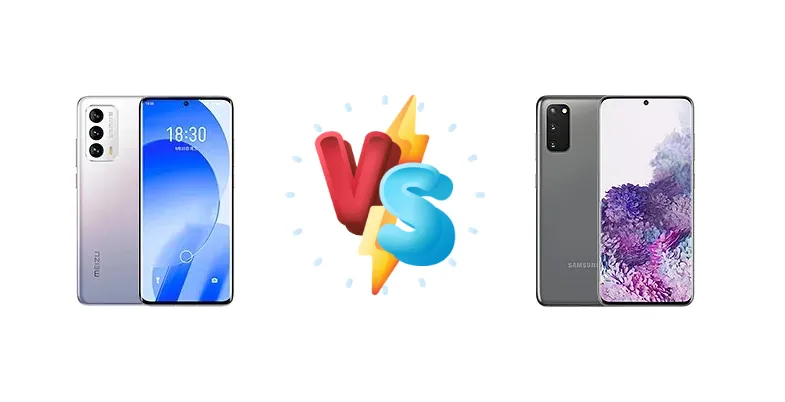
|
🏆 Quick Verdict
The Meizu 18s boasts a significantly faster Snapdragon 888+ chipset and faster charging, offering a more modern performance edge. However, the Galaxy S20 5G benefits from Samsung's established ecosystem, software support, and a more refined camera system, making it a strong contender for many.
| PHONES | ||
|---|---|---|
| Phone Names | Meizu 18s | Samsung Galaxy S20 5G |
| Network | ||
|---|---|---|
| 2G bands | GSM 850 / 900 / 1800 / 1900 | GSM 850 / 900 / 1800 / 1900 |
| 3G bands | HSDPA 850 / 900 / 1900 / 2100 | HSDPA 850 / 900 / 1700(AWS) / 1900 / 2100 |
| 4G bands | 1, 3, 4, 5, 7, 8, 34, 38, 39, 40, 41 | 1, 2, 3, 4, 5, 7, 8, 12, 13, 17, 18, 19, 20, 25, 26, 28, 32, 38, 39, 40, 41, 66 - SM-G981B |
| 5G bands | 1, 3, 41, 77, 78, 79 SA/NSA | 1, 3, 5, 7, 8, 28, 40, 77, 78 SA/NSA/Sub6 - SM-G981B |
| Speed | HSPA, LTE, 5G | HSPA 42.2/5.76 Mbps, LTE (7CA) Cat20 2000/200 Mbps, 5G (5+ Gbps DL) |
| Technology | GSM / HSPA / LTE / 5G | GSM / CDMA / HSPA / EVDO / LTE / 5G |
| - | 2, 5, 41, 66, 71 SA/NSA/Sub6 - SM-G981U | |
| Launch | ||
|---|---|---|
| Announced | 2021, September 22. Released 2021, September 23 | 2020, February 11 |
| Status | Discontinued | Available. Released 2020, March 06 |
| Body | ||
|---|---|---|
| Build | - | Glass front (Gorilla Glass 6), glass back (Gorilla Glass 6), aluminum frame |
| Dimensions | 152.4 x 69.2 x 8.2 mm (6.00 x 2.72 x 0.32 in) | 151.7 x 69.1 x 7.9 mm (5.97 x 2.72 x 0.31 in) |
| SIM | Nano-SIM + Nano-SIM | · Nano-SIM + eSIM· Nano-SIM + Nano-SIM |
| Weight | 162 g (5.71 oz) | 163 g (5.75 oz) |
| - | IP68 dust/water resistant (up to 1.5m for 30 min) | |
| Display | ||
|---|---|---|
| Protection | - | Corning Gorilla Glass 6 |
| Resolution | 1440 x 3200 pixels, 20:9 ratio (~563 ppi density) | 1440 x 3200 pixels, 20:9 ratio (~563 ppi density) |
| Size | 6.2 inches, 93.8 cm2 (~88.9% screen-to-body ratio) | 6.2 inches, 93.8 cm2 (~89.5% screen-to-body ratio) |
| Type | Super AMOLED, 120Hz, HDR10+, 420 nits (typ), 1300 nits (peak) | Dynamic AMOLED 2X, 120Hz, HDR10+, 1200 nits (peak) |
| - | Always-on display 120Hz@FHD/60Hz@QHD refresh rate | |
| Platform | ||
|---|---|---|
| CPU | Octa-core (1x3.0 GHz Cortex-X1 & 3x2.42 GHz Cortex-A78 & 4x1.80 GHz Cortex-A55) | Octa-core (2x2.73 GHz Mongoose M5 & 2x2.50 GHz Cortex-A76 & 4x2.0 GHz Cortex-A55) - GlobalOcta-core (1x2.84 GHz Cortex-A77 & 3x2.42 GHz Cortex-A77 & 4x1.80 GHz Cortex-A55) - USA |
| Chipset | Qualcomm SM8350 Snapdragon 888+ 5G (5 nm) | Exynos 990 (7 nm+) - GlobalQualcomm SM8250 Snapdragon 865 5G (7 nm+) - USA |
| GPU | Adreno 660 | Mali-G77 MP11 - GlobalAdreno 650 - USA |
| OS | Android 11, Flyme 9.2 | Android 10, upgradable to Android 13, One UI 5.1 |
| Memory | ||
|---|---|---|
| Card slot | No | microSDXC (uses shared SIM slot) |
| Internal | 128GB 8GB RAM, 256GB 8GB RAM, 256GB 12GB RAM | 128GB 8GB RAM, 128GB 12GB RAM |
| UFS 3.1 | UFS 3.0 | |
| Main Camera | ||
|---|---|---|
| Features | Dual-LED dual-tone flash, HDR, panorama | LED flash, auto-HDR, panorama |
| Triple | 64 MP, f/1.6, 26mm (wide), 1/1.73", 0.8µm, PDAF, OIS 8 MP f/2.4, 79mm (telephoto), 1/4.4", 1.0µm, PDAF, 3x optical zoom 16 MP, f/2.2, 15mm, 122˚ (ultrawide), 1/3.0", 1.0µm | 12 MP, f/1.8, 26mm (wide), 1/1.76", 1.8µm, dual pixel PDAF, OIS 64 MP, f/2.0, 29mm (telephoto), 1/1.72", 0.8µm, PDAF, OIS, 1.1x optical zoom, 3x hybrid zoom 12 MP, f/2.2, 13mm, 120˚ (ultrawide), 1/2.55" 1.4µm, Super Steady video |
| Video | 4K@30/60fps, 1080p; gyro-EIS | 8K@24fps, 4K@30/60fps, 1080p@30/60/240fps, 720p@960fps, HDR10+, stereo sound rec., gyro-EIS & OIS |
| Selfie camera | ||
|---|---|---|
| Features | HDR | HDR |
| Single | 20 MP, f/2.2, 26mm (wide), 1/3.4", 0.8µm | 10 MP, f/2.2, 26mm (wide), 1/3.24", 1.22µm, dual pixel PDAF |
| Video | 1080p@30fps | 4K@30/60fps, 1080p@30fps |
| Sound | ||
|---|---|---|
| 3.5mm jack | No | No |
| 35mm jack | No | No |
| Loudspeaker | Yes, with stereo speakers | Yes, with stereo speakers |
| - | 32-bit/384kHz audio Tuned by AKG | |
| Comms | ||
|---|---|---|
| Bluetooth | 5.2, A2DP, LE | 5.0, A2DP, LE |
| NFC | Yes | Yes |
| Positioning | GPS (L1+L5), GLONASS, BDS, GALILEO, QZSS | GPS, GLONASS, BDS, GALILEO |
| Radio | No | FM radio (Snapdragon model only; market/operator dependent) |
| USB | USB Type-C | USB Type-C 3.2, OTG |
| WLAN | Wi-Fi 802.11 а/b/g/n/ac/6e, dual-band, Wi-Fi Direct | Wi-Fi 802.11 a/b/g/n/ac/6, dual-band, Wi-Fi Direct |
| Features | ||
|---|---|---|
| Sensors | Fingerprint (under display, ultrasonic), accelerometer, gyro, proximity, compass | Fingerprint (under display, ultrasonic), accelerometer, gyro, proximity, compass, barometer |
| - | Samsung DeX, Samsung Wireless DeX (desktop experience support) ANT+ Bixby natural language commands and dictation Samsung Pay (Visa, MasterCard certified) | |
| Battery | ||
|---|---|---|
| Charging | 36W wired, PD3.0, QC3, 80% in 33 min, 100% in 55 min | 25W wired, PD3.0 15W wireless (Qi) 4.5W reverse wireless |
| Type | Li-Po 4000 mAh | Li-Ion 4000 mAh |
| Misc | ||
|---|---|---|
| Colors | Light Blue, White, Aurora, Pink/Violet | Cosmic Grey, Cloud Blue, Cloud Pink, Cloud White, Aura Red |
| Models | - | SM-G981, SM-G981F, SM-G981F/DS, SM-G981B/DS, SM-G981U, SM-G981U1, SM-G981N, SM-G981B, SM-G9810, SM-G981W, SC-51A, SCG01 |
| Price | About 490 EUR | $ 158.44 / £ 144.99 / € 272.39 |
| SAR | - | 1.07 W/kg (head) 1.03 W/kg (body) |
| SAR EU | - | 0.38 W/kg (head) 1.52 W/kg (body) |
Meizu 18s
- Faster Snapdragon 888+ Chipset
- 36W Fast Charging
- Sleek Design
- Competitive Price
- Less Established Software Support
- No Wireless Charging
- Camera Not as Versatile as S20 5G
Samsung Galaxy S20 5G
- Excellent AMOLED Display (120Hz)
- Versatile Camera System
- Samsung Ecosystem Integration
- Wireless Charging
- Slower Charging Speed
- Older Chipset (Exynos/Snapdragon 865)
- Can be more expensive
Display Comparison
The Galaxy S20 5G features a vibrant Dynamic AMOLED display with a 120Hz refresh rate, offering excellent color accuracy and smooth scrolling. The Meizu 18s also has a high-quality AMOLED display, but details on its refresh rate are less prominent. Samsung's display generally holds an edge in overall visual experience.
Camera Comparison
The Galaxy S20 5G's camera system is more versatile, offering a wider range of features and generally more consistent image quality. While the Meizu 18s has a capable camera, Samsung's processing and software optimization are typically superior. The S20 5G also has better video recording capabilities.
Performance
The Meizu 18s' Snapdragon 888+ is noticeably faster than the Galaxy S20 5G's Exynos 990 (global) or Snapdragon 865 (USA). Expect smoother multitasking, faster app loading, and better gaming performance on the Meizu 18s. The S20 5G is still capable, but the 888+ provides a clear advantage.
Battery Life
The Meizu 18s' 36W charging is significantly faster than the Galaxy S20 5G's 25W wired charging. Both phones offer similar battery capacities, but the Meizu 18s will recharge much quicker. Wireless charging is available on the S20 5G, absent on the Meizu 18s.
Buying Guide
The Meizu 18s is ideal for users prioritizing raw performance, fast charging, and a unique design. The Samsung Galaxy S20 5G is a better choice for those deeply invested in the Samsung ecosystem, valuing software updates, and desiring a versatile camera with established reliability.