
Meizu 18s vs Oppo Find X3 Pro: A Detailed Comparison of Snapdragon 888 Flagships
| Phones Images | |||||
|---|---|---|---|---|---|
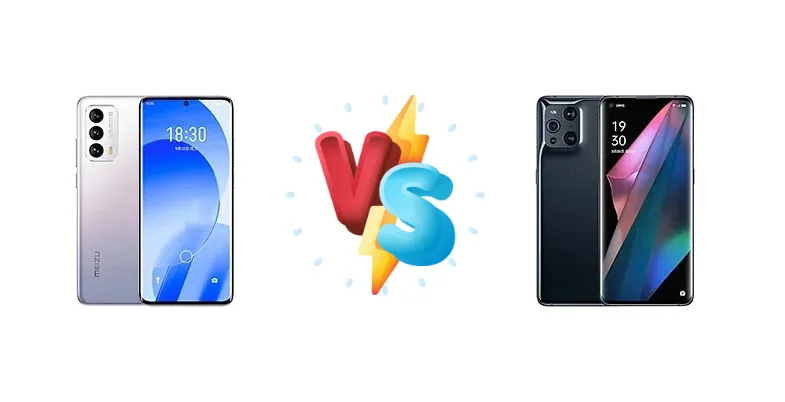
|
🏆 Quick Verdict
For most users, the Oppo Find X3 Pro emerges as the stronger choice. Its significantly faster 65W wired and 30W wireless charging, coupled with comparable battery endurance, offsets the slight CPU performance advantage of the Meizu 18s. The Find X3 Pro’s display also offers a superior viewing experience.
| PHONES | ||
|---|---|---|
| Phone Names | Meizu 18s | Oppo Find X3 Pro |
| Network | ||
|---|---|---|
| 2G bands | GSM 850 / 900 / 1800 / 1900 | GSM 850 / 900 / 1800 / 1900 |
| 3G bands | HSDPA 850 / 900 / 1900 / 2100 | HSDPA 800 / 850 / 900 / 1700(AWS) / 1900 / 2100 |
| 4G bands | 1, 3, 4, 5, 7, 8, 34, 38, 39, 40, 41 | 1, 2, 3, 4, 5, 7, 8, 12, 13, 17, 18, 19, 20, 25, 26, 28, 32, 34, 38, 39, 40, 41, 42, 66 - International |
| 5G bands | 1, 3, 41, 77, 78, 79 SA/NSA | 1, 3, 5, 7, 8, 20, 28, 38, 40, 41, 77, 78, 79 SA/NSA - International |
| Speed | HSPA, LTE, 5G | HSPA, LTE, 5G |
| Technology | GSM / HSPA / LTE / 5G | GSM / CDMA / HSPA / CDMA2000 / LTE / 5G |
| - | 1, 2, 3, 5, 7, 8, 12, 20, 28, 38, 40, 41, 66, 77, 78, 79 SA/NSA - China | |
| Launch | ||
|---|---|---|
| Announced | 2021, September 22. Released 2021, September 23 | 2021, March 11 |
| Status | Discontinued | Available. Released 2021, March 19 |
| Body | ||
|---|---|---|
| Build | - | Glass front (Gorilla Glass 5), glass back (Gorilla Glass 5), aluminum frame |
| Dimensions | 152.4 x 69.2 x 8.2 mm (6.00 x 2.72 x 0.32 in) | 163.6 x 74 x 8.3 mm (6.44 x 2.91 x 0.33 in) |
| SIM | Nano-SIM + Nano-SIM | Nano-SIM + eSIM |
| Weight | 162 g (5.71 oz) | 193 g (6.81 oz) |
| - | IP68 dust/water resistant (up to 1.5m for 30 min) | |
| Display | ||
|---|---|---|
| Protection | - | Corning Gorilla Glass 5 |
| Resolution | 1440 x 3200 pixels, 20:9 ratio (~563 ppi density) | 1440 x 3216 pixels, 20:9 ratio (~525 ppi density) |
| Size | 6.2 inches, 93.8 cm2 (~88.9% screen-to-body ratio) | 6.7 inches, 108.4 cm2 (~89.6% screen-to-body ratio) |
| Type | Super AMOLED, 120Hz, HDR10+, 420 nits (typ), 1300 nits (peak) | LTPO AMOLED, 1B colors, 120Hz, HDR10+, BT.2020, 500 nits (typ), 1300 nits (peak) |
| Platform | ||
|---|---|---|
| CPU | Octa-core (1x3.0 GHz Cortex-X1 & 3x2.42 GHz Cortex-A78 & 4x1.80 GHz Cortex-A55) | Octa-core (1x2.84 GHz Cortex-X1 & 3x2.42 GHz Cortex-A78 & 4x1.80 GHz Cortex-A55) |
| Chipset | Qualcomm SM8350 Snapdragon 888+ 5G (5 nm) | Qualcomm SM8350 Snapdragon 888 5G (5 nm) |
| GPU | Adreno 660 | Adreno 660 |
| OS | Android 11, Flyme 9.2 | Android 11, upgradable to Android 14, ColorOS 14 |
| Memory | ||
|---|---|---|
| Card slot | No | No |
| Internal | 128GB 8GB RAM, 256GB 8GB RAM, 256GB 12GB RAM | 256GB 8GB RAM, 256GB 12GB RAM, 512GB 16GB RAM |
| UFS 3.1 | UFS 3.1 | |
| Main Camera | ||
|---|---|---|
| Features | Dual-LED dual-tone flash, HDR, panorama | Color spectrum sensor, LED flash, HDR, panorama |
| Quad | - | 50 MP, f/1.8, 26mm (wide), 1/1.56", 1.0µm, multi-directional PDAF, OIS 13 MP, f/2.4, 52mm (telephoto), 1/3.4", 1.0µm, 2x optical zoom, PDAF 50 MP, f/2.2, 16mm, 110˚ (ultrawide), 1/1.56", 1.0µm, multi-directional PDAF 3 MP, f/3.0, (microscope), AF, ring flash, 60x magnification |
| Triple | 64 MP, f/1.6, 26mm (wide), 1/1.73", 0.8µm, PDAF, OIS 8 MP f/2.4, 79mm (telephoto), 1/4.4", 1.0µm, PDAF, 3x optical zoom 16 MP, f/2.2, 15mm, 122˚ (ultrawide), 1/3.0", 1.0µm | - |
| Video | 4K@30/60fps, 1080p; gyro-EIS | 4K@30/60fps, 1080p@30/60/240fps; gyro-EIS; HDR, 10‑bit video |
| Selfie camera | ||
|---|---|---|
| Features | HDR | Panorama |
| Single | 20 MP, f/2.2, 26mm (wide), 1/3.4", 0.8µm | 32 MP, f/2.4, 26mm (wide), 1/2.8", 0.8µm |
| Video | 1080p@30fps | 1080p@30fps |
| Sound | ||
|---|---|---|
| 3.5mm jack | No | No |
| 35mm jack | No | No |
| Loudspeaker | Yes, with stereo speakers | Yes, with stereo speakers |
| Comms | ||
|---|---|---|
| Bluetooth | 5.2, A2DP, LE | 5.2, A2DP, LE, aptX HD |
| NFC | Yes | Yes |
| Positioning | GPS (L1+L5), GLONASS, BDS, GALILEO, QZSS | GPS (L1+L5), GLONASS (L1), BDS (B1I+B1c+B2a), GALILEO (E1+E5a), QZSS (L1+L5) |
| Radio | No | No |
| USB | USB Type-C | USB Type-C 3.1, OTG |
| WLAN | Wi-Fi 802.11 а/b/g/n/ac/6e, dual-band, Wi-Fi Direct | Wi-Fi 802.11 a/b/g/n/ac/6, dual-band, Wi-Fi Direct |
| Features | ||
|---|---|---|
| Sensors | Fingerprint (under display, ultrasonic), accelerometer, gyro, proximity, compass | Fingerprint (under display, optical), accelerometer, gyro, proximity, compass |
| Battery | ||
|---|---|---|
| Charging | 36W wired, PD3.0, QC3, 80% in 33 min, 100% in 55 min | 65W wired, PD, 40% in 10 min 30W wireless, 100% in 80 min 10W reverse wireless |
| Type | Li-Po 4000 mAh | Li-Po 4500 mAh |
| Misc | ||
|---|---|---|
| Colors | Light Blue, White, Aurora, Pink/Violet | Gloss Black, Blue, White, Cosmic Mocha, Mars Edition, Photographer Edition |
| Models | - | CPH2173, PEEM00, OPG03 |
| Price | About 490 EUR | About 200 EUR |
| Tests | ||
|---|---|---|
| Battery life | - | Endurance rating 81h |
| Camera | - | Photo / Video |
| Display | - | Contrast ratio: Infinite (nominal) |
| Loudspeaker | - | -25.4 LUFS (Very good) |
| Performance | - | AnTuTu: 656467 (v8) GeekBench: 3316 (v5.1) GFXBench: 33fps (ES 3.1 onscreen) |
Meizu 18s
- Slightly faster CPU performance with Snapdragon 888+
- Potentially more compact design (based on Meizu's brand history)
- PD3.0 and QC3 compatibility for wider charger support
- Slower charging speeds (36W wired, no wireless)
- Limited camera details suggest a less advanced system
- No reverse wireless charging
Oppo Find X3 Pro
- Significantly faster 65W wired and 30W wireless charging
- Brighter display with infinite contrast ratio
- Reverse wireless charging for accessories
- Slightly slower CPU performance compared to the 888+
- May be larger and less comfortable to hold
- Relies on Oppo's proprietary charging standards
Display Comparison
The Oppo Find X3 Pro boasts a measured peak brightness of 774 nits, suggesting a more visible screen outdoors compared to the Meizu 18s (brightness data unavailable). While both likely utilize high-refresh-rate OLED panels, the Find X3 Pro’s infinite contrast ratio (nominal) indicates a superior black level performance. Without specific panel technology details for the Meizu 18s, it’s difficult to assess potential differences in color accuracy or viewing angles, but Oppo’s history suggests a focus on display calibration.
Camera Comparison
Both phones feature capable camera systems, but detailed sensor information is limited. The context data only indicates 'Photo / Video' capabilities for both. The Oppo Find X3 Pro’s camera system is known for its innovative approach, but without specifics on sensor size, aperture, or OIS, a direct comparison is challenging. It’s reasonable to assume the Find X3 Pro’s camera system is more advanced, given Oppo’s marketing focus on photography. The absence of details on the Meizu 18s’ camera suggests it may not be a primary selling point.
Performance
Both devices are powered by the Qualcomm Snapdragon 888 5G (5nm), but the Meizu 18s features the upgraded Snapdragon 888+ 5G. The 888+ boasts a slightly higher peak CPU clock speed (3.0 GHz Cortex-X1 vs 2.84 GHz on the 888), potentially leading to a marginal performance increase in CPU-intensive tasks. However, both share the same Cortex-A78 and A55 core configuration, meaning multi-core performance will be similar. The impact of this CPU difference will be most noticeable in sustained workloads where thermal throttling becomes a factor. RAM speed is not specified, but both likely utilize LPDDR5 for fast memory access.
Battery Life
The Oppo Find X3 Pro and Meizu 18s both achieve an endurance rating of 81 hours, indicating similar overall battery life despite potentially different battery capacities (not specified). However, the charging capabilities are drastically different. The Find X3 Pro supports 65W wired charging, achieving 40% charge in just 10 minutes, and 30W wireless charging, reaching 100% in 80 minutes. The Meizu 18s, with its 36W wired charging, takes 33 minutes for 80% and 55 minutes for a full charge. The Find X3 Pro also offers 10W reverse wireless charging, a feature absent on the Meizu 18s.
Buying Guide
Buy the Meizu 18s if you prioritize a slightly more responsive CPU for demanding tasks and prefer a potentially more compact form factor (though dimensions aren't provided, Meizu historically focuses on smaller devices). Buy the Oppo Find X3 Pro if you value blazing-fast charging speeds, a brighter and potentially more color-accurate display, and a more comprehensive wireless charging ecosystem including reverse wireless charging.