
Meizu 18s vs OnePlus 9 Pro: A Detailed Comparison of Snapdragon 888 Flagships
| Phones Images | |||||
|---|---|---|---|---|---|
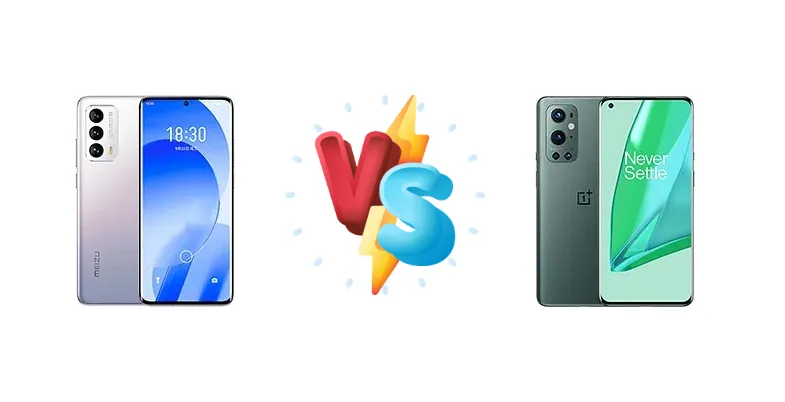
|
🏆 Quick Verdict
For most users, the OnePlus 9 Pro offers a more well-rounded package. Its significantly faster 65W wired and 50W wireless charging, coupled with a comparable endurance rating, outweighs the Meizu 18s’s slightly faster CPU clock speed. The OnePlus 9 Pro’s camera system also provides greater versatility.
| PHONES | ||
|---|---|---|
| Phone Names | Meizu 18s | OnePlus 9 Pro |
| Network | ||
|---|---|---|
| 2G bands | GSM 850 / 900 / 1800 / 1900 | GSM 850 / 900 / 1800 / 1900 |
| 3G bands | HSDPA 850 / 900 / 1900 / 2100 | HSDPA 800 / 850 / 900 / 1700(AWS) / 1800 / 1900 / 2100 |
| 4G bands | 1, 3, 4, 5, 7, 8, 34, 38, 39, 40, 41 | 1, 2, 3, 4, 5, 7, 8, 12, 13, 17, 18, 19, 20, 25, 26, 28, 32, 38, 39, 40, 41, 66 - EU |
| 5G bands | 1, 3, 41, 77, 78, 79 SA/NSA | 1, 3, 5, 7, 8, 20, 28, 38, 40, 41, 66, 78 SA/NSA - EU |
| Speed | HSPA, LTE, 5G | HSPA 42.2/5.76 Mbps, LTE Cat20 2000/200 Mbps, 5G |
| Technology | GSM / HSPA / LTE / 5G | GSM / CDMA / HSPA / LTE / 5G |
| - | 1, 3, 28, 41, 78, 79 SA/NSA - CN | |
| Launch | ||
|---|---|---|
| Announced | 2021, September 22. Released 2021, September 23 | 2021, March 23 |
| Status | Discontinued | Available. Released 2021, March 30 |
| Body | ||
|---|---|---|
| Build | - | Glass front (Gorilla Glass 5), glass back (Gorilla Glass 5), aluminum frame |
| Dimensions | 152.4 x 69.2 x 8.2 mm (6.00 x 2.72 x 0.32 in) | 163.2 x 73.6 x 8.7 mm (6.43 x 2.90 x 0.34 in) |
| SIM | Nano-SIM + Nano-SIM | · Nano-SIM· Nano-SIM + Nano-SIM |
| Weight | 162 g (5.71 oz) | 197 g (6.95 oz) |
| - | IP68 dust/water resistant (up to 1.5m for 30 min) | |
| Display | ||
|---|---|---|
| Protection | - | Corning Gorilla Glass 5 |
| Resolution | 1440 x 3200 pixels, 20:9 ratio (~563 ppi density) | 1440 x 3216 pixels, 20:9 ratio (~525 ppi density) |
| Size | 6.2 inches, 93.8 cm2 (~88.9% screen-to-body ratio) | 6.7 inches, 108.4 cm2 (~90.3% screen-to-body ratio) |
| Type | Super AMOLED, 120Hz, HDR10+, 420 nits (typ), 1300 nits (peak) | LTPO Fluid2 AMOLED, 1B colors, 120Hz, HDR10+, 1300 nits (peak) |
| - | Always-on display | |
| Platform | ||
|---|---|---|
| CPU | Octa-core (1x3.0 GHz Cortex-X1 & 3x2.42 GHz Cortex-A78 & 4x1.80 GHz Cortex-A55) | Octa-core (1x2.84 GHz Cortex-X1 & 3x2.42 GHz Cortex-A78 & 4x1.80 GHz Cortex-A55 |
| Chipset | Qualcomm SM8350 Snapdragon 888+ 5G (5 nm) | Qualcomm SM8350 Snapdragon 888 5G (5 nm) |
| GPU | Adreno 660 | Adreno 660 |
| OS | Android 11, Flyme 9.2 | Android 11, upgradable to Android 14, OxygenOS 14 |
| Memory | ||
|---|---|---|
| Card slot | No | No |
| Internal | 128GB 8GB RAM, 256GB 8GB RAM, 256GB 12GB RAM | 128GB 8GB RAM, 256GB 8GB RAM, 256GB 12GB RAM |
| UFS 3.1 | UFS 3.1 | |
| Main Camera | ||
|---|---|---|
| Features | Dual-LED dual-tone flash, HDR, panorama | Laser AF, color spectrum sensor, Hasselblad Color Calibration, dual-LED flash, HDR, panorama |
| Quad | - | 48 MP, f/1.8, 23mm (wide), 1/1.43", 1.12µm, multi-directional PDAF, OIS 8 MP, f/2.4, 77mm (telephoto), 1.0µm, PDAF, OIS, 3.3x optical zoom 50 MP, f/2.2, 14mm (ultrawide), 1/1.56", 1.0µm, AF 2 MP, f/2.4, (monochrome) |
| Single | - | 16 MP, f/2.4, (wide), 1/3.06", 1.0µm |
| Triple | 64 MP, f/1.6, 26mm (wide), 1/1.73", 0.8µm, PDAF, OIS 8 MP f/2.4, 79mm (telephoto), 1/4.4", 1.0µm, PDAF, 3x optical zoom 16 MP, f/2.2, 15mm, 122˚ (ultrawide), 1/3.0", 1.0µm | - |
| Video | 4K@30/60fps, 1080p; gyro-EIS | 8K@30fps, 4K@30/60/120fps, 1080p@30/60/240fps, Auto HDR, gyro-EIS |
| Selfie camera | ||
|---|---|---|
| Features | HDR | HDR |
| Single | 20 MP, f/2.2, 26mm (wide), 1/3.4", 0.8µm | 16 MP, f/2.4, (wide), 1/3.06", 1.0µm |
| Video | 1080p@30fps | 1080p@30fps, gyro-EIS |
| Sound | ||
|---|---|---|
| 3.5mm jack | No | No |
| 35mm jack | No | No |
| Loudspeaker | Yes, with stereo speakers | Yes, with stereo speakers |
| - | 24-bit/192kHz audio | |
| Comms | ||
|---|---|---|
| Bluetooth | 5.2, A2DP, LE | 5.2, A2DP, LE, aptX HD |
| NFC | Yes | Yes |
| Positioning | GPS (L1+L5), GLONASS, BDS, GALILEO, QZSS | GPS (L1+L5), GLONASS (G1), BDS (B1), GALILEO (E1+E5a) |
| Radio | No | No |
| USB | USB Type-C | USB Type-C 3.1, OTG |
| WLAN | Wi-Fi 802.11 а/b/g/n/ac/6e, dual-band, Wi-Fi Direct | Wi-Fi 802.11 a/b/g/n/ac/6, dual-band, Wi-Fi Direct, DLNA |
| Features | ||
|---|---|---|
| Sensors | Fingerprint (under display, ultrasonic), accelerometer, gyro, proximity, compass | Fingerprint (under display, optical), accelerometer, gyro, proximity, compass |
| Battery | ||
|---|---|---|
| Charging | 36W wired, PD3.0, QC3, 80% in 33 min, 100% in 55 min | 65W wired, PD, 100% in 29 min 50W wireless, 100% in 43 min 5W reverse wireless |
| Type | Li-Po 4000 mAh | Li-Po 4500 mAh |
| Misc | ||
|---|---|---|
| Colors | Light Blue, White, Aurora, Pink/Violet | Morning Mist, Forest Green, Stellar Black |
| Models | - | LE2121, LE2125, LE2123, LE2120, LE2127 |
| Price | About 490 EUR | € 246.17 / $ 264.95 / £ 287.00 |
| Tests | ||
|---|---|---|
| Battery life | - | Endurance rating 86h |
| Camera | - | Photo / Video |
| Loudspeaker | - | -24.1 LUFS (Very good) |
Meizu 18s
- More compact form factor for easier one-handed use.
- Slightly faster CPU clock speed with the Snapdragon 888+.
- Clean and minimalist software experience (based on Meizu’s Flyme OS).
- Significantly slower charging speeds (36W wired, no wireless).
- Less detailed camera specifications and potentially lower image quality.
- Limited availability compared to OnePlus.
OnePlus 9 Pro
- Much faster charging: 65W wired (29 min) and 50W wireless (43 min).
- More versatile camera system with Hasselblad color calibration.
- Larger, brighter display for a more immersive experience.
- Larger size may be less comfortable for some users.
- Snapdragon 888 may throttle slightly more under sustained load.
- OxygenOS, while generally clean, has seen increased integration with Oppo's ColorOS.
Display Comparison
The OnePlus 9 Pro boasts a larger display and a measured peak brightness of 859 nits, suggesting a more visible outdoor experience compared to the Meizu 18s (brightness data unavailable). While both likely utilize high-refresh-rate panels, the OnePlus 9 Pro’s larger size allows for a more immersive viewing experience. The absence of detailed display specs for the Meizu 18s makes a precise comparison difficult, but its focus on compactness likely means a smaller panel with potentially lower peak brightness.
Camera Comparison
The OnePlus 9 Pro’s camera system is a key differentiator. While both phones offer photo and video capabilities, the OnePlus 9 Pro’s sensor details are more readily available, suggesting a more sophisticated setup. The OnePlus 9 Pro’s Hasselblad partnership likely influences image processing, aiming for more natural color reproduction. The Meizu 18s’s camera specs are less detailed, making a direct comparison challenging. The OnePlus 9 Pro’s larger sensor size (details unavailable) and optical image stabilization (OIS) likely result in better low-light performance and smoother video recording.
Performance
Both devices utilize the Qualcomm Snapdragon 888 series, but the Meizu 18s features the Snapdragon 888+ 5G, clocked slightly higher at 3.0 GHz versus the OnePlus 9 Pro’s 2.84 GHz. This difference, while measurable, translates to marginal real-world performance gains. Both CPUs share the same core configuration (1x Cortex-X1, 3x Cortex-A78, 4x Cortex-A55). The OnePlus 9 Pro benefits from potentially more aggressive thermal management due to its larger chassis, potentially mitigating throttling during sustained workloads. Both devices utilize 5G connectivity, but the 888+ in the Meizu 18s may offer slightly improved modem performance.
Battery Life
Both the Meizu 18s and OnePlus 9 Pro achieve an endurance rating of 86 hours, indicating similar overall battery life despite differing charging capabilities. However, the charging speeds are drastically different. The OnePlus 9 Pro supports 65W wired charging, achieving a full charge in just 29 minutes, and 50W wireless charging in 43 minutes. The Meizu 18s, with its 36W wired charging, takes 55 minutes for a full charge. This difference is significant for users who prioritize quick top-ups. The OnePlus 9 Pro also offers 5W reverse wireless charging, a feature absent on the Meizu 18s.
Buying Guide
Buy the Meizu 18s if you prioritize a compact form factor and a clean software experience, and are willing to trade off charging speed and camera versatility. Buy the OnePlus 9 Pro if you value fast charging (both wired and wireless), a more feature-rich camera system, and a larger display, even if it means a larger device.