
Meizu 18s vs Meizu 18: A Detailed Comparison
| Phones Images | |||||
|---|---|---|---|---|---|
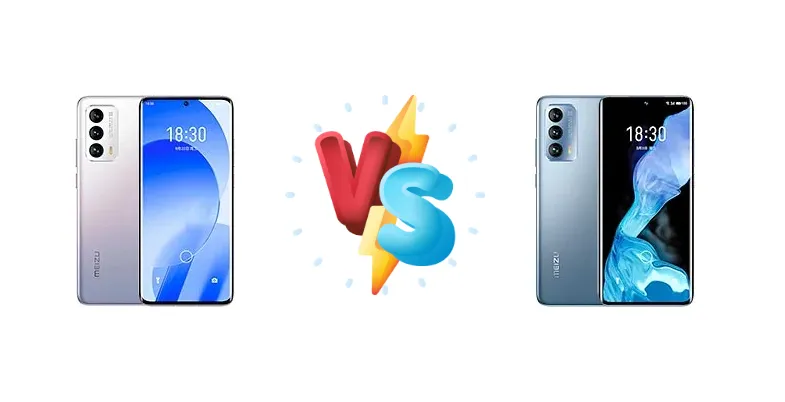
|
🏆 Quick Verdict
The Meizu 18s edges out the 18 thanks to its slightly faster Snapdragon 888+ chipset and quicker charging. However, the differences are subtle, and the 18 remains a compelling option, especially if price is a significant factor. Both offer a premium Meizu experience.
| PHONES | ||
|---|---|---|
| Phone Names | Meizu 18s | Meizu 18 |
| Network | ||
|---|---|---|
| 2G bands | GSM 850 / 900 / 1800 / 1900 | GSM 850 / 900 / 1800 / 1900 |
| 3G bands | HSDPA 850 / 900 / 1900 / 2100 | HSDPA 850 / 900 / 1900 / 2100 |
| 4G bands | 1, 3, 4, 5, 7, 8, 34, 38, 39, 40, 41 | 1, 3, 4, 5, 7, 8, 34, 38, 39, 40, 41 |
| 5G bands | 1, 3, 41, 77, 78, 79 SA/NSA | 1, 3, 41, 77, 78, 79 SA/NSA |
| Speed | HSPA, LTE, 5G | HSPA, LTE, 5G |
| Technology | GSM / HSPA / LTE / 5G | GSM / HSPA / LTE / 5G |
| Launch | ||
|---|---|---|
| Announced | 2021, September 22. Released 2021, September 23 | 2021, March 03. Released 2021, March 08 |
| Status | Discontinued | Discontinued |
| Body | ||
|---|---|---|
| Dimensions | 152.4 x 69.2 x 8.2 mm (6.00 x 2.72 x 0.32 in) | 152.4 x 69.2 x 8.2 mm (6.00 x 2.72 x 0.32 in) |
| SIM | Nano-SIM + Nano-SIM | Nano-SIM + Nano-SIM |
| Weight | 162 g (5.71 oz) | 162 g (5.71 oz) |
| Display | ||
|---|---|---|
| Resolution | 1440 x 3200 pixels, 20:9 ratio (~563 ppi density) | 1440 x 3200 pixels, 20:9 ratio (~563 ppi density) |
| Size | 6.2 inches, 93.8 cm2 (~88.9% screen-to-body ratio) | 6.2 inches, 93.8 cm2 (~88.9% screen-to-body ratio) |
| Type | Super AMOLED, 120Hz, HDR10+, 420 nits (typ), 1300 nits (peak) | Super AMOLED, 120Hz, HDR10+, 420 nits (typ), 1300 nits (peak) |
| Platform | ||
|---|---|---|
| CPU | Octa-core (1x3.0 GHz Cortex-X1 & 3x2.42 GHz Cortex-A78 & 4x1.80 GHz Cortex-A55) | Octa-core (1x2.84 GHz Cortex-X1 & 3x2.42 GHz Cortex-A78 & 4x1.80 GHz Cortex-A55) |
| Chipset | Qualcomm SM8350 Snapdragon 888+ 5G (5 nm) | Qualcomm SM8350 Snapdragon 888 5G (5 nm) |
| GPU | Adreno 660 | Adreno 660 |
| OS | Android 11, Flyme 9.2 | Android 11, Flyme 9 |
| Memory | ||
|---|---|---|
| Card slot | No | No |
| Internal | 128GB 8GB RAM, 256GB 8GB RAM, 256GB 12GB RAM | 128GB 8GB RAM, 256GB 8GB RAM, 256GB 12GB RAM |
| UFS 3.1 | UFS 3.1 | |
| Main Camera | ||
|---|---|---|
| Features | Dual-LED dual-tone flash, HDR, panorama | Dual-LED dual-tone flash, HDR, panorama |
| Triple | 64 MP, f/1.6, 26mm (wide), 1/1.73", 0.8µm, PDAF, OIS 8 MP f/2.4, 79mm (telephoto), 1/4.4", 1.0µm, PDAF, 3x optical zoom 16 MP, f/2.2, 15mm, 122˚ (ultrawide), 1/3.0", 1.0µm | 64 MP, f/1.6, 26mm (wide), 1/1.73", 0.8µm, PDAF, OIS 8 MP f/2.4, 79mm (telephoto), 1/4.4", 1.0µm, PDAF, 3x optical zoom 16 MP, f/2.2, 15mm, 122˚ (ultrawide), 1/3.0", 1.0µm |
| Video | 4K@30/60fps, 1080p; gyro-EIS | 4K@30/60fps, 1080p; gyro-EIS |
| Selfie camera | ||
|---|---|---|
| Features | HDR | HDR |
| Single | 20 MP, f/2.2, 26mm (wide), 1/3.4", 0.8µm | 20 MP, f/2.2, 26mm (wide), 1/3.4", 0.8µm |
| Video | 1080p@30fps | 1080p@30fps |
| Sound | ||
|---|---|---|
| 3.5mm jack | No | No |
| 35mm jack | No | No |
| Loudspeaker | Yes, with stereo speakers | Yes, with stereo speakers |
| Comms | ||
|---|---|---|
| Bluetooth | 5.2, A2DP, LE | 5.2, A2DP, LE |
| NFC | Yes | Yes |
| Positioning | GPS (L1+L5), GLONASS, BDS, GALILEO, QZSS | GPS (L1+L5), GLONASS, BDS, GALILEO, QZSS, NavIC |
| Radio | No | No |
| USB | USB Type-C | USB Type-C |
| WLAN | Wi-Fi 802.11 а/b/g/n/ac/6e, dual-band, Wi-Fi Direct | Wi-Fi 802.11 а/b/g/n/ac/6e, dual-band, Wi-Fi Direct |
| Features | ||
|---|---|---|
| Sensors | Fingerprint (under display, ultrasonic), accelerometer, gyro, proximity, compass | Fingerprint (under display, ultrasonic), accelerometer, gyro, proximity, compass |
| Battery | ||
|---|---|---|
| Charging | 36W wired, PD3.0, QC3, 80% in 33 min, 100% in 55 min | 36W wired, PD3.0, QC3, 40% in 15 min, 100% in 50 min |
| Type | Li-Po 4000 mAh | Li-Po 4000 mAh |
| Misc | ||
|---|---|---|
| Colors | Light Blue, White, Aurora, Pink/Violet | Light Blue, White, Aurora |
| Price | About 490 EUR | About 560 EUR |
Meizu 18s
- Faster Snapdragon 888+ Chipset
- Quicker Charging (36W)
- Premium Build Quality
- Excellent Display
- Potentially Higher Price
- Availability may be limited
Meizu 18
- Flagship Performance (Snapdragon 888)
- Excellent Display
- Potentially Lower Price
- Sleek Design
- Slower Charging (36W)
- Performance slightly behind 18s
Display Comparison
Both phones feature a 6.6-inch AMOLED display with a 120Hz refresh rate and a Full HD+ resolution. While the panels are likely very similar in quality, the 18s might have slightly better color calibration due to potential software optimizations, but this is difficult to confirm without direct testing. Expect vibrant colors, deep blacks, and smooth scrolling on both.
Camera Comparison
Both devices are expected to feature a triple-camera setup, likely including a 64MP main sensor, an ultrawide lens, and a telephoto lens. Image quality should be comparable, with both phones capable of capturing detailed photos in good lighting conditions. Software processing and low-light performance might differ slightly, but a definitive comparison requires extensive testing.
Performance
The key difference lies in the chipset. The 18s boasts the Snapdragon 888+, offering a modest performance boost over the standard 888 in the 18. This translates to slightly faster app loading times and smoother multitasking, particularly in demanding games. However, both phones are more than capable of handling everyday tasks and most mobile games with ease.
Battery Life
The Meizu 18s has a clear advantage in charging speed, reaching 80% in 33 minutes and 100% in 55 minutes, compared to the 18's 40% in 15 minutes and 100% in 50 minutes. Battery capacity is likely similar (around 4000-4500mAh), so the 18s' faster charging makes it more convenient for users who need a quick top-up.
Buying Guide
Who should buy the Meizu 18s? Users prioritizing the absolute best performance and faster charging will appreciate the 888+ chip. Who should buy the Meizu 18? Those seeking a flagship experience at a potentially lower price point, and who don't need the absolute peak performance, will find the 18 a great value.