
Meizu 18s vs Asus ROG Phone 5s: A Deep Dive into Snapdragon 888+ Implementations
| Phones Images | |||||
|---|---|---|---|---|---|
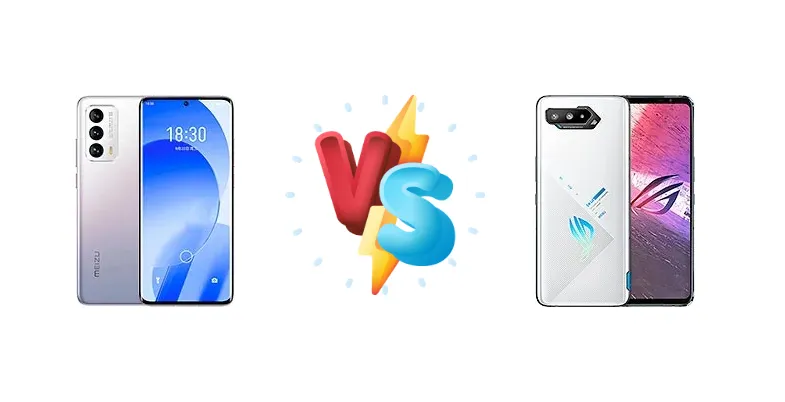
|
🏆 Quick Verdict
For the average user prioritizing portability and a balanced experience, the Meizu 18s offers a compelling package. However, gamers and power users will find the Asus ROG Phone 5s’ faster charging and likely more robust thermal management a worthwhile trade-off for its larger size.
| PHONES | ||
|---|---|---|
| Phone Names | Meizu 18s | Asus ROG Phone 5s |
| Network | ||
|---|---|---|
| 2G bands | GSM 850 / 900 / 1800 / 1900 | GSM 850 / 900 / 1800 / 1900 |
| 3G bands | HSDPA 850 / 900 / 1900 / 2100 | HSDPA 800 / 850 / 900 / 1700(AWS) / 1800 / 1900 / 2100 - Version 1 |
| 4G bands | 1, 3, 4, 5, 7, 8, 34, 38, 39, 40, 41 | 1, 2, 3, 4, 5, 7, 8, 12, 13, 17, 18, 19, 20, 25, 26, 28, 29, 30, 32, 34, 38, 39, 40, 41, 42, 48, 66, 71 - Version 1 |
| 5G bands | 1, 3, 41, 77, 78, 79 SA/NSA | 1, 2, 3, 5, 7, 8, 12, 20, 25, 28, 38, 40, 41, 66, 71, 77, 78, 79 SA/NSA - Version 1 |
| Speed | HSPA, LTE, 5G | HSPA 42.2/5.76 Mbps, LTE (7CA) Cat20 1400/150 Mbps, 5G 4 Gbps DL |
| Technology | GSM / HSPA / LTE / 5G | GSM / HSPA / LTE / 5G |
| - | 2, 3, 5, 7, 12, 20, 25, 28, 38, 40, 66, 71, 77, 78, 79 SA/NSA - Version 4 | |
| Launch | ||
|---|---|---|
| Announced | 2021, September 22. Released 2021, September 23 | 2021, August 16 |
| Status | Discontinued | Available. Released 2021, August 26 |
| Body | ||
|---|---|---|
| Build | - | Glass front (Gorilla Glass Victus), glass back (Gorilla Glass 3), aluminum frame |
| Dimensions | 152.4 x 69.2 x 8.2 mm (6.00 x 2.72 x 0.32 in) | 172.8 x 77.3 x 9.9 mm (6.80 x 3.04 x 0.39 in) |
| SIM | Nano-SIM + Nano-SIM | Nano-SIM + Nano-SIM |
| Weight | 162 g (5.71 oz) | 238 g (8.40 oz) |
| - | RGB light panel (on the back) Pressure sensitive zones (Gaming triggers) | |
| Display | ||
|---|---|---|
| Protection | - | Corning Gorilla Glass Victus |
| Resolution | 1440 x 3200 pixels, 20:9 ratio (~563 ppi density) | 1080 x 2448 pixels (~395 ppi density) |
| Size | 6.2 inches, 93.8 cm2 (~88.9% screen-to-body ratio) | 6.78 inches, 109.5 cm2 (~82.0% screen-to-body ratio) |
| Type | Super AMOLED, 120Hz, HDR10+, 420 nits (typ), 1300 nits (peak) | AMOLED, 1B colors, 144Hz, HDR10+, 800 nits (typ), 1200 nits (peak) |
| Platform | ||
|---|---|---|
| CPU | Octa-core (1x3.0 GHz Cortex-X1 & 3x2.42 GHz Cortex-A78 & 4x1.80 GHz Cortex-A55) | Octa-core (1x2.99 GHz Cortex-X1 & 3x2.42 GHz Cortex-A78 & 4x1.80 GHz Cortex-A55) |
| Chipset | Qualcomm SM8350 Snapdragon 888+ 5G (5 nm) | Qualcomm SM8350 Snapdragon 888+ 5G (5 nm) |
| GPU | Adreno 660 | Adreno 660 |
| OS | Android 11, Flyme 9.2 | Android 11, upgradable to Android 13, ROG UI |
| Memory | ||
|---|---|---|
| Card slot | No | No |
| Internal | 128GB 8GB RAM, 256GB 8GB RAM, 256GB 12GB RAM | 128GB 8GB RAM, 128GB 12GB RAM, 256GB 12GB RAM, 256GB 16GB RAM, 512GB 16GB RAM, 512GB 18GB RAM |
| UFS 3.1 | UFS 3.1 | |
| Main Camera | ||
|---|---|---|
| Features | Dual-LED dual-tone flash, HDR, panorama | LED flash, HDR, panorama |
| Triple | 64 MP, f/1.6, 26mm (wide), 1/1.73", 0.8µm, PDAF, OIS 8 MP f/2.4, 79mm (telephoto), 1/4.4", 1.0µm, PDAF, 3x optical zoom 16 MP, f/2.2, 15mm, 122˚ (ultrawide), 1/3.0", 1.0µm | 64 MP, f/1.8, 26mm (wide), 1/1.73", 0.8µm, PDAF 13 MP, f/2.4, 11mm, 125˚ (ultrawide) 5 MP (macro) |
| Video | 4K@30/60fps, 1080p; gyro-EIS | 8K@30fps, 4K@30/60/120fps, 1080p@30/60/120/240fps, 720p@480fps; gyro-EIS |
| Selfie camera | ||
|---|---|---|
| Features | HDR | Panorama, HDR |
| Single | 20 MP, f/2.2, 26mm (wide), 1/3.4", 0.8µm | 24 MP, f/2.5, 27mm (wide), 0.9µm |
| Video | 1080p@30fps | 1080p@30fps |
| Sound | ||
|---|---|---|
| 3.5mm jack | No | Yes |
| 35mm jack | No | Yes |
| Loudspeaker | Yes, with stereo speakers | Yes, with stereo speakers (2 amplifiers) |
| - | 24-bit/192kHz audio | |
| Comms | ||
|---|---|---|
| Bluetooth | 5.2, A2DP, LE | 5.2, A2DP, LE, aptX HD, aptX Adaptive |
| NFC | Yes | Yes |
| Positioning | GPS (L1+L5), GLONASS, BDS, GALILEO, QZSS | GPS (L1+L5), GLONASS (L1), BDS (B1I+B1c+B2a), GALILEO (E1+E5a), QZSS (L1+L5), NavIC (L5) |
| Radio | No | No |
| USB | USB Type-C | USB Type-C 3.1 (side), USB Type-C 2.0 (bottom), OTG, accessory connector |
| WLAN | Wi-Fi 802.11 а/b/g/n/ac/6e, dual-band, Wi-Fi Direct | Wi-Fi 802.11 a/b/g/n/ac/6e, dual-band, Wi-Fi Direct |
| Features | ||
|---|---|---|
| Sensors | Fingerprint (under display, ultrasonic), accelerometer, gyro, proximity, compass | Fingerprint (under display, optical), accelerometer, gyro, proximity, compass |
| Battery | ||
|---|---|---|
| Charging | 36W wired, PD3.0, QC3, 80% in 33 min, 100% in 55 min | 65W wired, PD3.0, QC5, 70% in 30 min, 100% in 52 min 10W reverse wired |
| Type | Li-Po 4000 mAh | Li-Po 6000 mAh |
| Misc | ||
|---|---|---|
| Colors | Light Blue, White, Aurora, Pink/Violet | Phantom Black, Storm White |
| Models | - | ZS676KS |
| Price | About 490 EUR | About 1030 EUR |
Meizu 18s
- Compact and pocketable design
- Clean and streamlined software experience
- Fast 36W charging
- Premium build quality
- Potential for thermal throttling under sustained load
- Smaller battery capacity (likely)
- Less focused on gaming features
Asus ROG Phone 5s
- Extremely fast 65W charging
- Advanced thermal management for sustained performance
- Gaming-centric features (AirTriggers, high refresh rate)
- Larger battery capacity (likely)
- Bulky and less comfortable for one-handed use
- More aggressive design aesthetic
- Potentially less refined camera image processing
Display Comparison
While both phones likely feature high-quality AMOLED panels, specific details like peak brightness and refresh rate are missing. However, the ROG Phone 5s, being a gaming phone, almost certainly boasts a higher refresh rate (likely 144Hz) than the Meizu 18s. This higher refresh rate translates to smoother animations and a more responsive gaming experience. The ROG Phone 5s’ larger display size also contributes to a more immersive visual experience. Bezels are likely comparable given the flagship status of both devices, but the ROG Phone 5s’ larger form factor allows for a more expansive screen-to-body ratio.
Camera Comparison
Without detailed camera specifications, a direct comparison is difficult. However, the ROG Phone 5s, despite its gaming focus, often includes capable camera systems. The Meizu 18s, as a flagship, likely prioritizes image quality and may feature a more refined image processing pipeline. Sensor size and lens apertures will be crucial factors. A larger sensor generally captures more light, resulting in better low-light performance. The ROG Phone 5s may lean towards more vibrant, saturated colors, while the Meizu 18s might aim for more natural color reproduction. We can assume both phones will offer a standard suite of camera features, but the Meizu 18s may offer more advanced computational photography features.
Performance
Both the Meizu 18s and Asus ROG Phone 5s are powered by the Qualcomm SM8350 Snapdragon 888+ 5G (5 nm) chipset, featuring an Octa-core CPU configuration (1x3.0 GHz Cortex-X1, 3x2.42 GHz Cortex-A78, and 4x1.80 GHz Cortex-A55). The slight clock speed difference (3.0 GHz on the Meizu vs 2.99 GHz on the Asus) is negligible in real-world performance. The key differentiator will be thermal management. Asus ROG Phones are renowned for their advanced cooling systems, likely incorporating vapor chambers and heat pipes, allowing the 888+ to sustain peak performance for longer durations. The Meizu 18s, constrained by its smaller size, may experience more thermal throttling under sustained load. Both devices utilize LPDDR5 RAM, but the ROG Phone 5s likely benefits from a larger RAM capacity, further aiding multitasking and gaming.
Battery Life
The Asus ROG Phone 5s significantly outpaces the Meizu 18s in charging speed with its 65W wired charging (PD3.0, QC5) compared to the Meizu’s 36W (PD3.0, QC3). This translates to a 70% charge in 30 minutes for the ROG Phone 5s and 80% in 33 minutes for the Meizu 18s. While the Meizu reaches 100% in 55 minutes, the ROG Phone 5s achieves 100% in 52 minutes. The ROG Phone 5s also offers 10W reverse wired charging, a feature absent on the Meizu 18s. While battery capacity isn't specified, the ROG Phone 5s likely has a larger battery to support its power-hungry gaming features and larger display. The faster charging of the ROG Phone 5s is a significant advantage for users who frequently need to top up their battery.
Buying Guide
Buy the Meizu 18s if you need a premium Android experience in a genuinely pocketable form factor, value a clean software experience, and don't require extreme gaming performance. Buy the Asus ROG Phone 5s if you prioritize gaming above all else, demand the fastest possible charging, and appreciate features like AirTriggers and a high refresh rate display, even at the expense of one-handed usability.