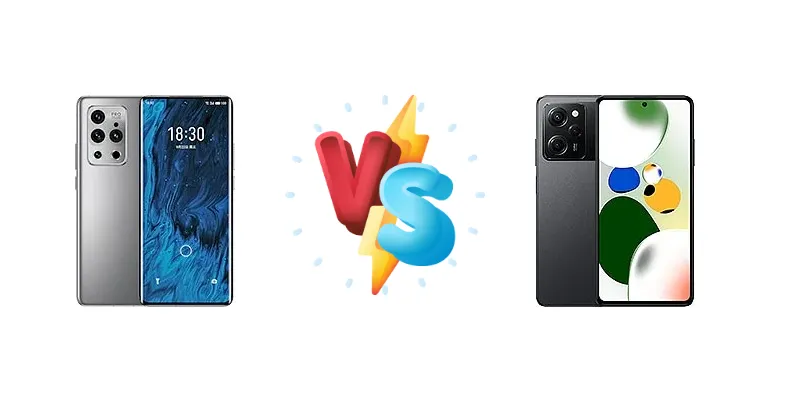
The smartphone market is overflowing with options, making it tough to choose. Today, we're pitting the Meizu 18s Pro, a former flagship contender, against the Xiaomi Redmi Note 12 Pro Speed, a popular mid-range device. Let's dive into a comprehensive comparison to see which phone reigns supreme.
🏆 Quick Verdict
The Meizu 18s Pro offers significantly superior performance thanks to its Snapdragon 888+ chipset. However, the Redmi Note 12 Pro Speed boasts faster charging and a potentially more accessible price. Ultimately, the choice depends on your priorities: raw power or value.
| Network |
|---|
| 2G bands | GSM 850 / 900 / 1800 / 1900 | GSM 850 / 900 / 1800 / 1900 |
| 3G bands | HSDPA 850 / 900 / 1700(AWS) / 1900 / 2100 | HSDPA 850 / 900 / 2100 |
| 4G bands | 1, 2, 3, 4, 5, 7, 8, 12, 34, 38, 39, 40, 41 | 1, 3, 5, 8, 19, 34, 38, 39, 40, 41 |
| 5G bands | 1, 3, 41, 77, 78, 79 SA/NSA | 1, 3, 5, 8, 28, 38, 41, 77, 78 SA/NSA |
| Speed | HSPA, LTE, 5G | HSPA, LTE, 5G |
| Technology | GSM / HSPA / LTE / 5G | GSM / CDMA / HSPA / CDMA2000 / LTE / 5G |
| | - | CDMA2000 1x |
| Launch |
|---|
| Announced | 2021, September 22. Released 2021, September 23 | 2022, December 27 |
| Status | Discontinued | Available. Released 2022, December 27 |
| Body |
|---|
| Dimensions | 162.5 x 73 x 8.1 mm (6.40 x 2.87 x 0.32 in) | 162.9 x 76 x 7.9 mm (6.41 x 2.99 x 0.31 in) |
| SIM | Nano-SIM + Nano-SIM | Nano-SIM + Nano-SIM |
| Weight | 189 g (6.67 oz) | 181 g (6.38 oz) |
| | Waterproof | IP53, dust and splash resistant |
| Display |
|---|
| Protection | Corning Gorilla Glass 6 | - |
| Resolution | 1440 x 3200 pixels, 20:9 ratio (~526 ppi density) | 1080 x 2400 pixels, 20:9 ratio (~395 ppi density) |
| Size | 6.7 inches, 107.6 cm2 (~90.7% screen-to-body ratio) | 6.67 inches, 107.4 cm2 (~86.8% screen-to-body ratio) |
| Type | Super AMOLED, 120Hz, HDR10+, 420 nits (typ), 1300 nits (peak) | OLED, 1B colors, 120Hz, Dolby Vision, HDR10+, 500 nits (typ), 900 nits (HBM) |
| Platform |
|---|
| CPU | Octa-core (1x3.0 GHz Cortex-X1 & 3x2.42 GHz Cortex-A78 & 4x1.80 GHz Cortex-A55) | Octa-core (1x2.4 GHz Cortex-A78 & 3x2.2 GHz Cortex-A78 & 4x1.9 GHz Cortex-A55) |
| Chipset | Qualcomm SM8350 Snapdragon 888+ 5G (5 nm) | Qualcomm SM7325 Snapdragon 778G 5G (6 nm) |
| GPU | Adreno 660 | Adreno 642L |
| OS | Android 11, Flyme 9.2 | Android 13, MIUI 14 |
| Memory |
|---|
| Card slot | No | No |
| Internal | 128GB 8GB RAM, 256GB 8GB RAM, 256GB 12GB RAM | 128GB 6GB RAM, 256GB 8GB RAM, 256GB 12GB RAM |
| | UFS 3.1 | UFS 2.2 |
| Main Camera |
|---|
| Features | LED flash, HDR, panorama | LED flash, HDR, panorama |
| Triple | 50 MP, f/1.9, 23mm (wide), 1/1.31", 1.2µm, dual pixel PDAF, OIS
8 MP f/2.4, 79mm (telephoto), 1/4.4", 1.0µm, PDAF, 3x optical zoom
32 MP, f/2.2, 15mm, 130˚ (ultrawide), 1/2.8", 0.8µm
0.3 MP, TOF 3D, f/1.4, (depth) | 108 MP, f/1.9, (wide), 1/1.52", 0.7µm, PDAF
8 MP, 119˚ (ultrawide), 1/4.0", 1.12µm
2 MP (macro) |
| Video | 8K, 4K@30/60fps, 1080p; gyro-EIS, HDR | 4K@30fps, 1080p@30/60/120fps, 720p@960fps, gyro-EIS |
| Selfie camera |
|---|
| Features | HDR | HDR |
| Single | 44 MP, f/2.4, (wide), 1/2.65”, 0.7µm | 16 MP, (wide), 1/3.06", 1.0µm |
| Video | 4K@30fps, 1080p@30fps | 1080p@30/60fps |
| Sound |
|---|
| 3.5mm jack | No | Yes |
| 35mm jack | No | Yes |
| Loudspeaker | Yes, with stereo speakers | Yes, with stereo speakers |
| | - | 24-bit/192kHz audio |
| Comms |
|---|
| Bluetooth | 5.2, A2DP, LE | 5.2, A2DP, LE |
| Infrared port | - | Yes |
| NFC | Yes | Yes |
| Positioning | GPS (L1+L5), GLONASS, BDS, GALILEO, QZSS | GPS (L1), GLONASS (G1), BDS (B1I+B1c), GALILEO (E1), QZSS (L1) |
| Radio | No | Unspecified |
| USB | USB Type-C | USB Type-C 2.0, OTG |
| WLAN | Wi-Fi 802.11 а/b/g/n/ac/6e, dual-band, Wi-Fi Direct | Wi-Fi 802.11 a/b/g/n/ac/6, dual-band, Wi-Fi Direct |
| Features |
|---|
| Sensors | Fingerprint (under display, ultrasonic), accelerometer, gyro, proximity, compass | Fingerprint (side-mounted), accelerometer, gyro, proximity, compass |
| Battery |
|---|
| Charging | 40W wired, PD3.0, QC4, 40% in 15 min, 100% in 55 min
40W wireless
10W reverse wireless | 67W wired, PD3.0, QC3+ |
| Type | Li-Po 4500 mAh | Li-Po 5000 mAh |
| Misc |
|---|
| Colors | Blue, White, Gray | Black, Blue, Green |
| Models | M192Q | 22101320C |
| Price | About 610 EUR | About 230 EUR |
Meizu 18s Pro
- Superior Performance (Snapdragon 888+)
- Potentially Better Display Quality
- Wireless Charging
- Reverse Wireless Charging
- Slower Charging (compared to Redmi)
- Potentially Higher Price
- Software Support (Meizu's track record can be inconsistent)
Xiaomi Redmi Note 12 Pro Speed
- Faster Charging (67W)
- More Affordable
- Good Value for Money
- Stylish Design
- Lower Performance (Snapdragon 778G)
- Potentially Lower Display Quality
- No Reverse Wireless Charging
Display Comparison
The Meizu 18s Pro likely features a higher quality AMOLED display with a smoother refresh rate (potentially 120Hz or higher, based on typical Meizu specs) and better color accuracy. The Redmi Note 12 Pro Speed will likely have a good OLED display, but may not match the flagship-level quality of the Meizu. Resolution is likely similar, around FHD+.
Camera Comparison
While both phones offer capable camera systems, the Meizu 18s Pro likely has a slight edge in image quality, particularly in low light, due to its higher-end processor and potentially better sensors. The Redmi Note 12 Pro Speed will likely offer a versatile camera setup with a high-resolution main sensor. Expect good results from both, but the Meizu may offer more detail and dynamic range.
Performance
This is where the Meizu 18s Pro truly shines. The Snapdragon 888+ is a significantly more powerful chipset than the Snapdragon 778G. Expect noticeably faster app loading, smoother multitasking, and better gaming performance on the Meizu. The Redmi Note 12 Pro Speed is still capable, but won't handle demanding tasks as effortlessly.
Battery Life
The Redmi Note 12 Pro Speed wins this round hands down with its 67W wired charging. It can likely charge from 0% to 100% in around 40-45 minutes. The Meizu 18s Pro's 40W charging is still respectable, but slower. Battery capacity is likely similar, around 4500-5000 mAh for both.
Buying Guide
The Meizu 18s Pro is ideal for power users, gamers, and those who demand the best possible performance. The Xiaomi Redmi Note 12 Pro Speed is a great choice for budget-conscious buyers who still want a capable and stylish phone with fast charging.
Frequently Asked Questions
❓ Is the Meizu 18s Pro still worth buying in 2024?
It depends. If you prioritize performance and can find it at a good price, it's still a capable phone. However, consider software support and potential battery degradation.
❓ Which phone has better software support?
Xiaomi generally offers more consistent and longer software support than Meizu. This is a key factor for many users.