
Meizu 18s Pro vs Sharp Aquos zero6: A Detailed Showdown
| Phones Images | |||||
|---|---|---|---|---|---|
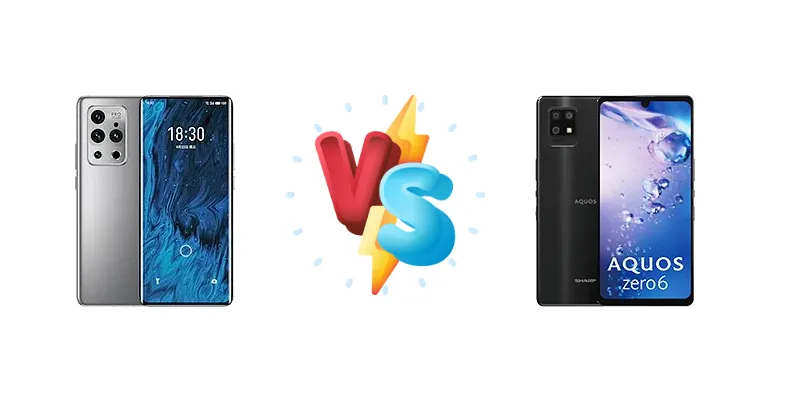
|
🏆 Quick Verdict
The Meizu 18s Pro is the clear performance winner thanks to its Snapdragon 888+ chipset. However, the Sharp Aquos zero6 offers a more refined software experience and potentially better camera optimization. Ultimately, the choice depends on your priorities: raw power or a polished, streamlined experience.
| PHONES | ||
|---|---|---|
| Phone Names | Meizu 18s Pro | Sharp Aquos zero6 |
| Network | ||
|---|---|---|
| 2G bands | GSM 850 / 900 / 1800 / 1900 | GSM 850 / 900 / 1800 / 1900 |
| 3G bands | HSDPA 850 / 900 / 1700(AWS) / 1900 / 2100 | HSDPA 900 / 2100 |
| 4G bands | 1, 2, 3, 4, 5, 7, 8, 12, 34, 38, 39, 40, 41 | 1, 3, 7, 8, 28, 38, 41 |
| 5G bands | 1, 3, 41, 77, 78, 79 SA/NSA | 1, 3, 28, 78, 257 SA/NSA/mmWave |
| Speed | HSPA, LTE, 5G | HSPA, LTE, 5G |
| Technology | GSM / HSPA / LTE / 5G | GSM / HSPA / LTE / 5G |
| Launch | ||
|---|---|---|
| Announced | 2021, September 22. Released 2021, September 23 | 2021, October 14. Released 2021, October 14 |
| Status | Discontinued | Discontinued |
| Body | ||
|---|---|---|
| Dimensions | 162.5 x 73 x 8.1 mm (6.40 x 2.87 x 0.32 in) | 158 x 73 x 7.9 mm (6.22 x 2.87 x 0.31 in) |
| SIM | Nano-SIM + Nano-SIM | Nano-SIM + eSIM |
| Weight | 189 g (6.67 oz) | 146 g (5.15 oz) |
| Waterproof | IPX5/IP6X/IPX8 water/dust resistant (up to 1.5m for 30 min) | |
| Display | ||
|---|---|---|
| Protection | Corning Gorilla Glass 6 | Corning Gorilla Glass Victus |
| Resolution | 1440 x 3200 pixels, 20:9 ratio (~526 ppi density) | 1080 x 2340 pixels, 19.5:9 ratio (~403 ppi density) |
| Size | 6.7 inches, 107.6 cm2 (~90.7% screen-to-body ratio) | 6.4 inches, 100.5 cm2 (~87.2% screen-to-body ratio) |
| Type | Super AMOLED, 120Hz, HDR10+, 420 nits (typ), 1300 nits (peak) | OLED, 1B colors, 240Hz |
| Platform | ||
|---|---|---|
| CPU | Octa-core (1x3.0 GHz Cortex-X1 & 3x2.42 GHz Cortex-A78 & 4x1.80 GHz Cortex-A55) | Octa-core (2x2.2 GHz Kryo 570 & 6x1.8 GHz Kryo 570) |
| Chipset | Qualcomm SM8350 Snapdragon 888+ 5G (5 nm) | Qualcomm SM7225 Snapdragon 750G 5G (8 nm) |
| GPU | Adreno 660 | Adreno 619 |
| OS | Android 11, Flyme 9.2 | Android 11 |
| Memory | ||
|---|---|---|
| Card slot | No | microSDXC |
| Internal | 128GB 8GB RAM, 256GB 8GB RAM, 256GB 12GB RAM | 128GB 8GB RAM |
| UFS 3.1 | - | |
| Main Camera | ||
|---|---|---|
| Features | LED flash, HDR, panorama | LED flash, HDR, panorama |
| Triple | 50 MP, f/1.9, 23mm (wide), 1/1.31", 1.2µm, dual pixel PDAF, OIS 8 MP f/2.4, 79mm (telephoto), 1/4.4", 1.0µm, PDAF, 3x optical zoom 32 MP, f/2.2, 15mm, 130˚ (ultrawide), 1/2.8", 0.8µm 0.3 MP, TOF 3D, f/1.4, (depth) | 48 MP, f/1.8, (wide), AF 8 MP, f/2.4, (telephoto), AF, 2x optical zoom 8 MP, f/2.4, 120˚ (ultrawide) TOF 3D (depth) |
| Video | 8K, 4K@30/60fps, 1080p; gyro-EIS, HDR | 1080p@30fps |
| Selfie camera | ||
|---|---|---|
| Features | HDR | - |
| Single | 44 MP, f/2.4, (wide), 1/2.65”, 0.7µm | 12.6 MP |
| Video | 4K@30fps, 1080p@30fps | 1080p@30fps |
| Sound | ||
|---|---|---|
| 3.5mm jack | No | Yes |
| 35mm jack | No | Yes |
| Loudspeaker | Yes, with stereo speakers | Yes |
| Comms | ||
|---|---|---|
| Bluetooth | 5.2, A2DP, LE | 5.1, A2DP, LE |
| NFC | Yes | Yes |
| Positioning | GPS (L1+L5), GLONASS, BDS, GALILEO, QZSS | GPS, GLONASS, BDS, GALILEO, QZSS |
| Radio | No | No |
| USB | USB Type-C | USB Type-C |
| WLAN | Wi-Fi 802.11 а/b/g/n/ac/6e, dual-band, Wi-Fi Direct | Wi-Fi 802.11 a/b/g/n/ac, dual-band, Wi-Fi Direct |
| Features | ||
|---|---|---|
| Sensors | Fingerprint (under display, ultrasonic), accelerometer, gyro, proximity, compass | Fingerprint (under display, optical), accelerometer |
| Battery | ||
|---|---|---|
| Charging | 40W wired, PD3.0, QC4, 40% in 15 min, 100% in 55 min 40W wireless 10W reverse wireless | - |
| Type | Li-Po 4500 mAh | Li-Ion 4010 mAh |
| Misc | ||
|---|---|---|
| Colors | Blue, White, Gray | Swan Black |
| Models | M192Q | - |
| Price | About 610 EUR | About 400 EUR |
Meizu 18s Pro
- Flagship Snapdragon 888+ performance
- Fast 40W wired & wireless charging
- Potentially higher refresh rate display
- Premium build quality
- Software support may be limited compared to larger brands
- Availability can be challenging
- Camera optimization might not be as refined as some competitors
Sharp Aquos zero6
- Sleek, near bezel-less design
- Clean and optimized software experience
- Reputable camera performance
- Premium feel
- Mid-range Snapdragon 750G chipset
- Slower charging speeds
- Less powerful than the Meizu 18s Pro
Display Comparison
Both phones feature OLED displays, but the Meizu 18s Pro likely has a higher refresh rate (potentially 120Hz) for smoother scrolling and animations. The Aquos zero6 is known for its near bezel-less design and vibrant colors. Expect excellent viewing experiences on both, but the Meizu might edge out the Aquos in terms of responsiveness.
Camera Comparison
The Aquos zero6 is often praised for its image processing and natural-looking photos. While the Meizu 18s Pro has a powerful processor to support advanced camera features, the Aquos' software optimization might give it an edge in everyday photography. Both likely offer versatile camera setups, but real-world testing is needed for a definitive verdict.
Performance
This is where the Meizu 18s Pro truly shines. The Snapdragon 888+ is a flagship chipset, significantly outperforming the Snapdragon 750G in the Aquos zero6. Expect faster app loading, smoother multitasking, and significantly better gaming performance on the Meizu.
Battery Life
The Meizu 18s Pro's 40W wired and wireless charging is a significant advantage. The Aquos zero6 likely has a decent battery life, but the Meizu's faster charging speeds will be a boon for users who need to top up quickly.
Buying Guide
The Meizu 18s Pro is ideal for gamers, power users, and those who demand top-tier performance. The Sharp Aquos zero6 is a great choice for users who prioritize a clean UI, a premium design, and a reliable camera experience, even if it sacrifices some processing power.