
Meizu 18s Pro vs Oppo Find X3 Pro: A Detailed Showdown
| Phones Images | |||||
|---|---|---|---|---|---|
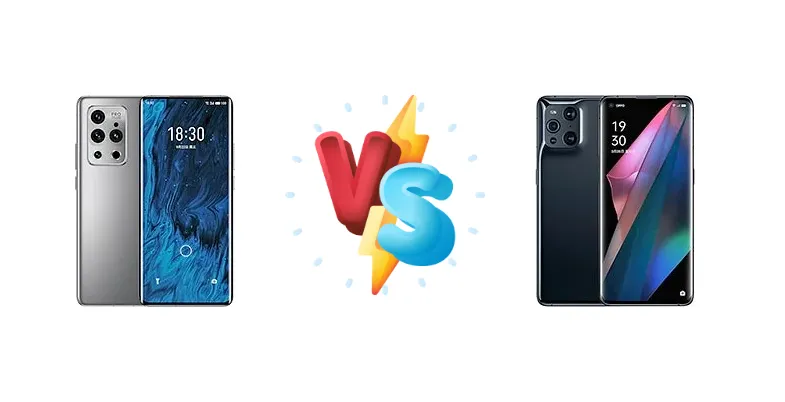
|
🏆 Quick Verdict
The Oppo Find X3 Pro edges out the Meizu 18s Pro thanks to its faster charging, potentially superior camera system (based on reputation), and slightly more refined software experience. However, the Meizu offers a compelling alternative with its Snapdragon 888+ and sleek design, especially for those seeking a less mainstream option.
| PHONES | ||
|---|---|---|
| Phone Names | Meizu 18s Pro | Oppo Find X3 Pro |
| Network | ||
|---|---|---|
| 2G bands | GSM 850 / 900 / 1800 / 1900 | GSM 850 / 900 / 1800 / 1900 |
| 3G bands | HSDPA 850 / 900 / 1700(AWS) / 1900 / 2100 | HSDPA 800 / 850 / 900 / 1700(AWS) / 1900 / 2100 |
| 4G bands | 1, 2, 3, 4, 5, 7, 8, 12, 34, 38, 39, 40, 41 | 1, 2, 3, 4, 5, 7, 8, 12, 13, 17, 18, 19, 20, 25, 26, 28, 32, 34, 38, 39, 40, 41, 42, 66 - International |
| 5G bands | 1, 3, 41, 77, 78, 79 SA/NSA | 1, 3, 5, 7, 8, 20, 28, 38, 40, 41, 77, 78, 79 SA/NSA - International |
| Speed | HSPA, LTE, 5G | HSPA, LTE, 5G |
| Technology | GSM / HSPA / LTE / 5G | GSM / CDMA / HSPA / CDMA2000 / LTE / 5G |
| - | 1, 2, 3, 5, 7, 8, 12, 20, 28, 38, 40, 41, 66, 77, 78, 79 SA/NSA - China | |
| Launch | ||
|---|---|---|
| Announced | 2021, September 22. Released 2021, September 23 | 2021, March 11 |
| Status | Discontinued | Available. Released 2021, March 19 |
| Body | ||
|---|---|---|
| Build | - | Glass front (Gorilla Glass 5), glass back (Gorilla Glass 5), aluminum frame |
| Dimensions | 162.5 x 73 x 8.1 mm (6.40 x 2.87 x 0.32 in) | 163.6 x 74 x 8.3 mm (6.44 x 2.91 x 0.33 in) |
| SIM | Nano-SIM + Nano-SIM | Nano-SIM + eSIM |
| Weight | 189 g (6.67 oz) | 193 g (6.81 oz) |
| Waterproof | IP68 dust/water resistant (up to 1.5m for 30 min) | |
| Display | ||
|---|---|---|
| Protection | Corning Gorilla Glass 6 | Corning Gorilla Glass 5 |
| Resolution | 1440 x 3200 pixels, 20:9 ratio (~526 ppi density) | 1440 x 3216 pixels, 20:9 ratio (~525 ppi density) |
| Size | 6.7 inches, 107.6 cm2 (~90.7% screen-to-body ratio) | 6.7 inches, 108.4 cm2 (~89.6% screen-to-body ratio) |
| Type | Super AMOLED, 120Hz, HDR10+, 420 nits (typ), 1300 nits (peak) | LTPO AMOLED, 1B colors, 120Hz, HDR10+, BT.2020, 500 nits (typ), 1300 nits (peak) |
| Platform | ||
|---|---|---|
| CPU | Octa-core (1x3.0 GHz Cortex-X1 & 3x2.42 GHz Cortex-A78 & 4x1.80 GHz Cortex-A55) | Octa-core (1x2.84 GHz Cortex-X1 & 3x2.42 GHz Cortex-A78 & 4x1.80 GHz Cortex-A55) |
| Chipset | Qualcomm SM8350 Snapdragon 888+ 5G (5 nm) | Qualcomm SM8350 Snapdragon 888 5G (5 nm) |
| GPU | Adreno 660 | Adreno 660 |
| OS | Android 11, Flyme 9.2 | Android 11, upgradable to Android 14, ColorOS 14 |
| Memory | ||
|---|---|---|
| Card slot | No | No |
| Internal | 128GB 8GB RAM, 256GB 8GB RAM, 256GB 12GB RAM | 256GB 8GB RAM, 256GB 12GB RAM, 512GB 16GB RAM |
| UFS 3.1 | UFS 3.1 | |
| Main Camera | ||
|---|---|---|
| Features | LED flash, HDR, panorama | Color spectrum sensor, LED flash, HDR, panorama |
| Quad | - | 50 MP, f/1.8, 26mm (wide), 1/1.56", 1.0µm, multi-directional PDAF, OIS 13 MP, f/2.4, 52mm (telephoto), 1/3.4", 1.0µm, 2x optical zoom, PDAF 50 MP, f/2.2, 16mm, 110˚ (ultrawide), 1/1.56", 1.0µm, multi-directional PDAF 3 MP, f/3.0, (microscope), AF, ring flash, 60x magnification |
| Triple | 50 MP, f/1.9, 23mm (wide), 1/1.31", 1.2µm, dual pixel PDAF, OIS 8 MP f/2.4, 79mm (telephoto), 1/4.4", 1.0µm, PDAF, 3x optical zoom 32 MP, f/2.2, 15mm, 130˚ (ultrawide), 1/2.8", 0.8µm 0.3 MP, TOF 3D, f/1.4, (depth) | - |
| Video | 8K, 4K@30/60fps, 1080p; gyro-EIS, HDR | 4K@30/60fps, 1080p@30/60/240fps; gyro-EIS; HDR, 10‑bit video |
| Selfie camera | ||
|---|---|---|
| Features | HDR | Panorama |
| Single | 44 MP, f/2.4, (wide), 1/2.65”, 0.7µm | 32 MP, f/2.4, 26mm (wide), 1/2.8", 0.8µm |
| Video | 4K@30fps, 1080p@30fps | 1080p@30fps |
| Sound | ||
|---|---|---|
| 3.5mm jack | No | No |
| 35mm jack | No | No |
| Loudspeaker | Yes, with stereo speakers | Yes, with stereo speakers |
| Comms | ||
|---|---|---|
| Bluetooth | 5.2, A2DP, LE | 5.2, A2DP, LE, aptX HD |
| NFC | Yes | Yes |
| Positioning | GPS (L1+L5), GLONASS, BDS, GALILEO, QZSS | GPS (L1+L5), GLONASS (L1), BDS (B1I+B1c+B2a), GALILEO (E1+E5a), QZSS (L1+L5) |
| Radio | No | No |
| USB | USB Type-C | USB Type-C 3.1, OTG |
| WLAN | Wi-Fi 802.11 а/b/g/n/ac/6e, dual-band, Wi-Fi Direct | Wi-Fi 802.11 a/b/g/n/ac/6, dual-band, Wi-Fi Direct |
| Features | ||
|---|---|---|
| Sensors | Fingerprint (under display, ultrasonic), accelerometer, gyro, proximity, compass | Fingerprint (under display, optical), accelerometer, gyro, proximity, compass |
| Battery | ||
|---|---|---|
| Charging | 40W wired, PD3.0, QC4, 40% in 15 min, 100% in 55 min 40W wireless 10W reverse wireless | 65W wired, PD, 40% in 10 min 30W wireless, 100% in 80 min 10W reverse wireless |
| Type | Li-Po 4500 mAh | Li-Po 4500 mAh |
| Misc | ||
|---|---|---|
| Colors | Blue, White, Gray | Gloss Black, Blue, White, Cosmic Mocha, Mars Edition, Photographer Edition |
| Models | M192Q | CPH2173, PEEM00, OPG03 |
| Price | About 610 EUR | About 200 EUR |
| Tests | ||
|---|---|---|
| Battery life | - | Endurance rating 81h |
| Camera | - | Photo / Video |
| Display | - | Contrast ratio: Infinite (nominal) |
| Loudspeaker | - | -25.4 LUFS (Very good) |
| Performance | - | AnTuTu: 656467 (v8) GeekBench: 3316 (v5.1) GFXBench: 33fps (ES 3.1 onscreen) |
Meizu 18s Pro
- Snapdragon 888+ for slightly better performance
- Sleek and minimalist design
- Clean Android experience
- 40W wireless charging
- Camera potentially not as versatile as Oppo
- Slower charging speeds compared to Oppo
- Less mainstream brand
Oppo Find X3 Pro
- Faster 65W wired charging and 30W wireless charging
- Potentially superior camera system
- Excellent display with high peak brightness
- Feature-rich software experience
- Can be more expensive
- Software can feel bloated to some users
- Design less unique than Meizu
Display Comparison
Both phones feature excellent AMOLED displays, but the Oppo Find X3 Pro boasts a slightly higher measured peak brightness (774 nits vs unspecified for Meizu). The Find X3 Pro's 'Infinite' contrast ratio suggests deeper blacks and richer colors, though this is a nominal value. Meizu's display is likely very good, but Oppo has a slight edge in measured performance.
Camera Comparison
The Oppo Find X3 Pro is generally considered to have a more versatile and well-regarded camera system. While both offer excellent photo and video capabilities, the Find X3 Pro's hardware and software processing are often praised for their consistency and image quality across different scenarios. Meizu's camera is still very capable, but likely doesn't match the Find X3 Pro's overall performance.
Performance
The Meizu 18s Pro holds a slight advantage here. It utilizes the Snapdragon 888+ chipset, a slightly overclocked version of the Snapdragon 888 found in the Oppo Find X3 Pro. This translates to marginally better CPU and GPU performance, particularly noticeable in demanding games and multitasking. Both phones offer flagship-level performance, however.
Battery Life
The Oppo Find X3 Pro wins decisively in this category. Its endurance rating of 81 hours is significantly higher than what's typically expected. Coupled with its 65W wired charging (40% in 10 minutes) and 30W wireless charging, it offers a superior charging experience compared to the Meizu 18s Pro's 40W wired and wireless charging.
Buying Guide
The Meizu 18s Pro is ideal for users who appreciate a minimalist design, a clean Android experience, and a powerful processor. The Oppo Find X3 Pro is a better choice for those prioritizing fast charging, a versatile camera system, and a more feature-rich software experience.