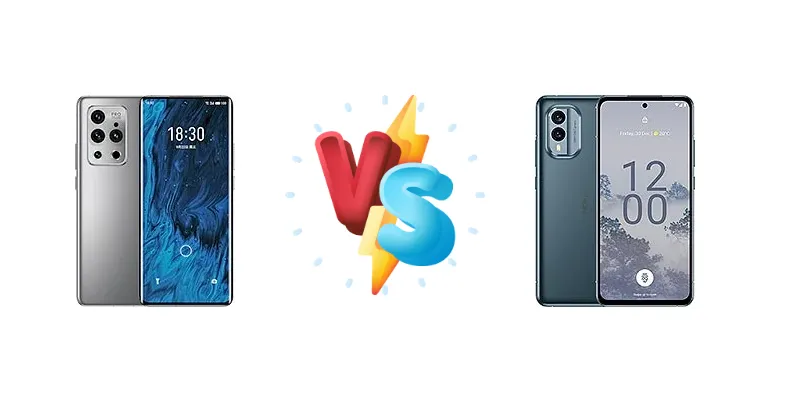
The smartphone market is overflowing with options, making it tough to choose. Today, we're pitting two distinct contenders against each other: the Meizu 18s Pro, boasting flagship power, and the Nokia X30, emphasizing sustainability and long battery life. Let's dive into a comprehensive comparison to see which phone emerges victorious.
🏆 Quick Verdict
The Meizu 18s Pro delivers significantly superior performance thanks to its Snapdragon 888+ chipset. However, the Nokia X30 shines with exceptional battery endurance and a focus on eco-friendly materials. For power users, the Meizu wins; for those prioritizing longevity and sustainability, the Nokia X30 is the better choice.
| Network |
|---|
| 2G bands | GSM 850 / 900 / 1800 / 1900 | GSM 850 / 900 / 1800 / 1900 |
| 3G bands | HSDPA 850 / 900 / 1700(AWS) / 1900 / 2100 | HSDPA 850 / 900 / 1700(AWS) / 1900 / 2100 |
| 4G bands | 1, 2, 3, 4, 5, 7, 8, 12, 34, 38, 39, 40, 41 | 1, 2, 3, 4, 5, 7, 8, 12, 17, 20, 28, 32, 38, 39, 40, 41 |
| 5G bands | 1, 3, 41, 77, 78, 79 SA/NSA | 1, 3, 5, 7, 8, 28, 38, 40, 41, 77, 78 SA/NSA/Sub6 |
| Speed | HSPA, LTE, 5G | HSPA, LTE, 5G |
| Technology | GSM / HSPA / LTE / 5G | GSM / HSPA / LTE / 5G |
| Launch |
|---|
| Announced | 2021, September 22. Released 2021, September 23 | 2022, September 01 |
| Status | Discontinued | Available. Released 2022, September 21 |
| Body |
|---|
| Build | - | Glass front (Gorilla Glass Victus), aluminum frame, plastic back |
| Dimensions | 162.5 x 73 x 8.1 mm (6.40 x 2.87 x 0.32 in) | 158.9 x 73.9 x 8 mm (6.26 x 2.91 x 0.31 in) |
| SIM | Nano-SIM + Nano-SIM | · Nano-SIM + eSIM· Nano-SIM + Nano-SIM |
| Weight | 189 g (6.67 oz) | 185 g (6.53 oz) |
| | Waterproof | IP67 dust/water resistant (up to 1m for 30 min) |
| Display |
|---|
| Protection | Corning Gorilla Glass 6 | Corning Gorilla Glass Victus |
| Resolution | 1440 x 3200 pixels, 20:9 ratio (~526 ppi density) | 1080 x 2400 pixels, 20:9 ratio (~409 ppi density) |
| Size | 6.7 inches, 107.6 cm2 (~90.7% screen-to-body ratio) | 6.43 inches, 99.8 cm2 (~85.0% screen-to-body ratio) |
| Type | Super AMOLED, 120Hz, HDR10+, 420 nits (typ), 1300 nits (peak) | AMOLED, 90Hz, 450 nits (typ), 700 nits (peak) |
| Platform |
|---|
| CPU | Octa-core (1x3.0 GHz Cortex-X1 & 3x2.42 GHz Cortex-A78 & 4x1.80 GHz Cortex-A55) | Octa-core (2x2.2 GHz Kryo 660 Gold & 6x1.7 GHz Kryo 660 Silver) |
| Chipset | Qualcomm SM8350 Snapdragon 888+ 5G (5 nm) | Qualcomm SM6375 Snapdragon 695 5G (6 nm) |
| GPU | Adreno 660 | Adreno 619 |
| OS | Android 11, Flyme 9.2 | Android 12, upgradable to Android 13 |
| Memory |
|---|
| Card slot | No | No |
| Internal | 128GB 8GB RAM, 256GB 8GB RAM, 256GB 12GB RAM | 128GB 6GB RAM, 128GB 8GB RAM, 256GB 8GB RAM |
| | UFS 3.1 | UFS 2.2 - 128GB
UFS 3.0 - 256GB |
| Main Camera |
|---|
| Dual | - | 50 MP, f/1.9, (wide), 1/1.56", 1.0µm, PDAF, OIS
13 MP, f/2.4, 123˚ (ultrawide), 1/3.06" |
| Features | LED flash, HDR, panorama | LED flash, HDR, panorama |
| Single | - | 16 MP, f/2.4, (wide), 1/3.06", 1.0µm |
| Triple | 50 MP, f/1.9, 23mm (wide), 1/1.31", 1.2µm, dual pixel PDAF, OIS
8 MP f/2.4, 79mm (telephoto), 1/4.4", 1.0µm, PDAF, 3x optical zoom
32 MP, f/2.2, 15mm, 130˚ (ultrawide), 1/2.8", 0.8µm
0.3 MP, TOF 3D, f/1.4, (depth) | - |
| Video | 8K, 4K@30/60fps, 1080p; gyro-EIS, HDR | 1080p@30/60fps |
| Selfie camera |
|---|
| Features | HDR | - |
| Single | 44 MP, f/2.4, (wide), 1/2.65”, 0.7µm | 16 MP, f/2.4, (wide), 1/3.06", 1.0µm |
| Video | 4K@30fps, 1080p@30fps | 1080p@30fps |
| Sound |
|---|
| 3.5mm jack | No | No |
| 35mm jack | No | No |
| Loudspeaker | Yes, with stereo speakers | Yes |
| Comms |
|---|
| Bluetooth | 5.2, A2DP, LE | 5.1, A2DP, LE, aptX HD |
| NFC | Yes | Yes |
| Positioning | GPS (L1+L5), GLONASS, BDS, GALILEO, QZSS | GPS, GLONASS, GALILEO, BDS |
| Radio | No | FM radio, RDS |
| USB | USB Type-C | USB Type-C 2.0, OTG |
| WLAN | Wi-Fi 802.11 а/b/g/n/ac/6e, dual-band, Wi-Fi Direct | Wi-Fi 802.11 a/b/g/n/ac/6, dual-band, Wi-Fi Direct |
| Features |
|---|
| Sensors | Fingerprint (under display, ultrasonic), accelerometer, gyro, proximity, compass | Fingerprint (under display, optical), accelerometer, gyro, proximity, compass |
| Battery |
|---|
| Charging | 40W wired, PD3.0, QC4, 40% in 15 min, 100% in 55 min
40W wireless
10W reverse wireless | 33W wired, PD3.0 |
| Type | Li-Po 4500 mAh | Li-Po 4200 mAh |
| Misc |
|---|
| Colors | Blue, White, Gray | Cloudy Blue, Ice White |
| Models | M192Q | TA-1450, TA-1443 |
| Price | About 610 EUR | $ 399.00 |
| SAR EU | - | 0.79 W/kg (head) 1.37 W/kg (body) |
| Tests |
|---|
| Battery life | - |
Endurance rating 94h
|
| Camera | - |
Photo / Video |
| Display | - |
Contrast ratio: Infinite (nominal) |
| Loudspeaker | - |
-27.5 LUFS (Good)
|
| Performance | - |
AnTuTu: 403732 (v9)
GeekBench: 1920 (v5.1)
GFXBench: 17fps (ES 3.1 onscreen) |
Meizu 18s Pro
- Flagship Snapdragon 888+ performance
- Fast 40W wired & wireless charging
- Likely vibrant AMOLED display
- Potentially superior camera system
- Battery life likely shorter than Nokia X30
- Meizu's software support can be inconsistent
- Availability may be limited
Nokia X30
- Exceptional 94-hour battery life
- Sustainable design and materials
- Clean Android experience
- Bright display (746 nits)
- Mid-range Snapdragon 695 performance
- Less powerful camera system
- Slower charging speeds
- May lack high refresh rate display
Display Comparison
The Meizu 18s Pro likely features a vibrant AMOLED display with a high refresh rate (likely 120Hz, based on similar Meizu models), offering smoother visuals and deeper blacks. The Nokia X30 boasts a bright display (746 nits measured) and an 'infinite' contrast ratio, suggesting good image quality, but likely lacks the high refresh rate of the Meizu. The Meizu's display will likely be more visually impressive overall.
Camera Comparison
Both phones offer 'Photo / Video' capabilities, but specifics are lacking. The Meizu 18s Pro likely has a more advanced camera system with higher resolution sensors and potentially more features like optical image stabilization (OIS). The Nokia X30 is expected to deliver reliable image quality, but likely won't match the Meizu's potential for detail and dynamic range.
Performance
This is where the Meizu 18s Pro truly shines. The Snapdragon 888+ is a flagship chipset, providing significantly faster processing speeds and better graphics performance than the Nokia X30's Snapdragon 695. Expect smoother multitasking, faster app loading, and a much better gaming experience on the Meizu.
Battery Life
The Nokia X30's standout feature is its exceptional battery life, boasting an endurance rating of 94 hours. The Meizu 18s Pro, while offering 40W wired and wireless charging, likely has a smaller battery capacity and won't match the Nokia's longevity. The Nokia X30 is the clear winner in this category.
Buying Guide
Who should buy the Meizu 18s Pro? Gamers, power users, and anyone demanding top-tier performance and fast charging. Who should buy the Nokia X30? Eco-conscious consumers, those prioritizing long battery life, and users seeking a reliable, durable device with a clean Android experience.
Frequently Asked Questions
❓ Is the Meizu 18s Pro worth the extra cost?
If performance is your top priority, the Meizu 18s Pro's Snapdragon 888+ makes it worth the investment. However, if you value battery life and sustainability, the Nokia X30 offers excellent value.
❓ Does the Nokia X30 receive timely software updates?
Nokia is generally known for providing consistent and timely software updates, which is a significant advantage for long-term device security and functionality.