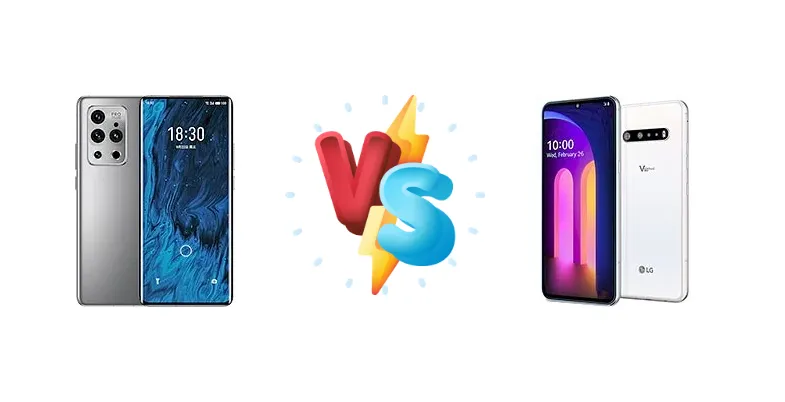
The smartphone landscape is constantly evolving, and choosing the right device can be overwhelming. Today, we pit two intriguing contenders against each other: the Meizu 18s Pro, known for its sleek design and powerful internals, and the LG V60 ThinQ 5G UW, a durable device with a focus on multimedia and camera versatility. Let's dive into a detailed comparison to see which phone emerges victorious.
🏆 Quick Verdict
The Meizu 18s Pro takes the lead with its Snapdragon 888+ chipset, faster charging, and generally more modern features. However, the LG V60 ThinQ 5G UW offers a more robust build quality and a headphone jack, appealing to users prioritizing those aspects. It's a close call, but the 18s Pro offers a more compelling overall package.
| Network |
|---|
| 2G bands | GSM 850 / 900 / 1800 / 1900 | GSM 850 / 900 / 1800 / 1900 |
| 3G bands | HSDPA 850 / 900 / 1700(AWS) / 1900 / 2100 | HSDPA 850 / 900 / 1700(AWS) / 1900 / 2100 |
| 4G bands | 1, 2, 3, 4, 5, 7, 8, 12, 34, 38, 39, 40, 41 | 2, 3, 4, 5, 7, 12, 13, 20, 28, 46, 48, 66 |
| 5G bands | 1, 3, 41, 77, 78, 79 SA/NSA | 260, 261 mmWave |
| Speed | HSPA, LTE, 5G | HSPA 42.2/5.76 Mbps, LTE (7CA) Cat22, 5G |
| Technology | GSM / HSPA / LTE / 5G | GSM / CDMA / HSPA / EVDO / LTE / 5G |
| | - | CDMA2000 1xEV-DO |
| Launch |
|---|
| Announced | 2021, September 22. Released 2021, September 23 | 2020, February 26. Released 2020, April 02 |
| Status | Discontinued | Discontinued |
| Body |
|---|
| Build | - | Glass front (Gorilla Glass 5), glass back (Gorilla Glass 6), aluminum frame |
| Dimensions | 162.5 x 73 x 8.1 mm (6.40 x 2.87 x 0.32 in) | 169.3 x 77.6 x 8.9 mm (6.67 x 3.06 x 0.35 in) |
| SIM | Nano-SIM + Nano-SIM | Nano-SIM (pre-installed) |
| Weight | 189 g (6.67 oz) | 218 g (7.69 oz) |
| | Waterproof | IP68 dust/water resistant (up to 1.5m for 30 min)
MIL-STD-810G compliant*
Method 516.6, Procedure IV "Transit Drop"
*does not guarantee ruggedness or use in extreme conditions |
| Display |
|---|
| Protection | Corning Gorilla Glass 6 | Corning Gorilla Glass 5 |
| Resolution | 1440 x 3200 pixels, 20:9 ratio (~526 ppi density) | 1080 x 2460 pixels (~395 ppi density) |
| Size | 6.7 inches, 107.6 cm2 (~90.7% screen-to-body ratio) | 6.8 inches, 109.8 cm2 (~83.6% screen-to-body ratio) |
| Type | Super AMOLED, 120Hz, HDR10+, 420 nits (typ), 1300 nits (peak) | P-OLED, HDR10+ |
| | - | Always-on display |
| Platform |
|---|
| CPU | Octa-core (1x3.0 GHz Cortex-X1 & 3x2.42 GHz Cortex-A78 & 4x1.80 GHz Cortex-A55) | Octa-core (1x2.84 GHz Cortex-A77 & 3x2.42 GHz Cortex-A77 & 4x1.80 GHz Cortex-A55) |
| Chipset | Qualcomm SM8350 Snapdragon 888+ 5G (5 nm) | Qualcomm SM8250 Snapdragon 865 5G (7 nm+) |
| GPU | Adreno 660 | Adreno 650 |
| OS | Android 11, Flyme 9.2 | Android 10, upgradable to Android 13 |
| Memory |
|---|
| Card slot | No | microSDXC (uses shared SIM slot) - dual-SIM model |
| Internal | 128GB 8GB RAM, 256GB 8GB RAM, 256GB 12GB RAM | 128GB 8GB RAM |
| | UFS 3.1 | UFS 2.1 |
| Main Camera |
|---|
| Dual | - | 64 MP, f/1.8, 27mm (standard), 1/1.72", 0.8µm, dual pixel PDAF, OIS
13 MP, f/1.9, 12mm (ultrawide), 1/3.4", 1.0µm
0.3 MP, TOF 3D, f/1.4, (depth) |
| Features | LED flash, HDR, panorama | Dual-LED dual-tone flash, HDR, panorama |
| Triple | 50 MP, f/1.9, 23mm (wide), 1/1.31", 1.2µm, dual pixel PDAF, OIS
8 MP f/2.4, 79mm (telephoto), 1/4.4", 1.0µm, PDAF, 3x optical zoom
32 MP, f/2.2, 15mm, 130˚ (ultrawide), 1/2.8", 0.8µm
0.3 MP, TOF 3D, f/1.4, (depth) | - |
| Video | 8K, 4K@30/60fps, 1080p; gyro-EIS, HDR | 8K@30fps, 4K@30/60fps, 1080p, HDR10+, 24-bit/192kHz stereo sound rec., gyro-EIS |
| Selfie camera |
|---|
| Features | HDR | HDR |
| Single | 44 MP, f/2.4, (wide), 1/2.65”, 0.7µm | 10 MP, f/1.9, 30mm (standard), 1/3.1", 1.22µm |
| Video | 4K@30fps, 1080p@30fps | 4K@30fps, gyro-EIS |
| Sound |
|---|
| 3.5mm jack | No | Yes |
| 35mm jack | No | Yes |
| Loudspeaker | Yes, with stereo speakers | Yes, with stereo speakers |
| | - | 32-bit/192kHz audio
24-bit/192kHz audio recording |
| Comms |
|---|
| Bluetooth | 5.2, A2DP, LE | 5.1, A2DP, LE, aptX HD |
| NFC | Yes | Yes |
| Positioning | GPS (L1+L5), GLONASS, BDS, GALILEO, QZSS | GPS, GLONASS, GALILEO, BDS |
| Radio | No | FM radio (USA model only) |
| USB | USB Type-C | USB Type-C 3.1, OTG |
| WLAN | Wi-Fi 802.11 а/b/g/n/ac/6e, dual-band, Wi-Fi Direct | Wi-Fi 802.11 a/b/g/n/ac/6, dual-band, Wi-Fi Direct, DLNA |
| Features |
|---|
| Sensors | Fingerprint (under display, ultrasonic), accelerometer, gyro, proximity, compass | Fingerprint (under display, optical), accelerometer, gyro, proximity, compass, barometer |
| Battery |
|---|
| Charging | 40W wired, PD3.0, QC4, 40% in 15 min, 100% in 55 min
40W wireless
10W reverse wireless | Wired, PD2.0, QC4
Wireless |
| Type | Li-Po 4500 mAh | Li-Po 5000 mAh |
| Misc |
|---|
| Colors | Blue, White, Gray | Classy Blue, Classy White |
| Models | M192Q | LM-V600VML, LMV600VML |
| Price | About 610 EUR | About 870 EUR |
| SAR | - | 0.85 W/kg (head) 1.12 W/kg (body) |
Meizu 18s Pro
- Superior Performance (Snapdragon 888+)
- Faster Charging (40W wired/wireless)
- Likely Higher Refresh Rate Display
- Sleek Design
- Potentially Less Durable Build
- Meizu's Software Support History (can be inconsistent)
- No Headphone Jack
LG V60 ThinQ 5G UW
- Durable Build Quality
- Headphone Jack
- Excellent Video Recording Capabilities
- Larger Display
- Slower Charging
- Older Processor (Snapdragon 865)
- Lower Refresh Rate Display
- LG's Exit from the Smartphone Market (potential support concerns)
Display Comparison
The Meizu 18s Pro boasts a likely AMOLED display with a higher refresh rate (estimated 120Hz) offering smoother visuals and vibrant colors. The LG V60 ThinQ 5G UW features a 6.8-inch OLED display, known for its accurate colors and brightness, but likely at a standard 60Hz refresh rate. The larger size of the V60 might be preferable for some.
Camera Comparison
The LG V60 ThinQ 5G UW is renowned for its versatile camera system, particularly its video recording capabilities. It offers a triple-lens setup with a focus on detail and stabilization. The Meizu 18s Pro likely features a competitive camera setup, but detailed comparisons require more testing. The V60's camera is generally considered more mature and refined.
Performance
The Snapdragon 888+ in the Meizu 18s Pro provides a significant performance advantage over the Snapdragon 865 in the LG V60. Expect faster app loading times, smoother multitasking, and better gaming performance on the Meizu. Both phones have ample RAM, but the newer chipset makes a noticeable difference.
Battery Life
The Meizu 18s Pro's 40W wired and wireless charging is a major advantage, allowing for significantly faster charging times compared to the LG V60's slower charging speeds. Battery capacity is likely similar, but the faster charging on the Meizu gives it an edge.
Buying Guide
The Meizu 18s Pro is ideal for users seeking top-tier performance, a beautiful display, and fast charging. It's a great choice for gamers and power users. The LG V60 ThinQ 5G UW is best suited for those who value durability, a headphone jack, and a versatile camera system with excellent video recording capabilities. It's a solid option for content creators and multimedia enthusiasts.
Frequently Asked Questions
❓ Does the Meizu 18s Pro have a headphone jack?
No, the Meizu 18s Pro does not have a headphone jack.
❓ Is the LG V60 ThinQ 5G UW still receiving software updates?
LG has discontinued smartphone production, so software updates are unlikely to continue. However, the device will still function on existing networks.