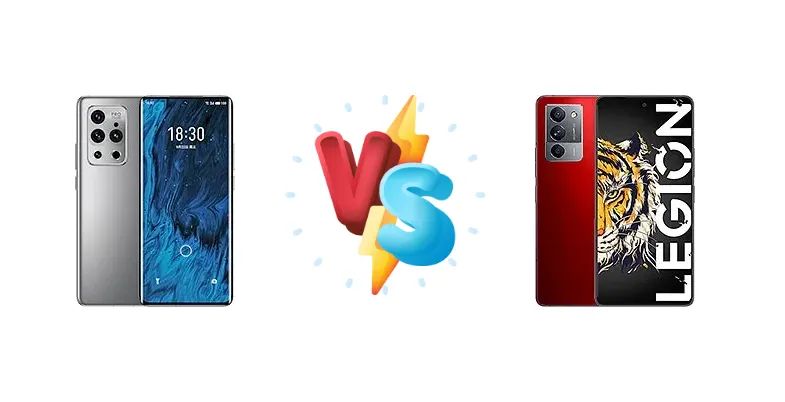
The smartphone market is brimming with options, and choosing the right device can be overwhelming. Today, we're pitting two compelling contenders against each other: the Meizu 18s Pro, known for its sleek design and premium features, and the Lenovo Legion Y70, a gaming-focused powerhouse. Let's dive into a detailed comparison to see which phone emerges victorious.
🏆 Quick Verdict
The Lenovo Legion Y70 takes the crown thanks to its superior Snapdragon 8+ Gen 1 chipset, faster charging, and gaming-centric features. While the Meizu 18s Pro offers a refined design and wireless charging, the Y70's raw power and performance edge make it the better overall choice for most users.
| Network |
|---|
| 2G bands | GSM 850 / 900 / 1800 / 1900 | GSM 850 / 900 / 1800 / 1900 |
| 3G bands | HSDPA 850 / 900 / 1700(AWS) / 1900 / 2100 | HSDPA 800 / 850 / 900 / 1900 / 2100 |
| 4G bands | 1, 2, 3, 4, 5, 7, 8, 12, 34, 38, 39, 40, 41 | LTE |
| 5G bands | 1, 3, 41, 77, 78, 79 SA/NSA | SA/NSA/Sub6 |
| Speed | HSPA, LTE, 5G | HSPA, LTE, 5G |
| Technology | GSM / HSPA / LTE / 5G | GSM / CDMA / HSPA / CDMA2000 / LTE / 5G |
| | - | CDMA2000 1x |
| Launch |
|---|
| Announced | 2021, September 22. Released 2021, September 23 | 2022, August 18 |
| Status | Discontinued | Available. Released 2022, August 23 |
| Body |
|---|
| Build | - | Glass front, aluminum frame |
| Dimensions | 162.5 x 73 x 8.1 mm (6.40 x 2.87 x 0.32 in) | 163.6 x 77 x 8 mm (6.44 x 3.03 x 0.31 in) |
| SIM | Nano-SIM + Nano-SIM | Nano-SIM + Nano-SIM |
| Weight | 189 g (6.67 oz) | 209 g (7.37 oz) |
| | Waterproof | - |
| Display |
|---|
| Protection | Corning Gorilla Glass 6 | - |
| Resolution | 1440 x 3200 pixels, 20:9 ratio (~526 ppi density) | 1080 x 2400 pixels, 20:9 ratio (~395 ppi density) |
| Size | 6.7 inches, 107.6 cm2 (~90.7% screen-to-body ratio) | 6.67 inches, 107.4 cm2 (~85.3% screen-to-body ratio) |
| Type | Super AMOLED, 120Hz, HDR10+, 420 nits (typ), 1300 nits (peak) | OLED, 144Hz, HDR10+, 1000 nits (peak) |
| Platform |
|---|
| CPU | Octa-core (1x3.0 GHz Cortex-X1 & 3x2.42 GHz Cortex-A78 & 4x1.80 GHz Cortex-A55) | Octa-core (1x3.19 GHz Cortex-X2 & 3x2.75 GHz Cortex-A710 & 4x1.80 GHz Cortex-A510) |
| Chipset | Qualcomm SM8350 Snapdragon 888+ 5G (5 nm) | Qualcomm SM8475 Snapdragon 8+ Gen 1 (4 nm) |
| GPU | Adreno 660 | Adreno 730 |
| OS | Android 11, Flyme 9.2 | Android 12, ZUI 14 |
| Memory |
|---|
| Card slot | No | No |
| Internal | 128GB 8GB RAM, 256GB 8GB RAM, 256GB 12GB RAM | 128GB 8GB RAM, 256GB 12GB RAM, 512GB 16GB RAM |
| | UFS 3.1 | UFS 3.1 |
| Main Camera |
|---|
| Features | LED flash, HDR, panorama | Dual-LED flash, panorama, HDR |
| Triple | 50 MP, f/1.9, 23mm (wide), 1/1.31", 1.2µm, dual pixel PDAF, OIS
8 MP f/2.4, 79mm (telephoto), 1/4.4", 1.0µm, PDAF, 3x optical zoom
32 MP, f/2.2, 15mm, 130˚ (ultrawide), 1/2.8", 0.8µm
0.3 MP, TOF 3D, f/1.4, (depth) | 50 MP, (wide), 1/1.55", 1.0µm, PDAF, OIS
13 MP, 120˚ (ultrawide), 1.12µm, AF
Auxiliary lens |
| Video | 8K, 4K@30/60fps, 1080p; gyro-EIS, HDR | 8K@30fps, 4K@30/60fps, 1080p@30/60/240fps, gyro-EIS |
| Selfie camera |
|---|
| Features | HDR | - |
| Single | 44 MP, f/2.4, (wide), 1/2.65”, 0.7µm | 16 MP |
| Video | 4K@30fps, 1080p@30fps | Yes |
| Sound |
|---|
| 3.5mm jack | No | No |
| 35mm jack | No | No |
| Loudspeaker | Yes, with stereo speakers | Yes, with stereo speakers |
| Comms |
|---|
| Bluetooth | 5.2, A2DP, LE | 5.2, A2DP, LE |
| NFC | Yes | Yes |
| Positioning | GPS (L1+L5), GLONASS, BDS, GALILEO, QZSS | GPS (L1+L5), GLONASS, GALILEO, BDS, QZSS |
| Radio | No | No |
| USB | USB Type-C | USB Type-C |
| WLAN | Wi-Fi 802.11 а/b/g/n/ac/6e, dual-band, Wi-Fi Direct | Wi-Fi 802.11 a/b/g/n/ac/6, dual-band, Wi-Fi Direct |
| Features |
|---|
| Sensors | Fingerprint (under display, ultrasonic), accelerometer, gyro, proximity, compass | Fingerprint (side-mounted), accelerometer, gyro, proximity, compass |
| Battery |
|---|
| Charging | 40W wired, PD3.0, QC4, 40% in 15 min, 100% in 55 min
40W wireless
10W reverse wireless | 68W wired, 80% in 34 min |
| Type | Li-Po 4500 mAh | Li-Po 5100 mAh |
| Misc |
|---|
| Colors | Blue, White, Gray | Black, Silver, Red |
| Models | M192Q | L71091 |
| Price | About 610 EUR | About 440 EUR |
Meizu 18s Pro
- Sleek and premium design
- Clean and optimized software
- Wireless charging
- Reverse wireless charging
- Excellent camera (generally)
- Slower charging speed
- Older chipset (Snapdragon 888+)
- Limited availability in some regions
- Missing display resolution details
Lenovo Legion Y70
- Powerful Snapdragon 8+ Gen 1 chipset
- Fast 68W wired charging
- Gaming-focused features (cooling, software)
- High performance
- Likely higher resolution display
- Potentially less refined design compared to Meizu
- Software might be more geared towards gaming
- May lack some of Meizu's premium features
Display Comparison
Both phones feature high-quality AMOLED displays, likely with 120Hz refresh rates (though specific resolution details are missing for Meizu). The Legion Y70's display might offer slightly higher brightness and potentially a higher resolution, catering to its gaming focus. Meizu's display is expected to have accurate color reproduction and a comfortable viewing experience.
Camera Comparison
While specific camera specs are missing for both, the Meizu 18s Pro is generally known for its excellent camera performance, often praised for its image processing. The Legion Y70 likely features a versatile camera system, potentially with a focus on video recording and gaming-specific features. A direct comparison would require detailed camera testing.
Performance
The Lenovo Legion Y70's Snapdragon 8+ Gen 1 is a significant upgrade over the Meizu 18s Pro's Snapdragon 888+. Expect noticeably faster processing speeds, smoother multitasking, and improved graphics performance on the Y70. The Y70's cooling system is also likely more robust, preventing throttling during extended gaming sessions.
Battery Life
The Lenovo Legion Y70's 68W wired charging is considerably faster than the Meizu 18s Pro's 40W. While both offer decent battery life, the Y70's faster charging provides a significant advantage for users who need to top up quickly. The Meizu 18s Pro's wireless charging and reverse wireless charging are nice additions, but don't compensate for the charging speed difference.
Buying Guide
The Meizu 18s Pro is ideal for users who prioritize aesthetics, a clean software experience, and appreciate features like wireless charging. The Lenovo Legion Y70 is the clear winner for gamers and power users who demand top-tier performance and rapid charging capabilities.
Frequently Asked Questions
❓ Is the Snapdragon 8+ Gen 1 significantly better than the Snapdragon 888+?
Yes, the Snapdragon 8+ Gen 1 offers a noticeable performance boost over the 888+, particularly in CPU and GPU performance, and is more power-efficient.
❓ Which phone has better software?
Meizu is known for its Flyme OS, which is generally considered clean and optimized. Lenovo's software might be more focused on gaming features, which could be a pro or con depending on your preferences.