
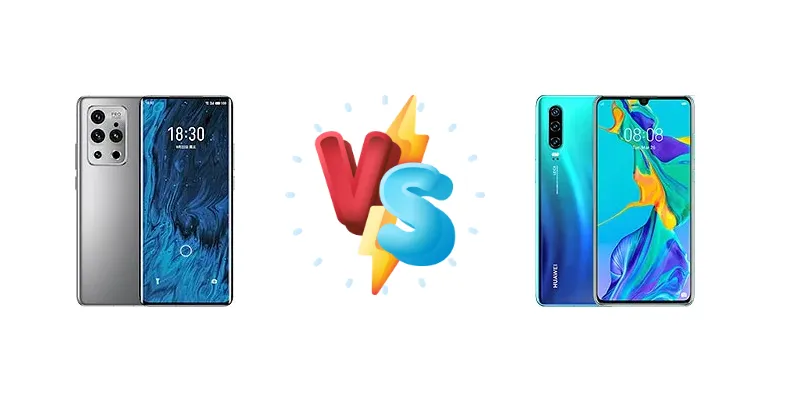
Meizu 18s Pro vs Huawei P30: A Detailed Showdown
| Phones Images | |||||
|---|---|---|---|---|---|
|
🏆 Quick Verdict
The Meizu 18s Pro offers significantly superior performance thanks to its Snapdragon 888+ chipset and faster charging. However, the Huawei P30 shines with its exceptional battery endurance and established camera reputation. Ultimately, the 18s Pro is for power users, while the P30 caters to those prioritizing longevity and photography.
| PHONES | ||
|---|---|---|
| Phone Names | Meizu 18s Pro | Huawei P30 |
| Network | ||
|---|---|---|
| 2G bands | GSM 850 / 900 / 1800 / 1900 | GSM 850 / 900 / 1800 / 1900 |
| 3G bands | HSDPA 850 / 900 / 1700(AWS) / 1900 / 2100 | HSDPA 800 / 850 / 900 / 1700(AWS) / 1900 / 2100 |
| 4G bands | 1, 2, 3, 4, 5, 7, 8, 12, 34, 38, 39, 40, 41 | 1, 2, 3, 4, 5, 6, 7, 8, 9, 12, 17, 18, 19, 20, 26, 28, 32, 34, 38, 39, 40 |
| 5G bands | 1, 3, 41, 77, 78, 79 SA/NSA | - |
| Speed | HSPA, LTE, 5G | HSPA 42.2/5.76 Mbps, LTE Cat21 1400/200 Mbps |
| Technology | GSM / HSPA / LTE / 5G | GSM / HSPA / LTE |
| Launch | ||
|---|---|---|
| Announced | 2021, September 22. Released 2021, September 23 | 2019, March 26. Released 2019, March 26 |
| Status | Discontinued | Discontinued |
| Body | ||
|---|---|---|
| Build | - | Glass front (Aluminosilicate glass), glass back (Aluminosilicate glass), aluminum frame |
| Dimensions | 162.5 x 73 x 8.1 mm (6.40 x 2.87 x 0.32 in) | 149.1 x 71.4 x 7.6 mm (5.87 x 2.81 x 0.30 in) |
| SIM | Nano-SIM + Nano-SIM | · Nano-SIM· Nano-SIM + Nano-SIM |
| Weight | 189 g (6.67 oz) | 165 g (5.82 oz) |
| Waterproof | IP53, dust and splash resistant | |
| Display | ||
|---|---|---|
| Protection | Corning Gorilla Glass 6 | - |
| Resolution | 1440 x 3200 pixels, 20:9 ratio (~526 ppi density) | 1080 x 2340 pixels, 19.5:9 ratio (~422 ppi density) |
| Size | 6.7 inches, 107.6 cm2 (~90.7% screen-to-body ratio) | 6.1 inches, 91.3 cm2 (~85.8% screen-to-body ratio) |
| Type | Super AMOLED, 120Hz, HDR10+, 420 nits (typ), 1300 nits (peak) | OLED, HDR10 |
| Platform | ||
|---|---|---|
| CPU | Octa-core (1x3.0 GHz Cortex-X1 & 3x2.42 GHz Cortex-A78 & 4x1.80 GHz Cortex-A55) | Octa-core (2x2.6 GHz Cortex-A76 & 2x1.92 GHz Cortex-A76 & 4x1.8 GHz Cortex-A55) |
| Chipset | Qualcomm SM8350 Snapdragon 888+ 5G (5 nm) | Kirin 980 (7 nm) |
| GPU | Adreno 660 | Mali-G76 MP10 |
| OS | Android 11, Flyme 9.2 | Android 9.0 (Pie), upgradable to Android 10, EMUI 10 |
| Memory | ||
|---|---|---|
| Card slot | No | Nano Memory (uses shared SIM slot) |
| Internal | 128GB 8GB RAM, 256GB 8GB RAM, 256GB 12GB RAM | 64GB 8GB RAM, 128GB 6GB RAM, 128GB 8GB RAM, 256GB 8GB RAM |
| UFS 3.1 | UFS 2.1 | |
| Main Camera | ||
|---|---|---|
| Features | LED flash, HDR, panorama | Laser AF, color spectrum sensor, Leica optics, dual-LED dual-tone flash, panorama, HDR |
| Triple | 50 MP, f/1.9, 23mm (wide), 1/1.31", 1.2µm, dual pixel PDAF, OIS 8 MP f/2.4, 79mm (telephoto), 1/4.4", 1.0µm, PDAF, 3x optical zoom 32 MP, f/2.2, 15mm, 130˚ (ultrawide), 1/2.8", 0.8µm 0.3 MP, TOF 3D, f/1.4, (depth) | 40 MP, f/1.8, 27mm (wide), 1/1.7", PDAF 8 MP, f/2.4, 80mm (telephoto), 1/4.0", PDAF, OIS, 3x optical zoom 16 MP, f/2.2, 17mm (ultrawide), PDAF |
| Video | 8K, 4K@30/60fps, 1080p; gyro-EIS, HDR | 4K@30fps, 1080p@60fps, 1080p@30fps (gyro-EIS), 720p@960fps |
| Selfie camera | ||
|---|---|---|
| Features | HDR | HDR |
| Single | 44 MP, f/2.4, (wide), 1/2.65”, 0.7µm | 32 MP, f/2.0, 26mm (wide), 1/2.8", 0.8µm |
| Video | 4K@30fps, 1080p@30fps | 1080p@30fps |
| Sound | ||
|---|---|---|
| 3.5mm jack | No | Yes |
| 35mm jack | No | Yes |
| Loudspeaker | Yes, with stereo speakers | Yes |
| - | 32-bit/384kHz audio | |
| Comms | ||
|---|---|---|
| Bluetooth | 5.2, A2DP, LE | 5.0, A2DP, aptX HD, LE |
| NFC | Yes | Yes |
| Positioning | GPS (L1+L5), GLONASS, BDS, GALILEO, QZSS | GPS (L1+L5), GLONASS (L1), BDS (B1), GALILEO (E1+E5a), QZSS (L1+L5) |
| Radio | No | No |
| USB | USB Type-C | USB Type-C 3.1 |
| WLAN | Wi-Fi 802.11 а/b/g/n/ac/6e, dual-band, Wi-Fi Direct | Wi-Fi 802.11 a/b/g/n/ac, dual-band, Wi-Fi Direct |
| Features | ||
|---|---|---|
| Sensors | Fingerprint (under display, ultrasonic), accelerometer, gyro, proximity, compass | Fingerprint (under display, optical), accelerometer, gyro, proximity, compass |
| Battery | ||
|---|---|---|
| Charging | 40W wired, PD3.0, QC4, 40% in 15 min, 100% in 55 min 40W wireless 10W reverse wireless | 22.5W wired |
| Type | Li-Po 4500 mAh | Li-Po 3650 mAh, non-removable |
| Misc | ||
|---|---|---|
| Colors | Blue, White, Gray | Aurora, Amber Sunrise, Breathing Crystal, Black, Pearl White |
| Models | M192Q | ELE-L29, ELE-L09, ELE-AL00, ELE-TL00, ELE-L04 |
| Price | About 610 EUR | About 280 EUR |
| Tests | ||
|---|---|---|
| Audio quality | - | Noise -96.2dB / Crosstalk -97.5dB |
| Battery life | - | Endurance rating 83h |
| Camera | - | Photo / Video |
| Display | - | Contrast ratio: Infinite (nominal) |
| Loudspeaker | - | Voice 83dB / Noise 75dB / Ring 83dB |
| Performance | - | AnTuTu: 314595 (v7) GeekBench: 10114 (v4.4) GFXBench: 28fps (ES 3.1 onscreen) |
Meizu 18s Pro
- Flagship Snapdragon 888+ Performance
- Fast 40W Wired & Wireless Charging
- Likely Brighter & More Vibrant Display
- Modern Design
- Software Support Uncertain (Meizu's history)
- Camera may not match P30's reputation
- Potentially shorter battery life than P30
Huawei P30
- Exceptional Battery Life (83h Endurance)
- Reputable Camera System
- Established Software Experience
- Good Value (especially now)
- Older Kirin 980 Chipset - Slower Performance
- Slower 22.5W Charging
- Lower Display Brightness
- Limited Software Updates
Display Comparison
The Meizu 18s Pro likely features a brighter and more vibrant AMOLED display, offering deeper blacks and more saturated colors. While the Huawei P30 boasts an 'infinite' contrast ratio (likely a marketing term), its 635 nits brightness is noticeably lower than what we'd expect from a modern flagship. Expect sharper visuals and smoother scrolling on the Meizu.
Camera Comparison
The Huawei P30 was renowned for its camera capabilities at launch, particularly its zoom capabilities. While the Meizu 18s Pro's camera is likely very good, the P30's image processing and established reputation give it an edge for many users. Both offer excellent photo and video capabilities, but the P30's color science is a key differentiator.
Performance
This is where the Meizu 18s Pro truly dominates. The Snapdragon 888+ is a significant leap over the Kirin 980. Expect dramatically faster app loading times, smoother multitasking, and significantly better gaming performance. The Kirin 980 is still capable, but it's showing its age.
Battery Life
The Huawei P30's endurance rating of 83 hours is exceptional. While the Meizu 18s Pro's battery capacity is likely similar, the Kirin 980's efficiency contributes to the P30's superior battery life. The Meizu's 40W charging is a significant advantage for quick top-ups.
Buying Guide
The Meizu 18s Pro is ideal for users who demand top-tier performance for gaming, multitasking, and demanding applications. It's a great choice for tech enthusiasts. The Huawei P30 is perfect for users who prioritize long battery life, a reliable camera for everyday photography, and a more mature, established software experience (though software updates are a consideration).