
Meizu 18 vs Xiaomi Mi 11i: A Detailed Comparison of Two Snapdragon 888 Powerhouses
| Phones Images | |||||
|---|---|---|---|---|---|
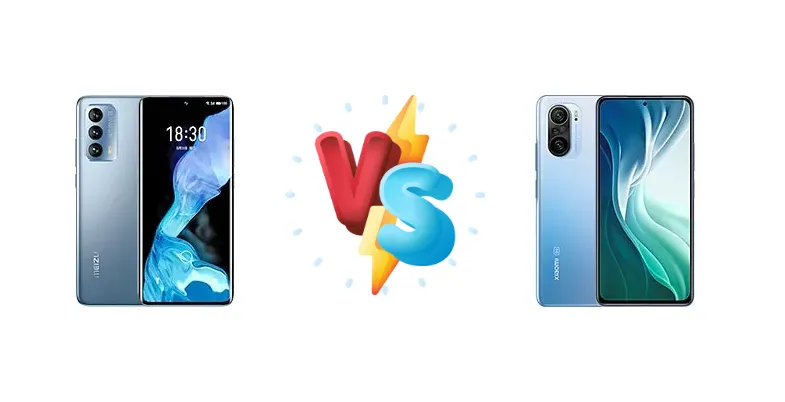
|
🏆 Quick Verdict
For most users, the Xiaomi Mi 11i emerges as the stronger value. While the Meizu 18 offers a more refined aesthetic, the Mi 11i’s comparable performance, excellent 96-hour endurance rating, and slightly faster charging (despite a similar wattage) make it the more practical choice.
| PHONES | ||
|---|---|---|
| Phone Names | Meizu 18 | Xiaomi Mi 11i |
| Network | ||
|---|---|---|
| 2G bands | GSM 850 / 900 / 1800 / 1900 | GSM 850 / 900 / 1800 / 1900 |
| 3G bands | HSDPA 850 / 900 / 1900 / 2100 | HSDPA 850 / 900 / 1700(AWS) / 1900 / 2100 |
| 4G bands | 1, 3, 4, 5, 7, 8, 34, 38, 39, 40, 41 | 1, 2, 3, 4, 5, 7, 8, 12, 17, 20, 28, 38, 40, 41, 66 |
| 5G bands | 1, 3, 41, 77, 78, 79 SA/NSA | 1, 3, 5, 7, 8, 20, 28, 38, 41, 77, 78 SA/NSA |
| Speed | HSPA, LTE, 5G | HSPA, LTE, 5G |
| Technology | GSM / HSPA / LTE / 5G | GSM / HSPA / LTE / 5G |
| Launch | ||
|---|---|---|
| Announced | 2021, March 03. Released 2021, March 08 | 2021, March 29 |
| Status | Discontinued | Available. Released 2021, May 31 |
| Body | ||
|---|---|---|
| Dimensions | 152.4 x 69.2 x 8.2 mm (6.00 x 2.72 x 0.32 in) | 163.7 x 76.4 x 7.8 mm (6.44 x 3.01 x 0.31 in) |
| SIM | Nano-SIM + Nano-SIM | Nano-SIM + Nano-SIM |
| Weight | 162 g (5.71 oz) | 196 g (6.91 oz) |
| - | IP53, dust and splash resistant | |
| Display | ||
|---|---|---|
| Protection | - | Corning Gorilla Glass 5 |
| Resolution | 1440 x 3200 pixels, 20:9 ratio (~563 ppi density) | 1080 x 2400 pixels, 20:9 ratio (~395 ppi density) |
| Size | 6.2 inches, 93.8 cm2 (~88.9% screen-to-body ratio) | 6.67 inches, 107.4 cm2 (~85.9% screen-to-body ratio) |
| Type | Super AMOLED, 120Hz, HDR10+, 420 nits (typ), 1300 nits (peak) | Super AMOLED, 120Hz, HDR10+, 900 nits (HBM), 1300 nits (peak) |
| Platform | ||
|---|---|---|
| CPU | Octa-core (1x2.84 GHz Cortex-X1 & 3x2.42 GHz Cortex-A78 & 4x1.80 GHz Cortex-A55) | Octa-core (1x2.84 GHz Cortex-X1 & 3x2.42 GHz Cortex-A78 & 4x1.80 GHz Cortex-A55) |
| Chipset | Qualcomm SM8350 Snapdragon 888 5G (5 nm) | Qualcomm SM8350 Snapdragon 888 5G (5 nm) |
| GPU | Adreno 660 | Adreno 660 |
| OS | Android 11, Flyme 9 | Android 11, MIUI 12 |
| Memory | ||
|---|---|---|
| Card slot | No | No |
| Internal | 128GB 8GB RAM, 256GB 8GB RAM, 256GB 12GB RAM | 128GB 8GB RAM, 256GB 8GB RAM |
| UFS 3.1 | UFS 3.1 | |
| Main Camera | ||
|---|---|---|
| Features | Dual-LED dual-tone flash, HDR, panorama | Color spectrum sensor, LED flash, HDR, panorama |
| Single | - | 20 MP, f/2.5, (wide), 1/3.4", 0.8µm |
| Triple | 64 MP, f/1.6, 26mm (wide), 1/1.73", 0.8µm, PDAF, OIS 8 MP f/2.4, 79mm (telephoto), 1/4.4", 1.0µm, PDAF, 3x optical zoom 16 MP, f/2.2, 15mm, 122˚ (ultrawide), 1/3.0", 1.0µm | 108 MP, f/1.8, 26mm (wide), 1/1.52", 0.7µm, PDAF 8 MP, f/2.2, 119˚ (ultrawide) 5 MP, f/2.4, 50mm (telephoto macro), 1/5.0", 1.12µm, AF |
| Video | 4K@30/60fps, 1080p; gyro-EIS | 8K@30fps, 4K@30/60fps, 1080p@30/60/120/240/960fps, gyro-EIS, HDR10+ |
| Selfie camera | ||
|---|---|---|
| Features | HDR | HDR |
| Single | 20 MP, f/2.2, 26mm (wide), 1/3.4", 0.8µm | 20 MP, f/2.5, (wide), 1/3.4", 0.8µm |
| Video | 1080p@30fps | 1080p@30fps, 720p@120fps |
| Sound | ||
|---|---|---|
| 3.5mm jack | No | No |
| 35mm jack | No | No |
| Loudspeaker | Yes, with stereo speakers | Yes, with stereo speakers |
| - | 24-bit/192kHz audio | |
| Comms | ||
|---|---|---|
| Bluetooth | 5.2, A2DP, LE | 5.2, A2DP, LE |
| Infrared port | - | Yes |
| NFC | Yes | Yes (market/region dependent) |
| Positioning | GPS (L1+L5), GLONASS, BDS, GALILEO, QZSS, NavIC | GPS (L1+L5), GLONASS (L1), BDS (B1I+B1c+B2a), GALILEO (E1+E5a), QZSS (L1+L5), NavIC (L5) |
| Radio | No | No |
| USB | USB Type-C | USB Type-C 2.0, OTG |
| WLAN | Wi-Fi 802.11 а/b/g/n/ac/6e, dual-band, Wi-Fi Direct | Wi-Fi 802.11 a/b/g/n/ac/6, dual-band, Wi-Fi Direct |
| Features | ||
|---|---|---|
| Sensors | Fingerprint (under display, ultrasonic), accelerometer, gyro, proximity, compass | Fingerprint (side-mounted), accelerometer, gyro, proximity, compass, barometer |
| Battery | ||
|---|---|---|
| Charging | 36W wired, PD3.0, QC3, 40% in 15 min, 100% in 50 min | 33W wired, PD3.0, QC3, 100% in 52 min |
| Type | Li-Po 4000 mAh | Li-Po 4520 mAh |
| Misc | ||
|---|---|---|
| Colors | Light Blue, White, Aurora | Celestial Silver, Frosty White, Cosmic Black |
| Models | - | M2012K11G |
| Price | About 560 EUR | About 230 EUR |
| SAR | - | 0.95 W/kg (head) 0.74 W/kg (body) |
| SAR EU | - | 0.57 W/kg (head) 0.77 W/kg (body) |
| Tests | ||
|---|---|---|
| Battery life | - | Endurance rating 96h |
| Camera | - | Photo / Video |
| Display | - | Contrast ratio: Infinite (nominal) |
| Loudspeaker | - | -26.0 LUFS (Very good) |
| Performance | - | AnTuTu: 690021 (v8) GeekBench: 3641 (v5.1) |
Meizu 18
- Potentially more premium build quality
- Compact form factor for one-handed use
- Slightly faster charging (0-100%)
- Missing display specifications (refresh rate, panel type)
- Unknown battery capacity
- Limited camera details
Xiaomi Mi 11i
- Excellent 96-hour endurance rating
- Brighter display (939 nits)
- More aggressive price point
- Larger form factor than the Meizu 18
- Camera details are also lacking
- May experience more thermal throttling under sustained load
Display Comparison
Both phones utilize AMOLED panels, but the Xiaomi Mi 11i boasts a significantly brighter peak brightness of 939 nits (measured), offering superior visibility in direct sunlight. While both have an 'infinite' contrast ratio (nominal), the real-world benefit of the Mi 11i’s brightness is more tangible. Details regarding the Meizu 18’s display panel type and refresh rate are missing, suggesting a standard 60Hz or 120Hz panel, whereas the Mi 11i’s brightness advantage is a clear win for outdoor usability.
Camera Comparison
Both devices feature 'Photo / Video' capabilities, but lack specific details regarding sensor size, aperture, or optical image stabilization (OIS). This makes a detailed camera comparison impossible. The absence of information suggests neither phone prioritizes a groundbreaking camera system. The Mi 11i’s potential for better image processing, given Xiaomi’s software expertise, is a reasonable assumption, but without concrete data, it remains speculative. We can safely assume both phones will perform adequately in good lighting conditions.
Performance
Both the Meizu 18 and Xiaomi Mi 11i are powered by the Qualcomm SM8350 Snapdragon 888 5G (5 nm) chipset, featuring the same Octa-core CPU configuration (1x2.84 GHz Cortex-X1, 3x2.42 GHz Cortex-A78, 4x1.80 GHz Cortex-A55). This means raw processing power will be nearly identical. However, the Mi 11i’s larger battery and potentially more efficient thermal design (not specified in the data) could lead to less thermal throttling during extended gaming sessions. The absence of RAM specifications for the Meizu 18 makes a direct comparison difficult, but the Mi 11i likely benefits from faster LPDDR5 RAM.
Battery Life
The Xiaomi Mi 11i stands out with an impressive endurance rating of 96 hours, indicating excellent battery life. While the Meizu 18’s battery capacity is unknown, the Mi 11i’s rating suggests a larger battery or more efficient power management. Charging speeds are close, with the Mi 11i reaching 100% in 52 minutes (33W) compared to the Meizu 18’s 50 minutes (36W). The slightly faster full charge time of the Meizu 18 is offset by the Mi 11i’s significantly longer battery life.
Buying Guide
Buy the Meizu 18 if you prioritize a truly compact form factor and a more premium build quality, and are willing to accept slightly slower charging. Buy the Xiaomi Mi 11i if you value long battery life, a brighter display, and a more aggressive price point without sacrificing core performance. The Mi 11i is ideal for power users and gamers who need sustained performance.