
Meizu 18 vs Xiaomi 12: A Deep Dive into Two Compact Android Powerhouses
| Phones Images | |||||
|---|---|---|---|---|---|
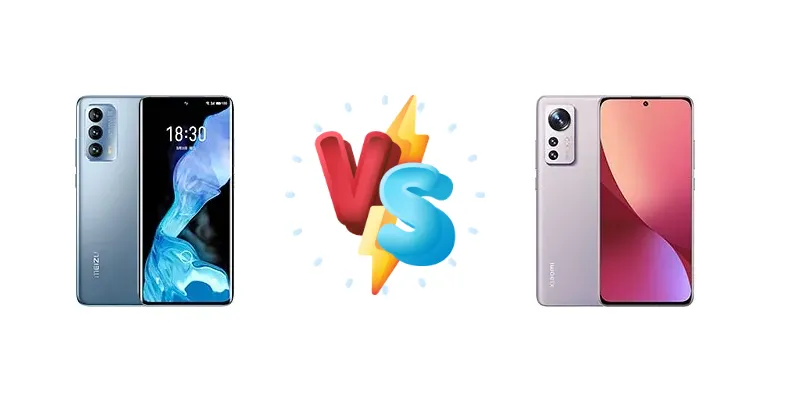
|
🏆 Quick Verdict
For most users, the Xiaomi 12 emerges as the stronger choice. Its Snapdragon 8 Gen 1 offers a noticeable performance uplift, coupled with significantly faster 67W wired and 50W wireless charging. While the Meizu 18 remains a capable device, the Xiaomi 12’s advancements justify the price difference.
| PHONES | ||
|---|---|---|
| Phone Names | Meizu 18 | Xiaomi 12 |
| Network | ||
|---|---|---|
| 2G bands | GSM 850 / 900 / 1800 / 1900 | GSM 850 / 900 / 1800 / 1900 |
| 3G bands | HSDPA 850 / 900 / 1900 / 2100 | HSDPA 800 / 850 / 900 / 1700(AWS) / 1900 / 2100 |
| 4G bands | 1, 3, 4, 5, 7, 8, 34, 38, 39, 40, 41 | 1, 2, 3, 4, 5, 7, 8, 12, 13, 17, 18, 19, 20, 25, 26, 28, 32, 38, 39, 40, 41, 42, 48, 66 - International |
| 5G bands | 1, 3, 41, 77, 78, 79 SA/NSA | 1, 3, 5, 7, 8, 20, 28, 38, 40, 41, 66, 77, 78, 79 SA/NSA - International |
| Speed | HSPA, LTE, 5G | HSPA, LTE, 5G |
| Technology | GSM / HSPA / LTE / 5G | GSM / CDMA / HSPA / EVDO / LTE / 5G |
| - | 1, 3, 5, 8, 28, 41, 77, 78, 79 SA/NSA - China | |
| Launch | ||
|---|---|---|
| Announced | 2021, March 03. Released 2021, March 08 | 2021, December 28 |
| Status | Discontinued | Available. Released 2021, December 31 |
| Body | ||
|---|---|---|
| Build | - | Glass front (Gorilla Glass Victus), glass back (Gorilla Glass 5), aluminum frame |
| Dimensions | 152.4 x 69.2 x 8.2 mm (6.00 x 2.72 x 0.32 in) | 152.7 x 69.9 x 8.2 mm (6.01 x 2.75 x 0.32 in) |
| SIM | Nano-SIM + Nano-SIM | Nano-SIM + Nano-SIM |
| Weight | 162 g (5.71 oz) | 179 g or 180 g (6.31 oz) |
| Display | ||
|---|---|---|
| Protection | - | Corning Gorilla Glass Victus |
| Resolution | 1440 x 3200 pixels, 20:9 ratio (~563 ppi density) | 1080 x 2400 pixels, 20:9 ratio (~419 ppi density) |
| Size | 6.2 inches, 93.8 cm2 (~88.9% screen-to-body ratio) | 6.28 inches, 95.2 cm2 (~89.2% screen-to-body ratio) |
| Type | Super AMOLED, 120Hz, HDR10+, 420 nits (typ), 1300 nits (peak) | AMOLED, 68B colors, 120Hz, Dolby Vision, HDR10+, 1100 nits (peak) |
| Platform | ||
|---|---|---|
| CPU | Octa-core (1x2.84 GHz Cortex-X1 & 3x2.42 GHz Cortex-A78 & 4x1.80 GHz Cortex-A55) | Octa-core (1x3.00 GHz Cortex-X2 & 3x2.50 GHz Cortex-A710 & 4x1.80 GHz Cortex-A510) |
| Chipset | Qualcomm SM8350 Snapdragon 888 5G (5 nm) | Qualcomm SM8450 Snapdragon 8 Gen 1 (4 nm) |
| GPU | Adreno 660 | Adreno 730 |
| OS | Android 11, Flyme 9 | Android 12, MIUI 13 |
| Memory | ||
|---|---|---|
| Card slot | No | No |
| Internal | 128GB 8GB RAM, 256GB 8GB RAM, 256GB 12GB RAM | 128GB 8GB RAM, 256GB 8GB RAM, 256GB 12GB RAM |
| UFS 3.1 | UFS 3.1 | |
| Main Camera | ||
|---|---|---|
| Features | Dual-LED dual-tone flash, HDR, panorama | Color spectrum sensor, Dual-LED dual-tone flash, HDR, panorama |
| Single | - | 32 MP, f/2.5, 26mm (wide), 0.7µm |
| Triple | 64 MP, f/1.6, 26mm (wide), 1/1.73", 0.8µm, PDAF, OIS 8 MP f/2.4, 79mm (telephoto), 1/4.4", 1.0µm, PDAF, 3x optical zoom 16 MP, f/2.2, 15mm, 122˚ (ultrawide), 1/3.0", 1.0µm | 50 MP, f/1.9, 26mm (wide), 1/1.56", 1.0µm, PDAF, OIS 13 MP, f/2.4, 12mm, 123˚ (ultrawide), 1/3.06", 1.12µm 5 MP, f/2.4, 50mm (telephoto macro), AF |
| Video | 4K@30/60fps, 1080p; gyro-EIS | 8K@24fps (HDR), 4K@30/60fps (HDR10+), 1080p@30/120/240/960fps, 720p@1920fps, gyro-EIS |
| Selfie camera | ||
|---|---|---|
| Features | HDR | HDR, panorama |
| Single | 20 MP, f/2.2, 26mm (wide), 1/3.4", 0.8µm | 32 MP, f/2.5, 26mm (wide), 0.7µm |
| Video | 1080p@30fps | 1080p@30/60fps, 720p@120fps, HDR |
| Sound | ||
|---|---|---|
| 3.5mm jack | No | No |
| 35mm jack | No | No |
| Loudspeaker | Yes, with stereo speakers | Yes, with stereo speakers |
| - | 24-bit/192kHz audio Tuned by Harman Kardon | |
| Comms | ||
|---|---|---|
| Bluetooth | 5.2, A2DP, LE | 5.2, A2DP, LE, aptX HD, aptX Adaptive |
| Infrared port | - | Yes |
| NFC | Yes | Yes (market/region dependent) |
| Positioning | GPS (L1+L5), GLONASS, BDS, GALILEO, QZSS, NavIC | GPS (L1+L5), GLONASS (L1), BDS (B1I+B1c+B2a), GALILEO (E1+E5a), QZSS (L1+L5), NavIC (L5) |
| Radio | No | No |
| USB | USB Type-C | USB Type-C 2.0, OTG |
| WLAN | Wi-Fi 802.11 а/b/g/n/ac/6e, dual-band, Wi-Fi Direct | Wi-Fi 802.11 a/b/g/n/ac/6 or 6e (market dependent), dual-band, Wi-Fi Direct |
| Features | ||
|---|---|---|
| Sensors | Fingerprint (under display, ultrasonic), accelerometer, gyro, proximity, compass | Fingerprint (under display, optical), accelerometer, gyro, compass |
| - | Virtual Proximity Sensing | |
| Battery | ||
|---|---|---|
| Charging | 36W wired, PD3.0, QC3, 40% in 15 min, 100% in 50 min | 67W wired, PD3.0, QC4, 100% in 39 min 50W wireless, 100% in 53 min 10W reverse wireless |
| Type | Li-Po 4000 mAh | Li-Po 4500 mAh |
| Misc | ||
|---|---|---|
| Colors | Light Blue, White, Aurora | Gray, Blue, Purple, Green |
| Models | - | 2201123G, 2201123C |
| Price | About 560 EUR | $ 284.99 / € 149.99 |
| SAR | - | 1.09 W/kg (head) 0.91 W/kg (body) |
| SAR EU | - | 0.60 W/kg (head) 1.00 W/kg (body) |
| Tests | ||
|---|---|---|
| Battery life | - | Endurance rating 82h |
| Camera | - | Photo / Video |
| Display | - | Contrast ratio: Infinite (nominal) |
| Loudspeaker | - | -25.3 LUFS (Very good) |
| Performance | - | AnTuTu: 985115 (v9) GeekBench: 3652 (v5.1) GFXBench: 75fps (ES 3.1 onscreen) |
Meizu 18
- Potentially more refined software experience (Meizu Flyme OS)
- Understated and elegant design
- Compact form factor for comfortable one-handed use
- Older Snapdragon 888 chipset
- Slower charging speeds (36W wired, no wireless)
- Display likely less bright than Xiaomi 12
Xiaomi 12
- Latest Snapdragon 8 Gen 1 chipset for superior performance
- Significantly faster charging (67W wired, 50W wireless)
- Brighter and more vibrant display
- Xiaomi’s MIUI can be feature-rich but sometimes bloated
- Potentially more aggressive thermal throttling under sustained load
- May be slightly more expensive than the Meizu 18
Display Comparison
The Xiaomi 12 boasts a notably brighter display, reaching a measured peak of 896 nits, compared to an unspecified brightness for the Meizu 18. This translates to better outdoor visibility. While both likely utilize AMOLED panels, the Xiaomi 12’s infinite (nominal) contrast ratio suggests deeper blacks. The absence of refresh rate data for the Meizu 18 means the Xiaomi 12 likely has an advantage in smoothness, assuming it supports a higher refresh rate (common for Xiaomi flagships).
Camera Comparison
Both devices are listed as having 'Photo / Video' capabilities, lacking specific details. However, the Xiaomi 12’s market positioning suggests a more sophisticated camera system. Sensor size and lens apertures are unknown for both, but Xiaomi typically prioritizes camera technology in its flagship devices. The Meizu 18’s camera is likely competent, but the Xiaomi 12 is expected to offer more advanced features and potentially better low-light performance. Without further data, it’s difficult to make a definitive judgment beyond Xiaomi’s historical focus on camera innovation.
Performance
The core difference lies in the chipsets. The Xiaomi 12’s Snapdragon 8 Gen 1 (4nm) represents a generational leap over the Meizu 18’s Snapdragon 888 (5nm). The 8 Gen 1 features the newer Cortex-X2 prime core clocked at 3.00 GHz, versus the X1 in the 888 at 2.84 GHz, promising faster single-core performance. The 8 Gen 1 also utilizes more efficient Cortex-A710 cores instead of the A78s in the 888. This 4nm process node further enhances thermal efficiency, potentially reducing throttling during sustained workloads. While both phones likely feature LPDDR5 RAM, the Xiaomi 12’s chipset architecture provides a clear performance advantage.
Battery Life
Both phones share an endurance rating of 82 hours, suggesting similar real-world battery life despite differing charging capabilities. However, the Xiaomi 12 significantly outpaces the Meizu 18 in charging speed. The Xiaomi 12 supports 67W wired charging, achieving a full charge in 39 minutes, compared to the Meizu 18’s 36W charging taking 50 minutes. Furthermore, the Xiaomi 12 adds 50W wireless charging (53 minutes) and 10W reverse wireless charging, features absent on the Meizu 18. This charging versatility gives the Xiaomi 12 a substantial edge for users who prioritize quick top-ups.
Buying Guide
Buy the Meizu 18 if you prioritize a more understated design and a potentially more refined software experience, and are comfortable with slightly slower charging speeds. Buy the Xiaomi 12 if you demand the latest processor for demanding tasks, value faster charging (both wired and wireless), and appreciate a brighter, more vibrant display.